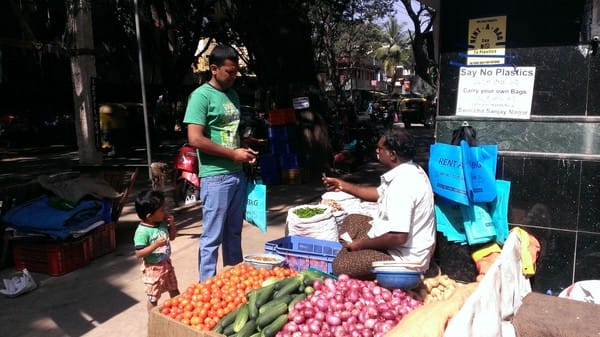
A vegetable vendor rents a bag to a customer. Pic: Vignan Gowda
Vignan Gowda, Business Excellence and Operations Manager with an IT firm and a resident of Sanjay Nagar, spearheaded several clean up drives in his area. In all the clean up drives, he observed a pattern: polythene covers comprised a significant portion of the garbage. It was this that led him to do something about it.
Gowda mobilised several other active members in the locality to figure out what they could do to reduce the usage of plastic. The group then decided to tackle the problem at the source. Gowda says, “While shopping, one of the key reasons that people ask for polythene covers to carry their purchases is because they use it to dispose of garbage.” Doing away with plastic bags at shops seemed like a viable solution.
The group pooled in Rs 17,000 and purchased 1,500 recyclable cloth bags. They then went from shop to shop and pitched the idea to the owners. Here is how the programme works: Shops that sign up for the programme display a yellow board, signifying that they are a Rent a Bag (RAB) shop. The shops rent out the reusable bags to shoppers who do not come with their own bags at no cost. Shoppers have to however pay a deposit of Rs 5 for small bags and Rs 20 for large bags. On returning the bags to any RAB enabled shop, shoppers can collect the deposit once again.
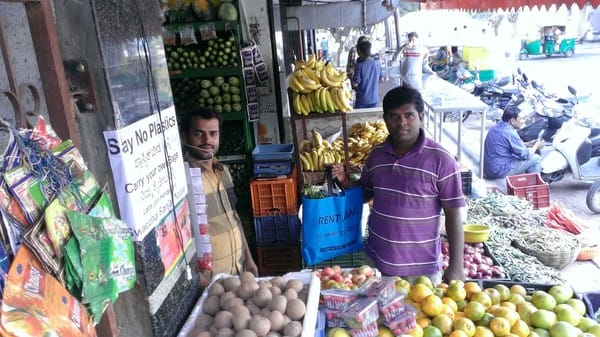
A proud customer holding a rented bag. Pic: Vignan Gowda
Focus on small vendors
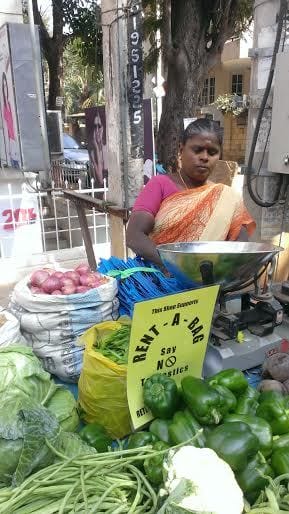
As many as 15 vendors have endorsed Rent A Bag campaign. Pic: Vignan Gowda
The ‘Rent A Bag (RAB)’ concept, launched on December 7th, has already gathered momentum—15 shops in the area have signed up. The shops include mid-sized supermarkets, as well as smaller fruit and vegetable vendors. Considering that shopkeepers spend anywhere between Rs 3,000 to Rs 15,000 a month on plastic covers, getting their buy-in to the program was an easy affair.
Vignan says, “Especially with the smaller vendors, the BBMP inspects the quality of plastic bags that they use. If the bags are less than 40 microns in thickness, they are seized. The RAB program eliminates the loss that the vendors incur when their bags are seized and also enables these vendors to reduce their cost of buying plastic covers.”
The bags are made from non-woven fabric. Vignan says he has the buy-back guarantee from the seller, who will collect the used and worn out bags and recycle them.
While there are plans to get the larger supermarket chains to adopt the RAB program as well, for now the focus is on the smaller shops. He says, “For now it’s okay, since the plastic bags that large supermarkets use are recyclable. Let the program gather momentum and we will then approach the bigger shops as well.”
Though the bags have been distributed among the shopkeepers free of cost this time around, Vignan says that there are plans to make them purchase them in the future, and that they are looking for sponsors to fund the cost of the bags. Talks are also underway with a Chennai-based vendor to produce a second batch of bags as well. And while it has been less than a week since the RAB program was launched, it is already showing results. Vignan says that one of the shopkeepers has called him to place an order for 1,000 bags.
Vignan adds, “Our goal is to reduce our contribution of plastic as waste to the environment and to encourage folks to reuse bags or carry their own bags while shopping.” He also mentions that they are looking for additional support in spreading awareness about the initiative. If you would like to pitch in, you can get in touch with Vignan by email: vignan[dot]n[at]hotmail[dot]com.
Addendum (February 13th 2015)
Sugandhi and Rana Belur of Aranyaparva featured the Rent a Bag initiative on their YouTube channel under the series titled Ordinary people, extraordinary stories.
Related Articles
Citizens’ drive at Agara Lake collects 70 bags of plastic
Bengaluru citizens take up no-plastic bag challenge
BBMP wakes up, plastic carry bag ban from today
Yes or no to plastic bags?
Plastic-blended roads now the norm
Paper or plastic? Styrofoam or glass?
From anti-plastic steps to zero waste management
This is a brilliant initiative Vigyan and friends! From the pics I am not able to tell if the bags are actually “cloth” or non-woven polyurethane fabric. Hope it is cloth because the non-woven ones crumble with time and are going to have a similar impact as plastic.
Fantastic initiative. Kudos to the group. Shows what a team of concerned citizens can achieve. Worthy of emulation in other areas.
good initiative this can be spread to other areas
‘@Arathi: Message from Vignan
“Thank you Arathi,
These are Non-Woven bags which are released in Pilot, Note: Cloth bags are on the way and we will be releasing cloth bags from next week onwards.we have been getting excellent feedback from people and we will make it big..!
Non-Woven bags were released upon on receiving a confirmation from the Plastic recycle unit in Bangalore North stating that these can be recycled.The Vendor of these Bags has also confirmed that she will buy back damaged bags for recycling.”
Great initiative! Plastic bags are a menace to society. We @ http://www.2bin1bag.in have started a petition to ban plastic bags. To fight the plastic lobby, we need to rev up a concerted effort.Counting on each of you to sign,foward,repost and share this petition!!
Link: http://www.change.org/p/hon-chief-minister-karnataka-bengaluru-plastic-bag-ban-please-make-this-a-reality
This is an excellent concept and I hope it will spread to the entire city. Just one issue – the bags look like the ones made of non-woven polypropylene (PP) – the so-called Chinese jute. Please note that though these bags may last longer, they are as bad as plastic bags. They do not biodegrade and are very technology intensive to recycle. It is better if the reusable bags were made of cotton or jute.