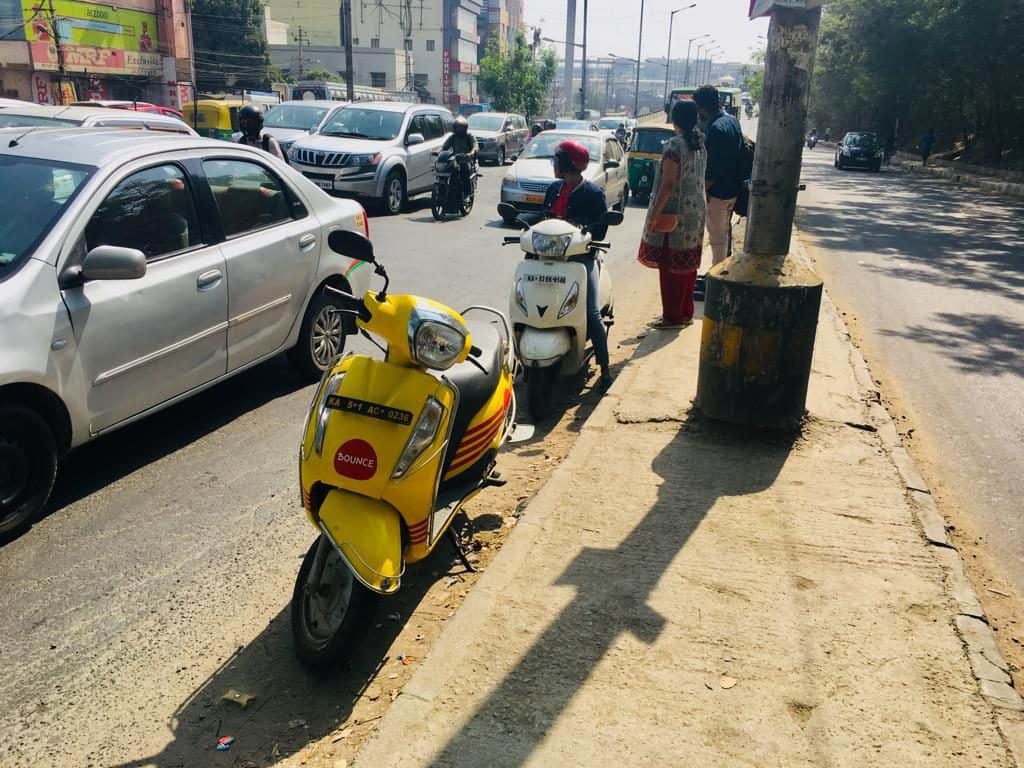
Bike rentals in Bengaluru. Pic: Meera K
Mass transit such as BMTC, Namma Metro, or even cabs and auto rickshaws no longer dictate the convenience or time of your commute. A valid driving license and digital photo is all it would take for you to drive away with your choicest brand of two-wheelers.
For over a year now, popular rent-a-bike services have been offering ‘rides’ to Bengalureans, catering to their local and hyperlocal commute. With low security deposit, online payment options, and no parking hassles, these app-based services make you think twice about owning a two-wheeler.
Bounce, Drivezy, Vogo, Twic, ONN Bikes, Royal Brothers and Wheelstreet are among the many rent-a-bike services that have permission from the Karnataka Transport Department to ply their services. Decked with black registration plates on which fonts are embossed in yellow, their bikes now ply on Bengaluru’s streets.
Given the traffic density in the city and the hassle of constant gear-shifting, most rent-a-bike providers offer gearless range of scooters for daily commuters. In addition to gearless variants like Honda Activa, TVS Jupiter and Suzuki Access 125, these companies also offer geared bikes like KTM Duke, Royal Enfield 350 and Yamaha FZ.
In a recent Times of India report, Vivekananda Hallekere, Co-founder of Bounce, was quoted as saying that the company had 6000 scooters in Bengaluru, and that their main users were metro commuters, college students and those who didn’t want to own a bike.
From charging users by the minute, to offering year-long contracts, these service providers offer last mile connectivity while assuring vehicle maintenance and insurance. They also offer users the option to swap vehicles anytime.
How do the app-based platforms work?
Here are the facilities provided and charges levied by platforms that offer short-ride services, based on information from their official websites.
| Service Provider | Security Deposit | Tariff (Minimum, for short rides) | Pickup/Drop | Fuel status |
| Bounce | Nil | Rs 5/km or Rs 0.50/min (Varies depending on bike model) | Location /Anywhere (i.e., from designated pickup point to anywhere) | Inclusive |
| Bykemania | Yes | Rs 14/hr or Rs 250/day | Location/Location (designated pickup point to pre-agreed destination) | In reserve (user then fills as required) |
| Drivezy | Nil | Rs 12/hr | Door Delivery/Location | In reserve |
| ONN Bikes | Nil | Rs 249/day | Location/Location | In reserve |
| Twic | Yes | Rs 298/day | Location/Location | In reserve |
| Roadpanda | Nil | Rs 12/hr | Location/Location | In reserve |
| Royal Brothers | Yes | Rs 15/hr | Location/Location | In reserve |
| Vogo | Nil | Rs 1.2/min | Location/Location | Inclusive |
| Wheelstreet | Nil | Rs 250/day | Location/Location | In reserve |
* Excluded monthly rental providers and single city operators due to concerns over their operational scalability, low investment and technology, and since they are general rental service agencies.
Most of these apps have similar features, but each highlight a facility or two as its USP.
* Drivezy and Royal Brothers arrange door delivery of vehicles, unlike other service providers whose clients have to pick up the bike at a specified location.
* Bounce allows users to park the bike anywhere after ride completion; the bike will then be collected by Bounce’s fleet executives.
* Service providers like ONN Bikes and Roadpanda do not collect security deposit.
* Wheelstreet and Bykemania claim to offer superbikes for users.
* Vogo claims to include fuel cost in the total charges.
All rent-a-bike services offer minimum of a single helmet, and legal requirements like vehicle registration and insurance, Life Time Tax, Pollution Under Control (PUC) certificate and renting permits. Some of these services also follow a keyless or dockless system, wherein an OTP from the app allows the user to lock/unlock the vehicle, or gives him access to the bike key.
Riders may find that some companies surge their prices around weekends. A few firms offer roadside assistance in case of vehicle breakdown due to maintenance issues. But most companies suggest that the rider bear the responsibility and cost of fixing a flat tyre or riding-related damages like scratches or dents, since these depend on the rider’s driving skills.
These GPS-tagged bikes also come with speed governors. Companies such as Bounce fine the rider Rs 200 each time he crosses the specified speed limit.
Can rental bikes reduce traffic?
Speaking to Inc42 media, Founder of ONN Bikes, Namit Jain, said that due to the increase in cost and lack of availability of cab rides, people have started renting bikes as an alternate mode of transport. “The cost of our self-driving bikes are 70 percent lower than that of cab rides,” Jain said.
Nikhil Kumar, a 29-year-old executive at a media outlet, says that app-based bike renting services are much cheaper than his former BMTC Vayu Vajra pass, currently pegged at Rs 3350 per month.
“I have hired a gearless scooter; it’s convenient for me to zip through the traffic from Madivala to St Marks road, or to meet people. Since the nature of my work is ‘on-call’ basis, I cannot wait for buses. Moreover, buses used to be expensive since I had to rely on either auto or cab to reach my exact destination from the drop point,” he says.
Further, with the rise in demand for food delivery apps, rent-a-bike service providers are trying to tap the potential in this sector.
Srikant K, a delivery boy with a leading food delivery brand, says that, based on his experience, renting a bike is much cheaper than owning one. “It saved me from taking bank loans for a vehicle. They (service providers) take care of regular maintenance and I can change the vehicle as and when I want. All I have to do is follow Google Voice navigation on my phone to execute delivery orders,” the Anekal native says.
Fueled by investors, and powered by the Internet of Things (IoT), these two-wheeler ‘self-drives’ are trying to become the disruptive players to ease commute in Bengaluru. But do they really resolve the last mile connectivity issue or just add to the vehicle density, traffic woes and pollution?
According to the Karnataka Transport Department, as of this January, over 55 lakh two-wheelers were registered in the city. Urban experts believe that the option to rent a vehicle will eventually reduce the need to own one, and hence contribute to fewer vehicle registrations.
However, the entrepreneurs who have launched these business models are still at the experimental stage. Urban expert Ashwin Mahesh says, “I don’t think there is a good business model yet. All are watching these models closely, so that if there is a success it can be replicated. Nevertheless, there is a need to concentrate on increasing mass public transport, especially buses, and every city lacks the numbers.”
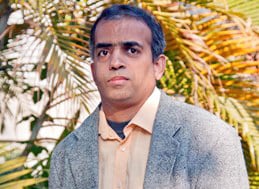
Government should ensure low-cost last mile connectivity, says urban expert Ashwin Mahesh. File Pic
He adds that a Public Bike Sharing (PBS) system will ensure environment-friendly mobility. “However, public transport systems and PBS should not be profit-motivated, and should aim at giving low-cost connectivity to all. Maybe the government can step in to ensure no one is deprived of low-cost last mile connectivity,” Mahesh says.
It’s not just residents of Bengaluru that the rent-a-bike services want to cater to; their list of potential clients include students, job-seekers, couriers, marketing executives and tourists who arrive by the minute into the city.
While the future prospects of two-wheeler rentals remain a question, on the business front many stakeholders are taking note of the emerging segment. For instance, in December, Ola invested $100 million in Vogo, whereas Honda has added 3000 scooters to Drivezy’s fleet in a strategic partnership.
With greater internet penetration, app-based rent-a-ride services are swiftly gaining traction among the middle income groups and those looking for on-demand mobility.
There should be strict rules like
1) Insurance coverage for both customer & Rider
2) Luggage/baggage should be limited to one bag/30 kgs and provision such as hook or any better modification to carry baggage.
3) Rider should have separate ID card with serial number and mobile details embossed in ID Card, Aadhaar card and all details of rider must be painted in 2 wheeler.
4) Should be limited to one customer only.
5) Proper protection be given to lady customers.
Why not trying this awesome concept in Delhi NCR?
There are not for the other commuters, 2 main problems, 1. they are parked in the middle of the roads, adding to the traffic. 2. generally those bikes are rode rashly.
Just travel from mahadevpura to HSR stretch on ORR, we can see 10s of rented bikes parked on ORR.