Whitefield Rising hosted an enlightening session on Sunday, September 26, with eminent environmentalist A.N. Yellappa Reddy, who connected the dots among environmental consciousness, waste management, sewage treatment, lake purification, biodiversity promotion, and reconnection with nature. Held at the serene campus of Ecumenical Christian Centre, the session titled ‘Increasing Urban Greenery to Promote Healthy Living’ was attended by more than 60 citizens of all ages from different parts of the city.
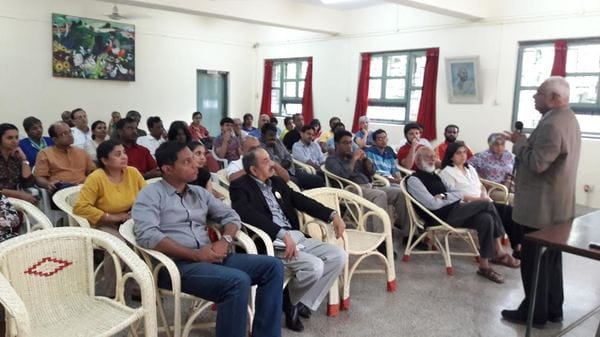
Yellappa Reddy addressing the residents of Whitefield
Mr Reddy explained the various ways in which citizens could make a difference—through the choices they made and by questioning the administration. He told the audience that Whitefield could serve as an exemplary centre for environmental awareness and citizens’ involvement in improving the ecosystem. He also offered to provide guidance for green initiatives.
Mr Reddy described the fine balance in nature with the fitting example of how caves attract bats, whose droppings promote fungus growth, which feeds the beetles. The beetles in turn enable pollination of the aquatic plants, which are an integral part of the purification cycle of lakes.
(This was written by Sharlene Das and RajaRajeshwari Nagasigamani, volunteers of Whitefield Rising.)
More about the Speaker
Mr A.N. Yellappa Reddy is a graduate in agricultural science and a post-graduate in soil science. He was a member of the Indian Forest Service, and served as Administrator of Forests for 20 years. He was in the Research Wing of the Forest Services for 10 years, and also held the post of Chief Conservator of Forests. He retired as the Secretary, Department of Ecology and Environment, Government of Karnataka.
Mr Reddy has written a book titled ‘Sacred Plants’ about the plants used in various rituals, wherein he explains the logic and the science behind their usage. He is a governing council member, Foundation for Ecological Security of India. He is also member of Karnataka High Court Lok Adalat, as well as the Chief Advisor, Bangalore University Biodiversity Park. He is an active member of Bangalore Environment Trust.
Notes from the Talk by AN Yellappa Reddy
Team Whitefield Rising
- We are not being stewards of the existing planet, but rather we want to go to Moon and elsewhere. Is this real progress or education?
- A tree is always a giver all the time, all its lifetime.
- When many kids were asked what they would want to become in their next lives, they chose to be born as trees.
- Go to Wilson Garden and see how each tree has at least 3,000 wounds and leaves coated with carbon and dust that we generate. Yet these trees are somehow surviving and continue to “give.” When you explain this irony to children they get it.
- We cut down what nature takes hundreds of years to make, and then pour more and more money into ACs at home and in cars, as pollution and heat take their toll on us.
- Villagers had wisdom to take care of the basic elements required for life, which includes animals, birds and bees.
- One bee visits 50,000 flowers a day and collects one gram of nectar. Yet millions of them die in our garbage heaps that they get attracted to.
- Let us make an action plan; e.g., Hasiru Dala wants to get forest land to put leaves from our area down to compost. Yet they can’t get the approval. But citizens can.
- Local people have to own their assets. Jakkur Lake is a good example. Here is a well-rejuvenated asset, and yet local residents are not owning it, and it is now going backwards. WR can be the group that demonstrates that local ownership is possible.
- Whitefield Rising needs to be the group that talks the language of environment, not that of those who are focused on the progress of tech business and buildings.
- Put pressure on the government, so that his recommendation as part of the Lake Vision committee for Varthur and Bellandur could be accepted and acted upon.
- Lakes improve moisture, which is a key lungs’ lubricant.
- Lakes improve ground water; why rely on fossil or water that is over 1,500-year-old?
For more information about Whitefield Rising, please contact: hello@whitefieldrising.org