A sea of vehicles struggles to move forward from Pallavaram signal to the Airport flyover on a Friday morning. Vehicles move inch by inch, literally, taking more than twenty minutes to cover a kilometre. In a rush to reach their destinations on time, two-wheeler riders take the easy route — they simply take over the pedestrian space, while four-wheelers often jump red signals. In all this chaos, there’s little room for even ambulances to find a clear corridor. In short, Grand Southern Trunk (GST Road), the spacious two-lane highway that connects the suburbs such as Tambaram and Pallavaram to the city, has become a commuter’s nightmare.
Barring a few hours in the afternoon and late in the night, the road is congested at all times and all days. Especially at a few localities such as Chrompet junction, Perungalathur and Pallavaram signal, life comes to a halt. But why have things come to such a pass?
One can easily identify five reasons why traffic congestion on GST Road is becoming a nightmare for road users:
#1: Omnibuses that travel to the southern districts, such as Madurai and Trichy, take the GST Road. They don’t just stop at the designated points according to Traffic Police instructions but wherever they spot passengers. Omnibuses contribute to the early morning and late evening traffic at GST when the buses leave and enter the city. “The number of Omnibuses that ply on the GST Road decreased steadily after we imposed a hefty fine of Rs 2500 for every vehicle that violates instructions. Few buses still take the GST road, rather than going directly on the bypass,” said P Manimaran, Sub Inspector, Chrompet Traffic Police Station.
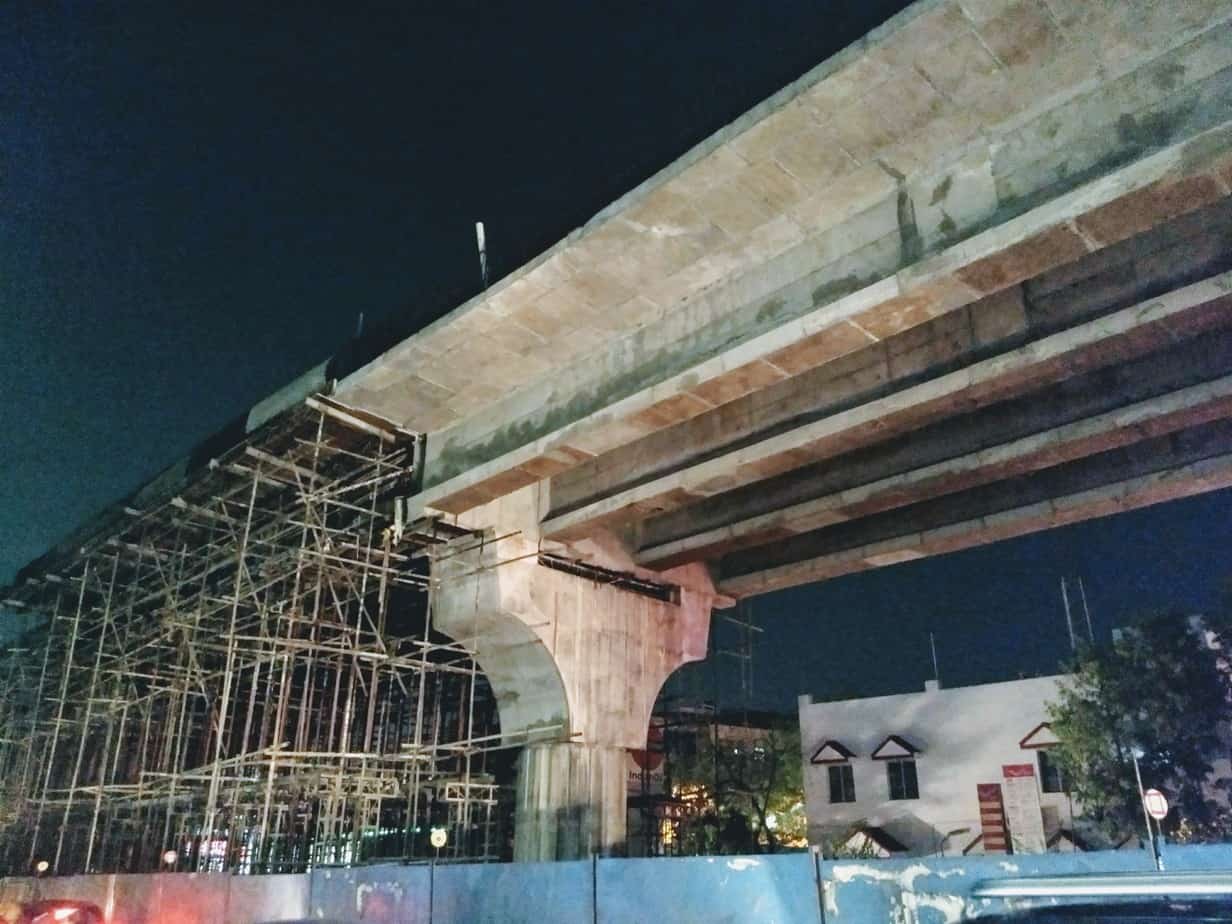
A view of the incomplete flyover at Pallavaram, from a year ago. The flyover is still under construction. Pic: Laasya Shekhar
#2: It is to ease the traffic at GST that the Tamil Nadu government took up the construction of Pallavaram Flyover. The ongoing work, however, blocks the traffic on both sides of GST. The work that was due to be completed in June 2018, has skipped the deadline yet again; the highways department, which sought time till the end of 2018, has been unable to complete the project this year too. “Work is on at a fast pace and we expect the project to be completed in less than two months. Non-availability of sand and shortage of funds are among many reasons for the delay of the project,” said a Divisional Engineer, Highways Department.
#3: Traffic signals at Tambaram Sanatorium and Pallavaram are always orange, and with no police manning these junctions, road users take forever to cross the gridlocks. “It is shocking to see that the vehicles use no indicators and horns before overtaking. Is this how an express highway is supposed to be? It is due to such indiscipline that the GST records around 30 deaths a year,” said Social Activist, V Santhanam who sourced the information through RTI two years ago.
#4: In recent years, the road has been commercialised beyond imagination. However, here is what happens as a result: citizens visiting the restaurants, textile and jewellery showrooms on the GST road park their vehicles hazardously on the road, thus eating into the road space. “I have never seen traffic police confiscating the illegally parked vehicles on GST. How else will the situation change?” questioned Gnana Kumar, an office goer.
#5: GST Road is well connected by public transport, such as suburban trains and MTC buses. There are share autos at every corner of the road. However, there is still a heavy chunk of the population relying on bikes and cars. Reason: Buses and trains are crowded during peak hours. “The 21G bus that connects Vandalur to Mandaveli (a 27-km route) gets crowded at Vandalur itself. I switched to private transport after using the bus for a week and experiencing an uncomfortable ride,” said Senthil K, who works at Kotturpuram.
Finding solutions
A recent announcement by Chennai Metro Rail Limited that it will be extending the services from Airport to Kilambakkam connecting Tambaram and Vandalur, is comforting. But since the project has not yet commenced, it is necessary to think of immediate solutions.
A critical analysis of the causes of traffic congestion will help to arrive at a solution. For example, the speedy completion of flyover work would be one step and close monitoring by the traffic police, another. However, citizens also have an important role to play in traffic management. “I share the space in my car with three other women who live in the vicinity. It is a win-win situation, to reduce traffic and pollution,” said Devika C, who resides in East Tambaram.
A lot of citizens have changed their shift timings, to commute during non-peak hours. “I start at 7 am in the morning and come back home by 3 pm. This way, I avoid rush-hour traffic,” said Solomon George, who works at a publishing house in Porur.
Meanwhile, amid the flurry of vehicles honking and emitting jet black smoke, a daily road user on the GST has given up hopes of a quick solution and derives solace from the melodies of Ilayaraja and A R Rahman playing in his ears!
real mess that is gst road today -agree with the article
1 allongoing flyover construction between airport to chinglepet be expedited
2 at sp koil flyover over railwayline connecting gst to oragadam sriperumbdur bypass be done as it is hanging in the air
3 stop further commercial buildings on gst for some time in this stretch
r omni buses are posing to be a real nuisance in the morning and late evening they should all compulsorily take the maduravoil bypass and not choke up the city