In a country like ours, where mass gatherings of various kinds are an integral part of life, we keep hearing of stampedes invariably leading to casualties, every now and then. Last year saw two such events, which made national headlines and shook the nation, one a sports victory parade gone sour in Bengaluru and the other, a stampede at a political road show in Karur, Tamil Nadu. The year before, Chennai witnessed huge crowds at an IAF show on the Marina Beach, which led to five deaths and more than a hundred hospitalisations due to heat-related issues and chaos arising from crowd management.
The aftermath of the incidents brought about the inevitable inquests and ongoing probes, also highlighting a sore point, that no lessons seemed to have been learnt from past tragedies.
Following the Karur stampede, the Madras High Court ordered the State Government to develop a Standard Operating Procedure (SOP) for regulating and managing public gatherings in Tamil Nadu. After consultations with various stakeholders, including political parties, this was formulated and issued by the government on Jan 5, 2026.
Responsibility for ensuring safety with organisers
The SOP, which applies to all meetings, road shows, protests and all other forms of public gatherings, where the anticipated number of participants exceeds 5,000, seeks to provide a comprehensive framework for planning, regulating, monitoring and conducting public gatherings in the state, with exclusions to religious gatherings organised in places of worship as customary events or where precedents already fix the venue/route. The applicability shall also be limited during the period the Model Code of Conduct is in force, as the norms/guidelines issued by the Election Commission of India would prevail.
Read more: How can you protest in Mumbai? A citizens’ guide to rules and responsibilities
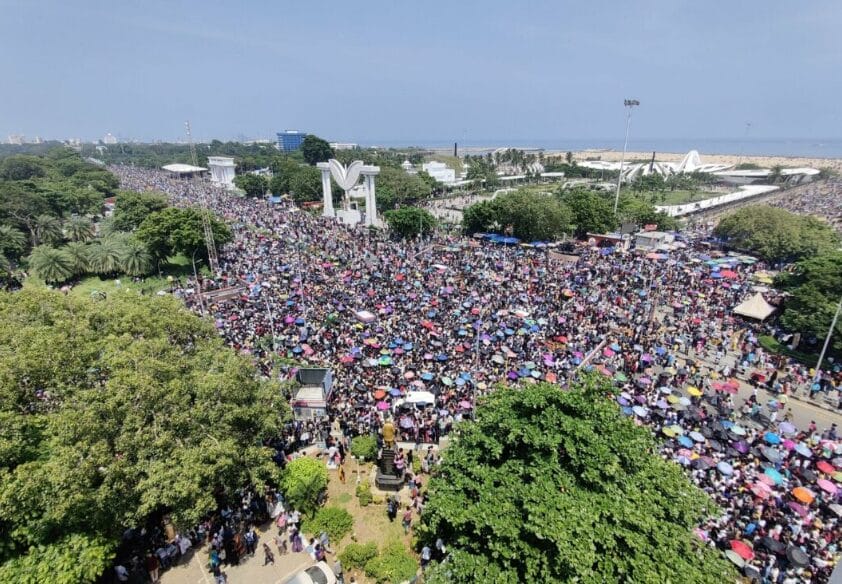
According to the SOP, the primary responsibility for the event-related safety and convenience of all the participants attending lies with the organiser. The government’s role is to ensure protection to the organisers and aid in the smooth conduct of the event, while ensuring that the public is not put to inconvenience, and traffic and public order are not disturbed in the conduct of the event.
Without going into the specifics of the SOP, it must be said that it seems to be a fairly comprehensive one, covering every aspect of a public gathering, right from the permission stage to facilitating a post-event analysis for continuous improvement in crowd management.
Focus on vulnerable groups
What is interesting to note is the emphasis placed on ensuring adequate facilities for people attending the event. It quantifies the provisioning of water and toilet facilities by way of benchmarks. It also mandates that vulnerable sections such as senior-citizens, pregnant women, children and differently-abled people are safeguarded and that separate enclosures are provided for them. Yet another provision is that audience shall not be made to assemble more than two hours in advance, which is extremely essential given the tendency to “gather crowds” in a display of organisational strength and keep them waiting under intense heat for long hours.
Adequate volunteers, properly identified, are to be present to ensure the smooth conduct of the gatherings. The draft SOP, which had been laid out in November 2025, proposed the collection of a refundable security deposit ranging from Rs 1 Lakh to Rs 20 Lakhs from the organisers, which was omitted in the final version issued based on the feedback received from political parties.
A necessary guideline for crowd safety
The response to the SOP across the political spectrum has expectedly been mixed. Two of its provisions have been challenged because they are discriminatory in nature, and there is too much of a burden placed on the organisers. While the matter lies sub-judice on these grounds, it is imperative to understand that these SOPs have been designed to bring about a sense of standardisation in terms of how public gatherings ought to be managed.
While its effectiveness may lie in how truly it is followed in spirit, there can be no denying the fact that this was very much a necessary documentation. There can be no compromise on public safety at any cost, and it is essential that the organisers, too, understand this and extend their cooperation. We just cannot afford to repeat the “tragedy – umbrage – move on with it till the next one” cycle anymore.
[This article first appeared in Madras Musings, Vol. 35, No. 21, February 16-28, 2026 and has been republished with permission. The original article may be read here.