Pothole deaths are the most devastating accidents. Monsoon and a cut in utility maintenance worsen the condition of potholes. There are many causes for a cut in utility maintenance: new utility connections (such as water, sewage and power lines), pipe damage due to heavy traffic movement, old pipe replacements, BESCOM line damage, etc.
If potholes are not constantly monitored and maintained, they can result in large craters, which can be fatal for motorists, especially two-wheelers.
Read more: Bengaluru’s potholes cost lives and money, but here’s how you can hold BBMP accountable
Why do potholes form?
It is essential to understand the root causes of potholes. Below is a breakdown of each contributing cause, along with the necessary measures that should be undertaken to effectively tackle them.
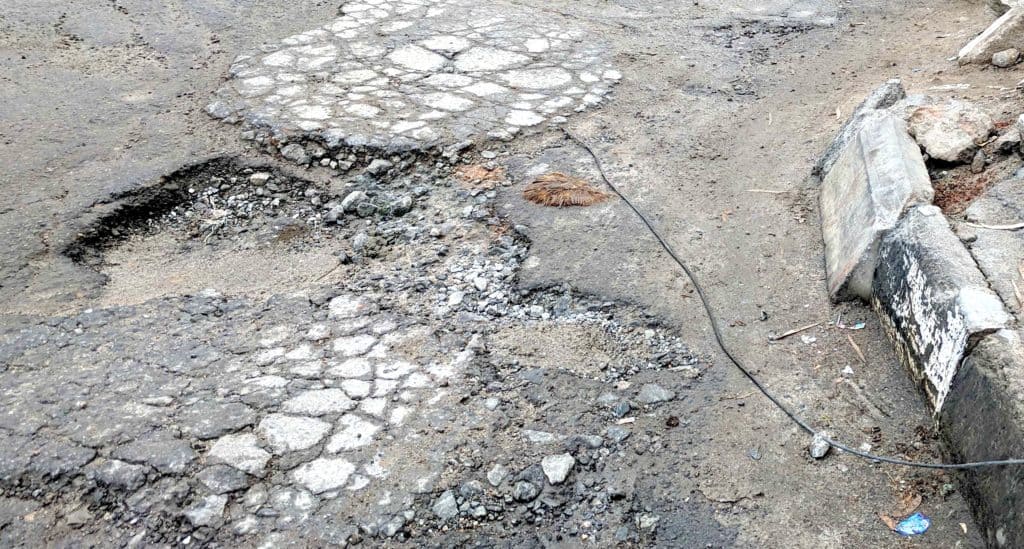
The most common cause of pothole formation is loss of adhesive in bituminous wearing courses due to entry of water. The pavement becomes soft as a result of loss of cohesion and due to traffic stress. If this is not addressed on time, aggregates in the surface get progressively loose, which results in a pothole.
Inadequate bonding between bituminous surfacing and underlying water-bound macadam, a compacted layer of tar-bound broken stones used for road surfacing, can also lead to potholes.
A thin bituminous surface, which is unable to withstand heavy traffic, and improper, inadequate camber (a road designed and constructed to enable water drainage is known as a camber) can also cause potholes.
Read more: Road safety: Audit reveals BBMP roads most hazardous, with 19-20 hazards per km
Types, causes and treatment methods of potholes
- Hungry Surface: This occurs when there is a loss of aggregates (granular material, such as sand, gravel, or crushed stone) from the surface or fine cracks appear. This may be due to its low water absorption value. As an emergency repair, a fog seal a thin liquid oil, (a fog seal is an application of a specially formulated asphalt emulsion to an existing asphalt pavement surface) may be used. Treatment: A slurry seal may be used for emergency repair. It is applied in an average thickness of 2 — 5 mm.
- Alligator Cracks/map cracking: This is a series of interconnecting cracks caused by fatigue failure of the AC (asphalt concrete) surface. This could be because of repeated traffic loading, which is the volume of vehicles that ply on the road at any given point in time. This distress is caused by loss of load-carrying capacity of the pavement’s base, sub-base, or sub-grade support due to improper drainage. Improving the drainage of the pavement so that water can flow out of the sub-base and strengthen the asphalt base is a long-term repair and control option for alligator cracking issues.
- Slippage: are crescent-shaped indents. This appears as half-moon-shaped cracks, with the ends pointing away from the direction of traffic. They are produced when a vehicle brakes or wheels turn, causing the pavement surface to slide. This usually occurs when there is a low-strength surface mix or poor bond between the surface and the next layer of pavement structure. Repair entails the removal and replacement of the affected area.
- Shallow Depression: Roughness (generally defined as an expression of irregularities in the pavement surface that adversely affect the ride quality of a vehicle), indents filled with water can cause vehicle hydroplaning (tires lose their grip on a road surface and instead travel on a film of water sitting on top of the road). It is caused due to inadequate compacted pockets or movement of the supporting layers beneath the surface course due to instability. Remedial measures include filling with pre-mix materials, and excavating and rebuilding the localised depressions. Reconstruction is required for extensive depressions.
- Settlement of pavements: This means a reduction in a pavement’s layers due to the exertion of the force of these on the underlying layers. Cracks form allowing water seepage to the lower layers. These cause a serious reduction in traffic speed. The repair of the pavements involves relaying the affected layers. Sometimes the cracks are surface-sealed.
- Ravelling: is the disintegration of an asphalt road surface due to the dislodgment of the aggregate materials (gravel, sand, and crushed stone). It reduces skid resistance, roughens the road surface, and exposes the layers underneath. If the ravelling is limited to a small area, apply a simple asphalt patch. If you have large ravelled areas of pavement, it could be because of general asphalt failure. When this happens, the best long-term strategy is to remove the damaged pavement and then overlay it with fresh asphalt.
In part two of this series, we will look at what BBMP can do to address the pothole menace.
[Compiled by Raghu Rajagopal]
Even the courts have been helpess in the matter, only God can help us now