More than 830 police personnel have tested positive for COVID-19 in Chennai. An Inspector with Mambalam Police Station succumbed to the virus recently, the first cop to have died with COVID-19 in Tamil Nadu.
From protecting individuals to taking care of guest workers in shelters, ensuring compliance with mandated norms in hospitals and public places and inspecting checkpoints, the police has had to deal with a variety of tasks on a daily basis.
Well aware of their vulnerability to the infection, a total of 18,000 cops belonging to Traffic, Law and Order and crime departments have been toiling on the frontline since the day the pandemic struck. Of them, several have co-morbidities and are over 55 years of age.
No quarantine period
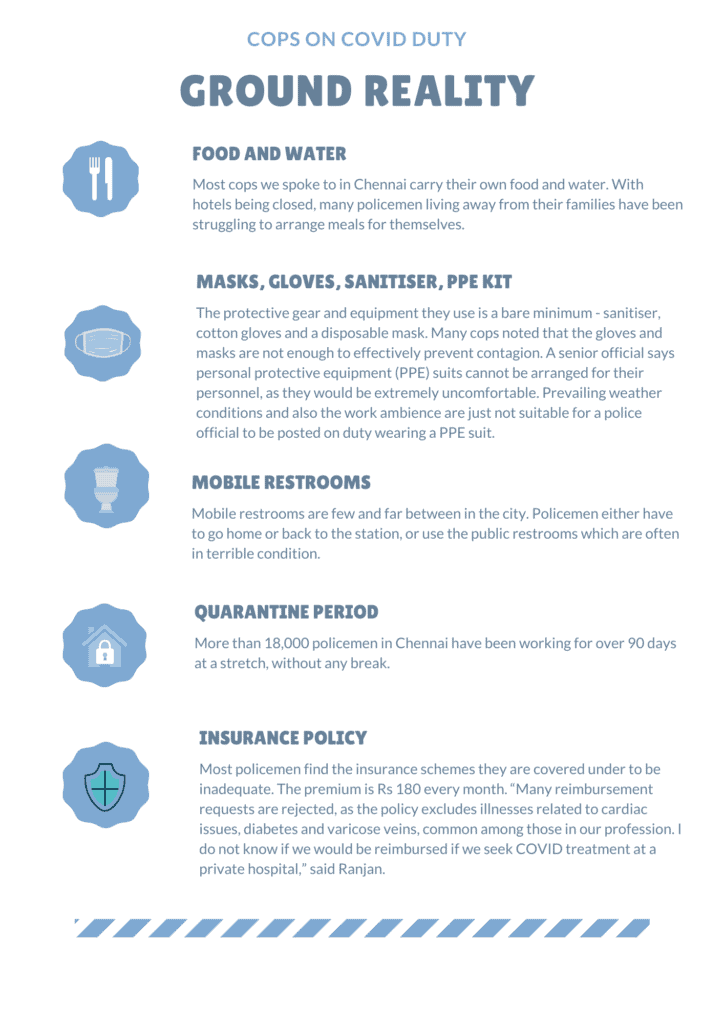
A bit of probing exposes several lapses within the system. One particular cause of concern is that while cops in other districts of Tamil Nadu are given a seven-day quarantine period after completing a two-week duty, no such protocol is implemented in Chennai, the epicentre of COVID-19.
Every morning Ranjan (38), a sub-Inspector, wakes up with a sense of deep fear; as soon as he gets up from bed, he measures his body temperature and checks for other symptoms, if any. He is worried, because the government will not do a COVID test unless a cop is symptomatic.
Ranjan was posted at the Koyambedu market, a known cluster for the virus; he reported for duty at the market every day for 90 days at a stretch, without any quarantine following that. “It was sheer luck that has saved me from contracting COVID yet,” he says, now working in a contained zone.
Sumana (36), another sub-Inspector in the Central Chennai zone, has a similar story to relate. Living with two senior citizens and two children, she rushes to take a bath soon after reaching her quarters and prays that it will prove to be enough. Even though two of her colleagues have tested positive for COVID-19, Sumana was not tested.
All these cases give rise to a natural question: is the absence of proper quarantining and lack of testing the reasons behind increasing COVID cases among cops? Lack of quarantine at reasonable intervals over the pandemic period poses a threat not just to the police force (through exposure to colleagues), but also to the community at large.
And where that is evident, why are adequate quarantine or isolation norms not mandated for the police force in Chennai?
Shortage of staff has always been a key issue. As many as 8,500 new recruits were deployed on lockdown duty in May, even before they went through the mandatory training, due to staff shortage. “The department needs more hands. If there is no reserve force, how can existing cops be allowed a quarantine period?” asks M Radhakrishnan of Thozhan.
However, the employee crunch can be compensated for by strategic planning and use of technology. “Instead of deploying police force in every hotspot (street), it should be handled ward-wise. There are so many CCTVs installed in the city, these can be used to monitor law and order (and compliance) issues in an area. Planning this way can help in reducing the number of cops being currently allocated to every hotspot,” says activist M Radhakrishnan.
Gaps in facilities
The conditions in which the police work also call for scrutiny in the time of COVID.
Cops on the road often take shelter under trees in the absence of proper posts. These spots are unsanitised and free for all. Those working the night shifts sleep in parked vehicles or on benches.
Women cops may be marginally better off, as unlike men, they are eligible to take a day off every week. But it doesn’t take away much from the many difficulties they face, due to missing amenities.
Deployed in the city on COVID duty, Lalitha M, a sub-Inspector, is one among the thousands of cops who have been on duty for over 100 days, without any quarantine period in between. Recently, while on her periods, Lalitha had to visit her home thrice during her 8-hour-shift to change sanitary napkins.
Menstruation during lockdown brings on additional worries for women personnel like Lalitha, especially because there are simply not enough mobile toilets. “The only resort in normal times is a loo in a hotel for the police, but now even these hotels are closed. Since my home is just 2 km away from the duty spot, I go home,” she says.
It is not easy for her male counterparts either; they either use the stinking public toilets or have to go back the police station.
Several safety protocols remain unaddressed for frontline workers even at this hour when Chennai is alarmingly witnessing more than 1,500 cases every day. Strategic planning is amiss, putting cops at risk and pushing the curve up.
(Names of the policemen have been changed on request)
The problem is corona is like GOD. It exists everywhere. So the scheme for providing less vulnerable place for those personnel who do continuous duty is not possible. Govt can consider offering policing jobs that does not involve law and order to those who voluntarily offer their services, with some honorarium and preference in govt recruitment in future.
Much is talked about spike in Covid-19 and news about new cases published daily. But nobody seems to have come out against transportation (bringing back home) of hundreds and hundreds of Indians stranded abroad. This should have been done and completed before the end of April. I personally feel this is the third important factor contributing to rise in Covid-19. The other two are Tabhlighi Jamaad and Johannesburg Cluster, not to speak of panic created by State Lockdown.