Bengaluru is racing to bridge the gap between first-mile and last-mile connectivity in public transport, but for people with disabilities, the journey is riddled with obstacles. Inaccessible bus stops and terminals in the city keep them excluded. “I have been travelling on muscle memory alone. There are no supportive facilities or infrastructure in bus stops or terminals,” says Mohan Kumar, a visually-impaired person who has been commuting in Bengaluru buses since 2012.
The exclusion starts at the bus stop. “Even if buses are inclusive, it is nearly impossible to reach the bus stops in Bengaluru due to poor design and execution. We never know which direction the bus is coming from, as there is no intimation infrastructure,” says Ashmira Hamirani, Senior Coordinator, Yes to Access, Association of People with Disability (APD), a Bengaluru-based NGO working for disability rights. Ashmira is visually impaired and has stopped commuting in buses due to their lack of basic inclusivity.
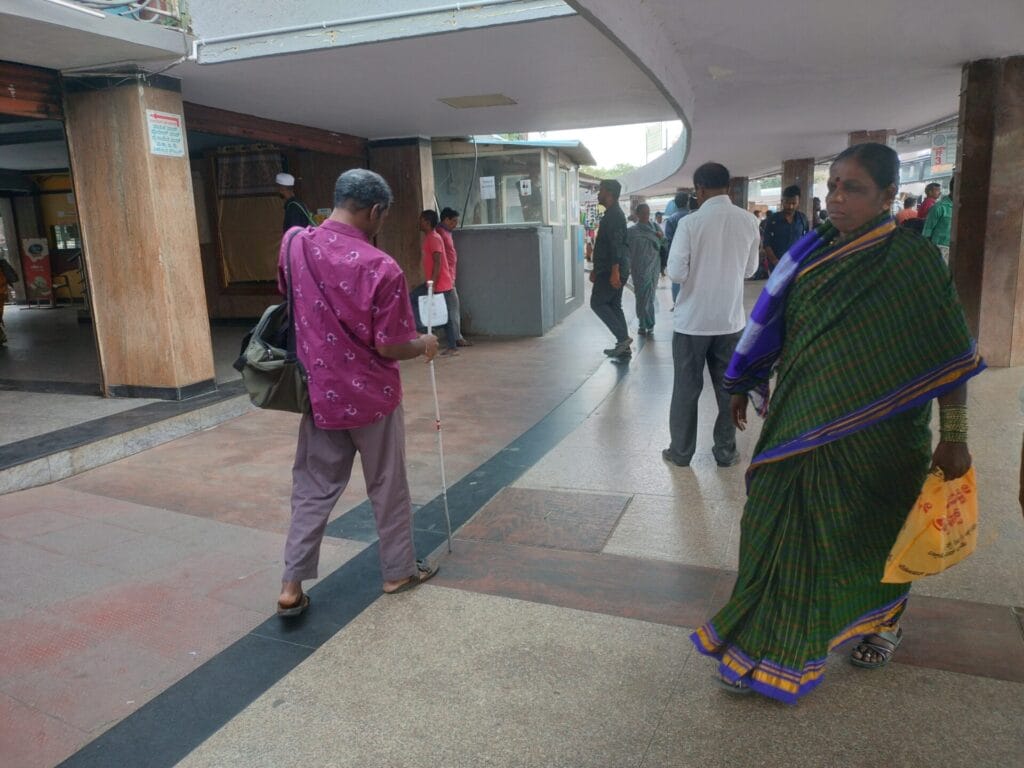
In 2023, the Ministry of Road Transport and Highways (MoRTH) released the Accessibility Guidelines for Bus Terminals and Bus Stops. These guidelines aim to make public transport more inclusive through specific design and infrastructure standards. Yet, our on‑ground investigation shows that in Bengaluru, commuting by bus remains inaccessible and exclusionary for people with disabilities.
Smart bus stops? Not really
Take the example of Electronic City Industrial Township Authority’s (ELCITA) four ‘smart bus stops,’ constructed in 2023. They were applauded for features such as vertical gardens, phone charging stations, sanitary napkin dispensers, vending machines and smart bins.
But these “South-Korean-style” bus stops overlooked basic accessibility: they lacked space for wheelchair movement, reserved seating, tactile pavements, audio announcements, low-floor boarding, and ramps to footpaths. Even vending machines were placed too high for wheelchair users to reach.
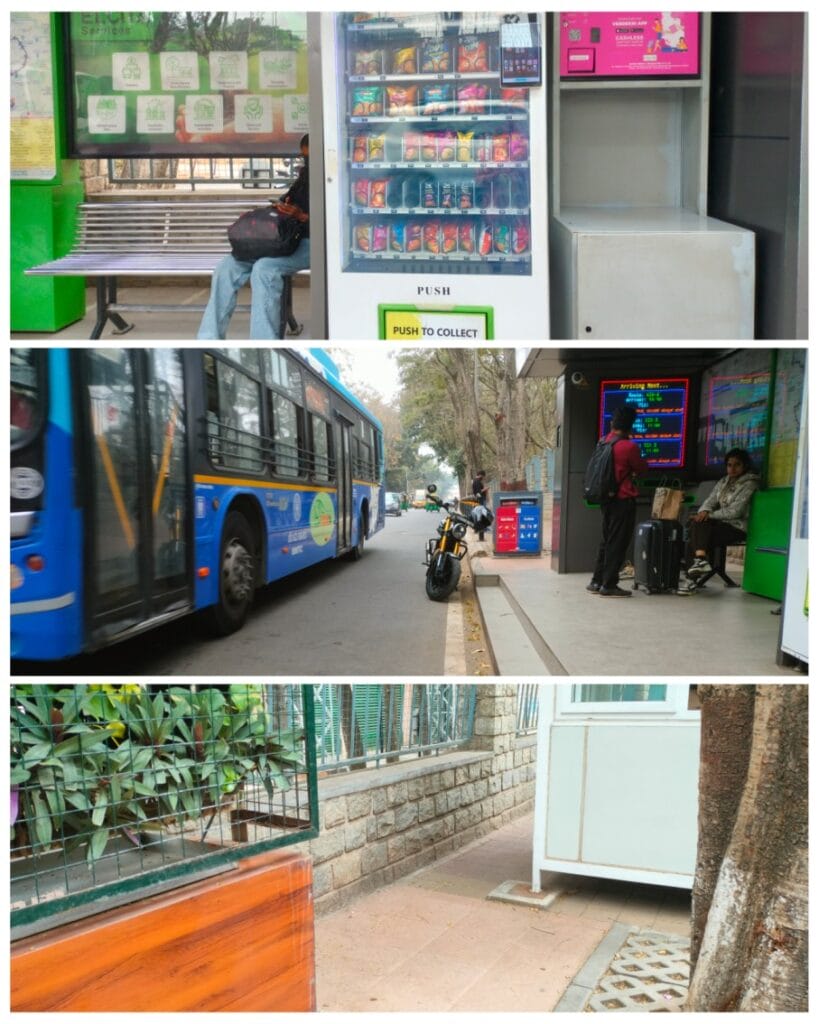
If smart bus stops exclude persons with disabilities, ordinary ones fare worse. On the contrary, bus terminals in Bengaluru have basic ramp and railing facilities, but miss the crucial first‑ and last‑point connectivity, forcing commuters through unnecessary steps before reaching the waiting area. “Even if the whole facility is accessible inside, if you add one step without ramp connectivity, it defeats the whole purpose of inclusive design,” says Kumar Mahavir, consultant (research and outreach), Yes to Access, APD.
Citizen Matters visited 17 bus stops and three main bus terminals across Bengaluru and found that most public transport infrastructure was in blatant violation of MoRTH guidelines on accessibility.
Bus stops in Bengaluru don’t look like it
While the Bengaluru Metropolitan Transport Corporation (BMTC) manages bus terminals, bus stops are maintained by the Greater Bengaluru Authority (GBA). Bus stops lack the bare minimum infrastructure: ramps, railings, designated waiting areas, and auditory announcements. Some stops, in fact, are just open spots where the bus halts, known only to locals and bus drivers.
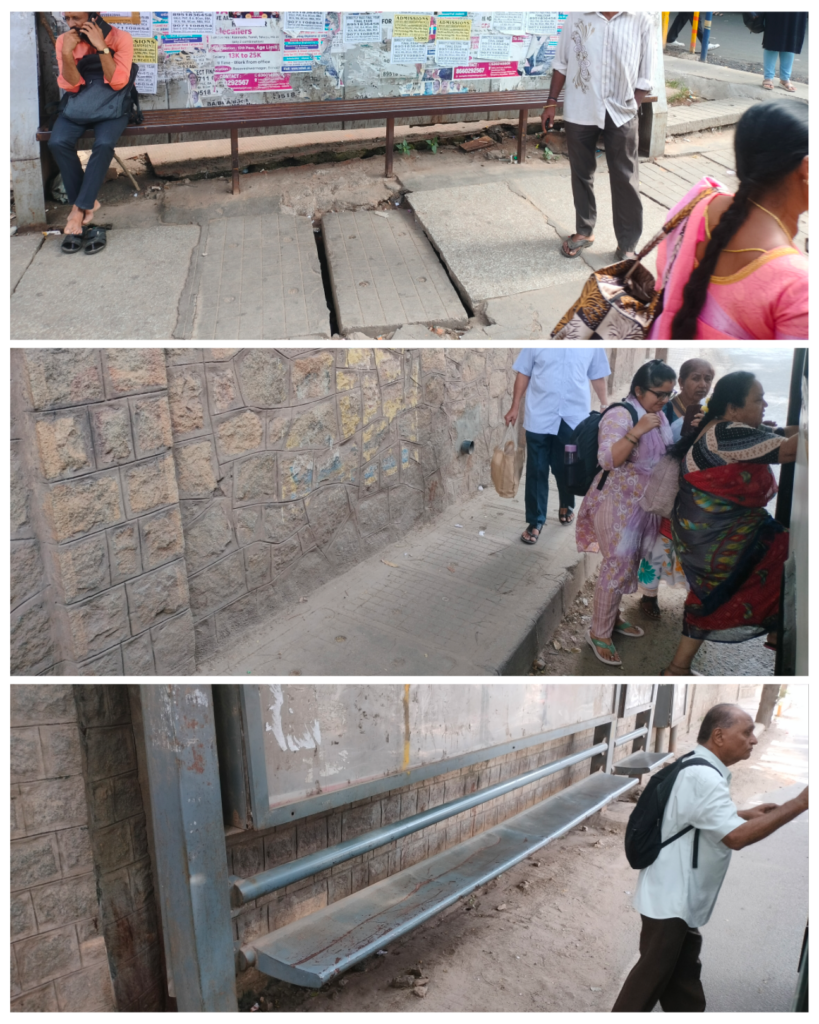
Of the 17 bus stops inspected by Citizen Matters, none had:
- Low-floor boarding
- Non-slip flooring and shaded area
- Audio announcements and/or braille signages
- Tactile paths leading from footpath to boarding point
- Obstacle-free boarding points
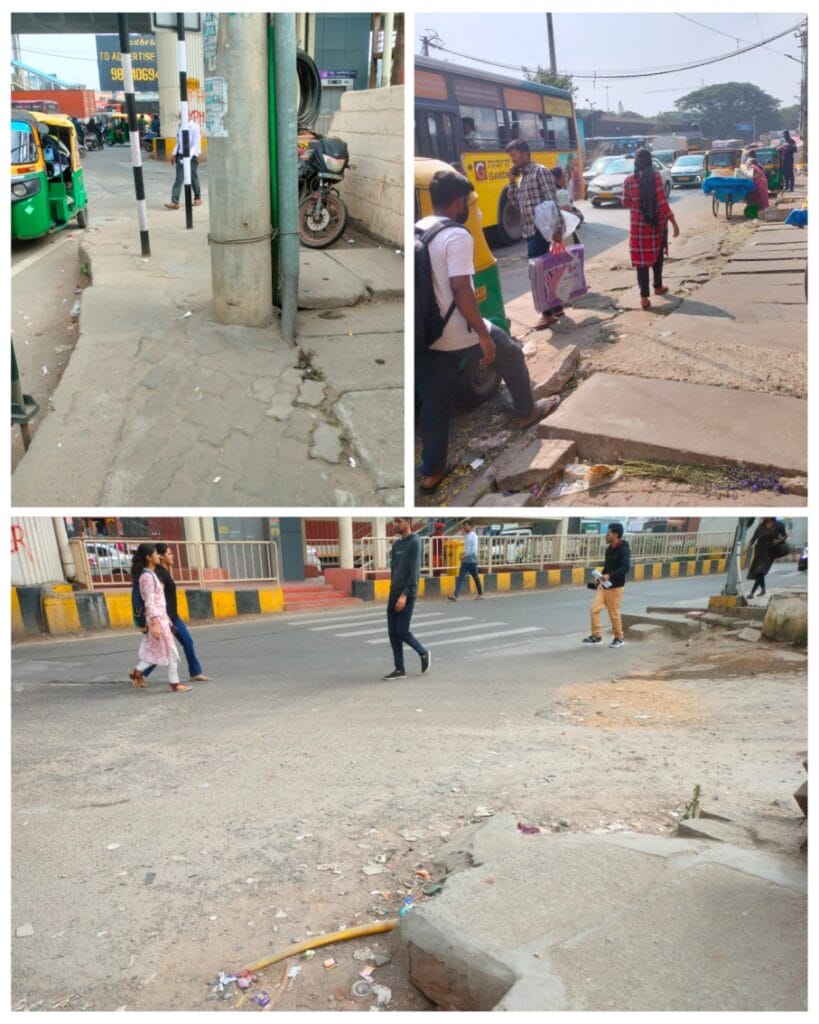
Some bus stops have seating, maps, lighting, and drop kerbs for wheelchair access. But bollards near stops block wheelchair entry, and ramps, often too narrow or steep, are effectively unusable.
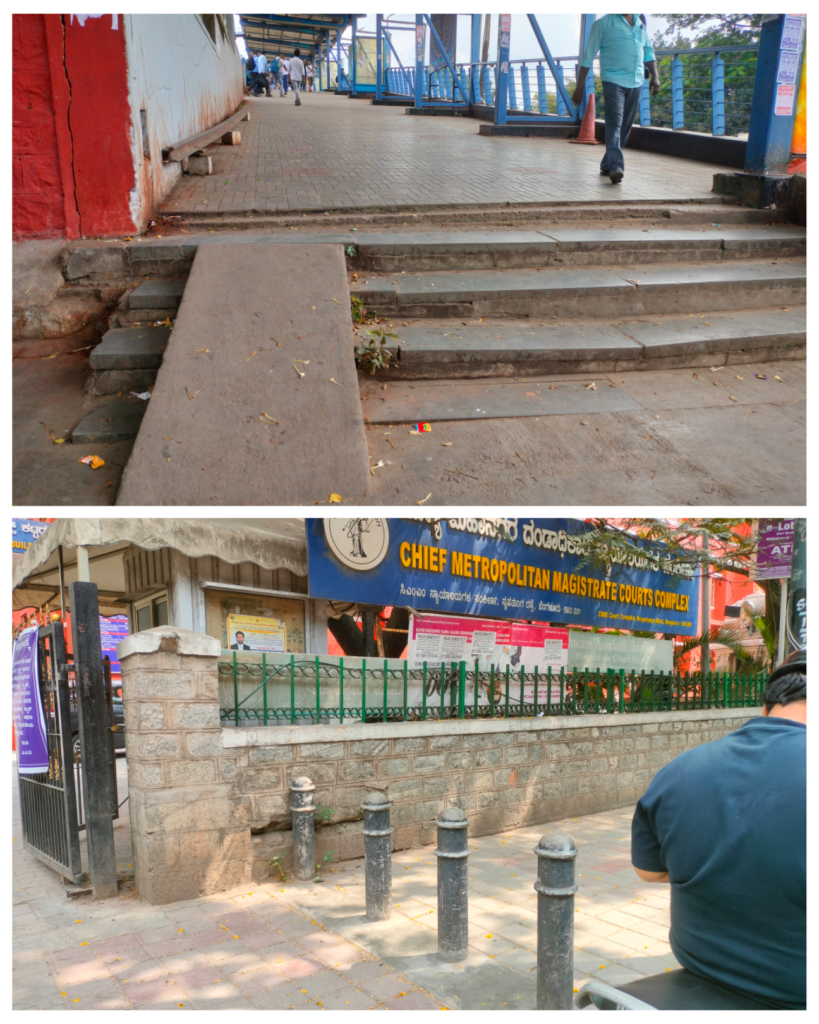
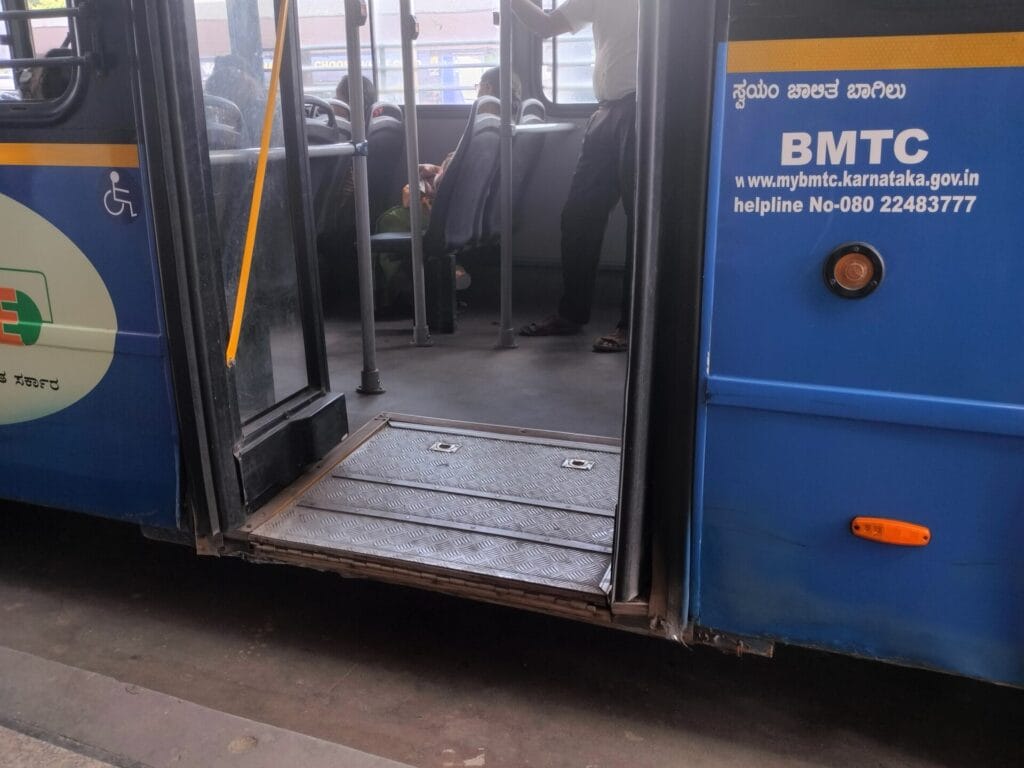
BMTC officials that Citizen Matters spoke to claimed that every bus station has manual metal ramps for the boarding and alighting of wheelchair users commuting in older BMTC buses. However, we found metal ramps in only one of the three bus terminals. “There are no specific staff to help persons with disabilities. When we see someone needing assistance, we help them out. Many times, conductors and staff manually lift the wheelchairs onto the buses when we encounter such instances,” says a BMTC constable, requesting anonymity.
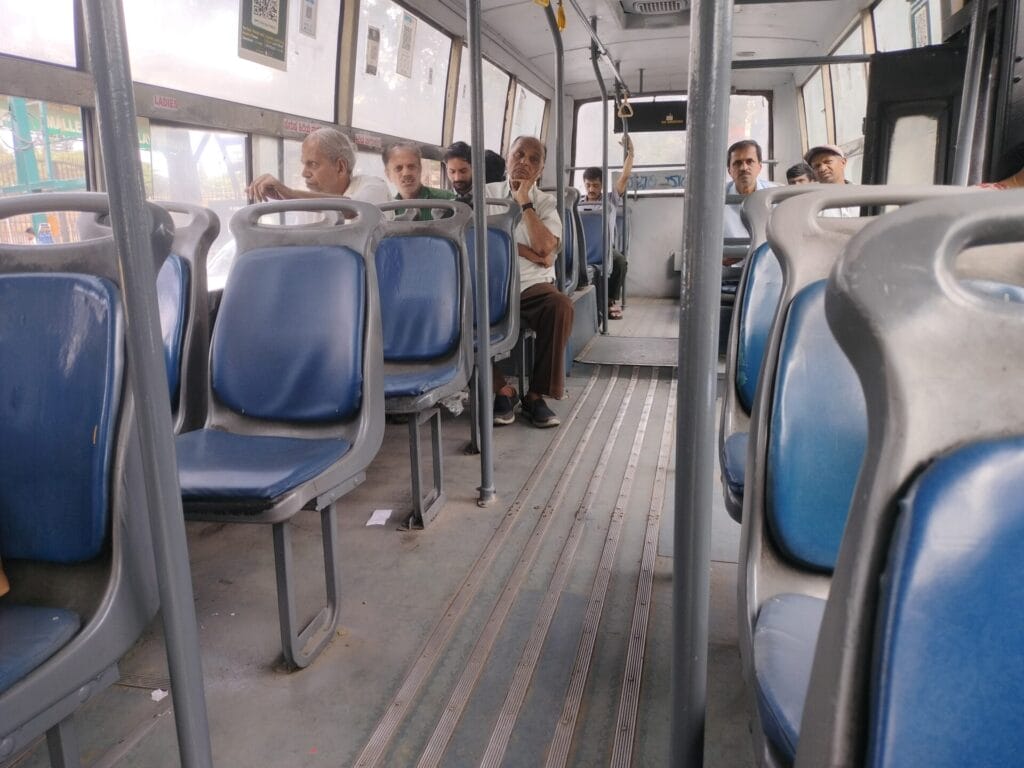
“Of the over 7,200 BMTC buses, around 1,800 EV buses have in-built ramps for wheelchair accessibility,” adds another BMTC official. However, the bus stops don’t match these facilities.
Inaccessible bus stops and terminals violate RPwD Act
The MoRTH guidelines on accessibility intend to introduce the concept of universal accessibility needs of persons with disabilities, elderly, women, children and other user groups with special needs in the built environment of bus terminals and bus stops across the country. These guidelines also include a checklist for auditing ramp slopes, tactile paths, entry levels, platform heights, door widths, lift dimensions, counters, parking arrangements, and signage.
While the MoRTH prescriptions are meant to ensure accessibility, a legal obligation as per the Right of Persons with Disabilities Act (RPwD), 2016, they are framed as guidelines only. Hence failure to adhere to these does not attract punitive or legal action.
Read more: Are Chennai’s bus stops and terminals truly accessible? A reality check
Sections 45 to 49 of the Act focus on making existing infrastructure and premises accessible, mandating governments and service providers to bring public buildings, transport, and services (like hospitals, schools, stations) into compliance with notified accessibility standards within two years of the rules being notified, with plans for gradual improvement. The Act also mandates social audits of all development schemes involving persons with disabilities.
How accessible are Bengaluru’s bus terminals?
Based on these guidelines, Citizen Matters created a checklist to examine multiple bus stops and terminals across Bengaluru.
Editor’s Note: Click on icons for Majestic, Kalasipalayam and Shantinagara on the map to view how each bus terminal fared against our checklist.
Kempegowda Station: Busiest, yet inaccessible
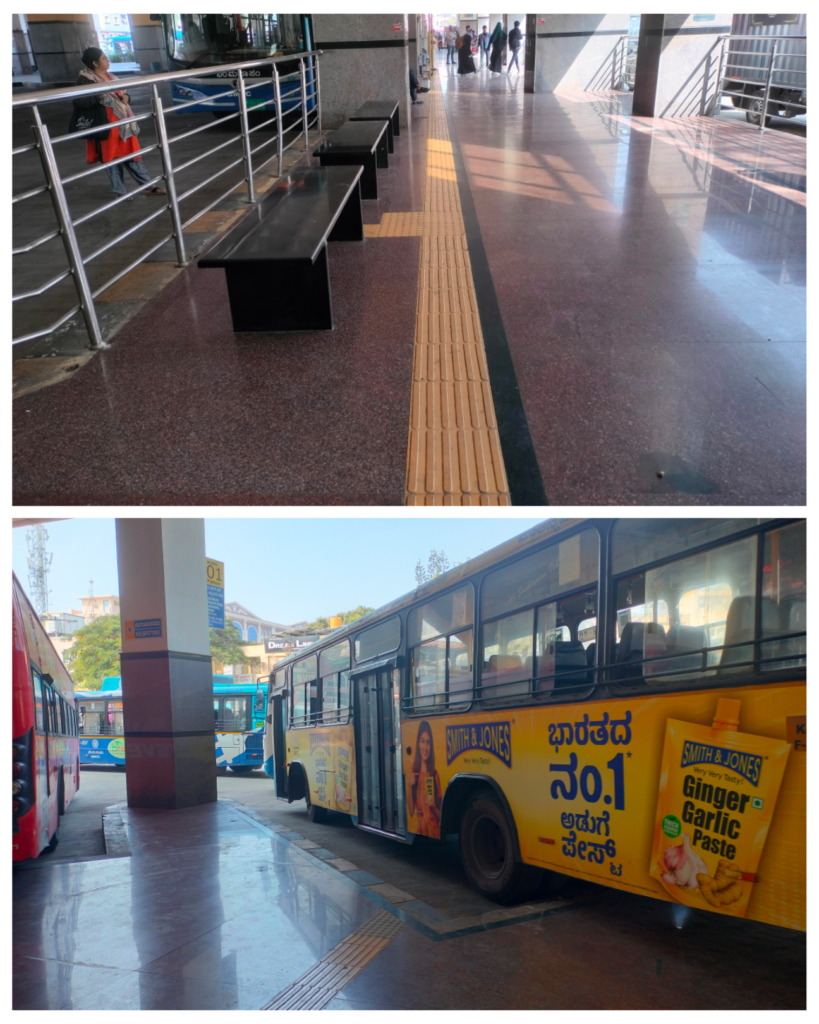
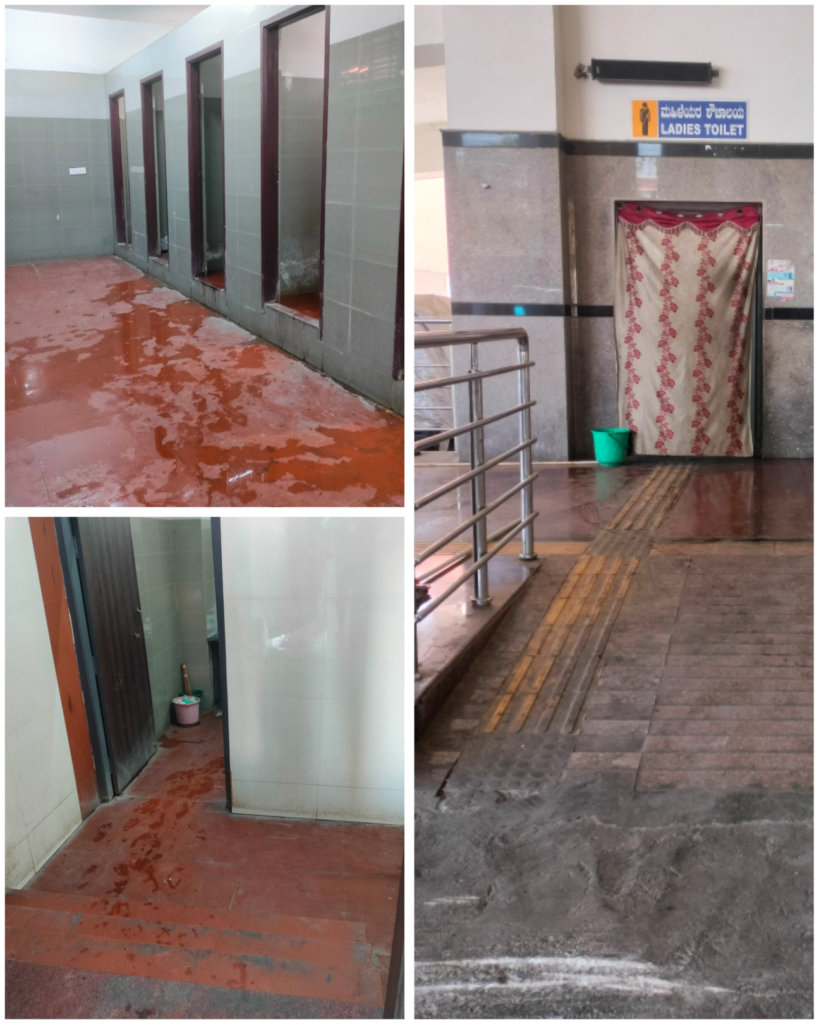
“Majestic has installed ramps and railings only to show that they are inclusive. But they have a step to climb at every crucial spot, including ticket counters, toilets and even at the start of the terminals, making them inaccessible,” says Vinitha S, a pharmacist and wheelchair user. Vinitha used to commute to her workplace via Kempegowda Bus Station and soon stopped commuting in buses altogether.
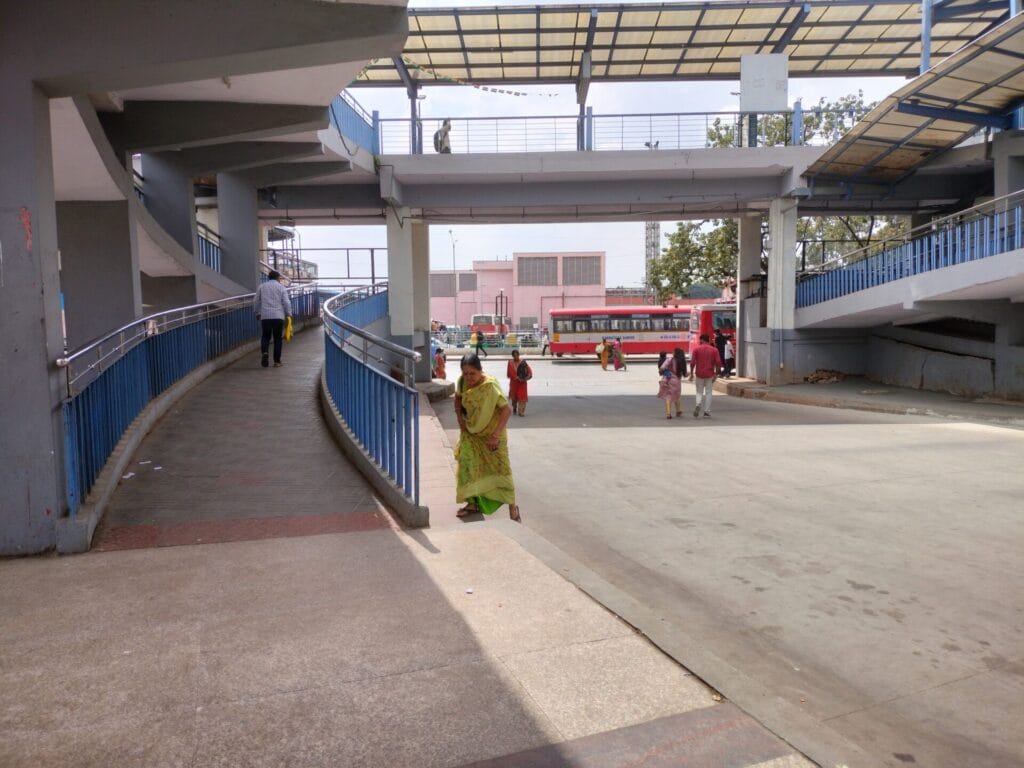
Furthermore, Kempegowda Bus Station has no tactile flooring or braille maps, leaving the visually impaired to navigate routes on muscle memory alone. Functioning since 1969, Kempegowda Bus Station is the city’s biggest and busiest bus terminal with an estimated footfall of five lakh BMTC commuters a day. This 32-acre bus terminal is undergoing redevelopment for ₹1,500 crore, as per reports and BMTC officials.
Shanthinagar: No disability-friendly design
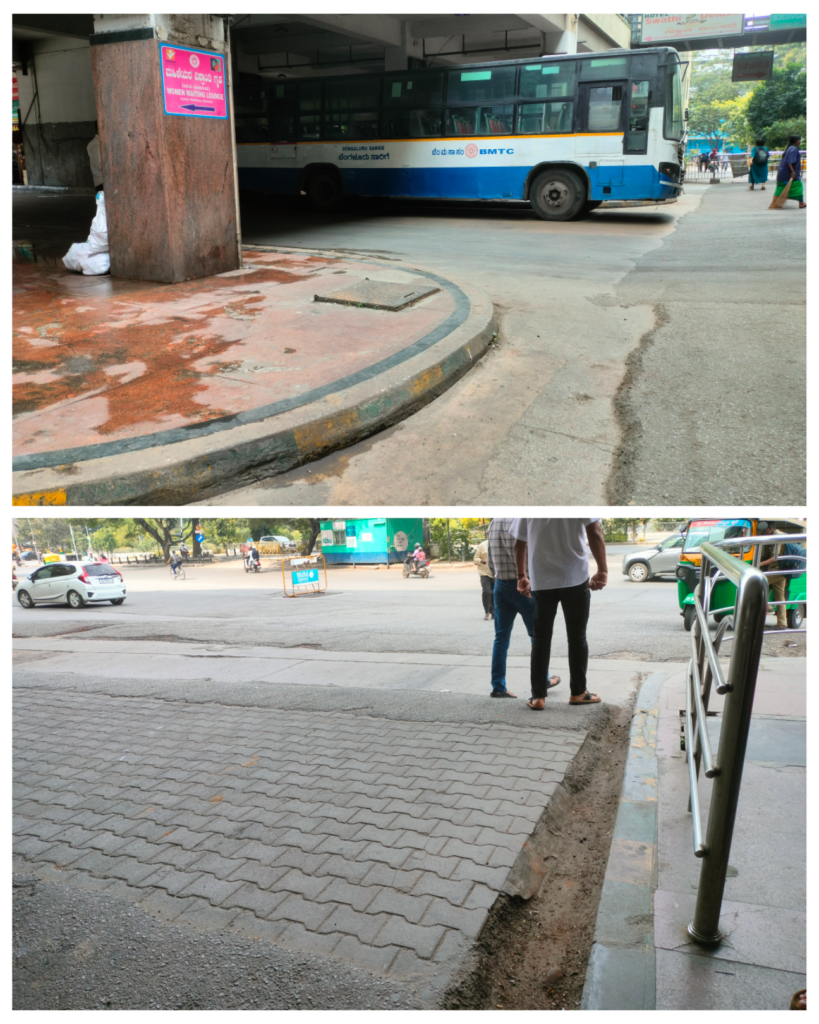
Operating since the early 2000s, Shantinagar Bus Terminal highlights how accessibility fails at the start. Despite nearby parking, a wheelchair lounge, well-placed ticket counters, and low-floor boarding, steps at every platform make the terminal unusable for wheelchair users—defeating the purpose of inclusive design.
Kalasipalyam: Platforms are a problem
Newly inaugurated in 2023, the Kalasipalyam Bus Terminal in the KR Market is comparatively more accessible. The terminal building has end-to-end connectivity via ramps and railings, tactile flooring, manual ramps and wheelchairs for old buses, and ramps to toilets. While the inside of the terminal building is accessible, platforms outside the building have steps at every corner with no low-floor boarding.
Is there political will to get out of an ableist attitude?
As per the 2011 census, Bengaluru had about 2.74 lakh persons with disabilities, and the number may be much higher today under the provisions of the RPwD Act. Yet, public transport remains a distant dream for many, reflecting a lack of political will. “There is a basic attitudinal problem. We are frequently asked, ‘If you are disabled, why opt for public transport?’” says Ashmira.
Kumar adds, “For those who cannot afford costly auto or cab rides, every bus journey requires extra effort; arriving early, finding less crowded spots, and seeking help to board buses. Crowds are mismanaged, and staff are neither trained nor sensitised to support people with disabilities.”
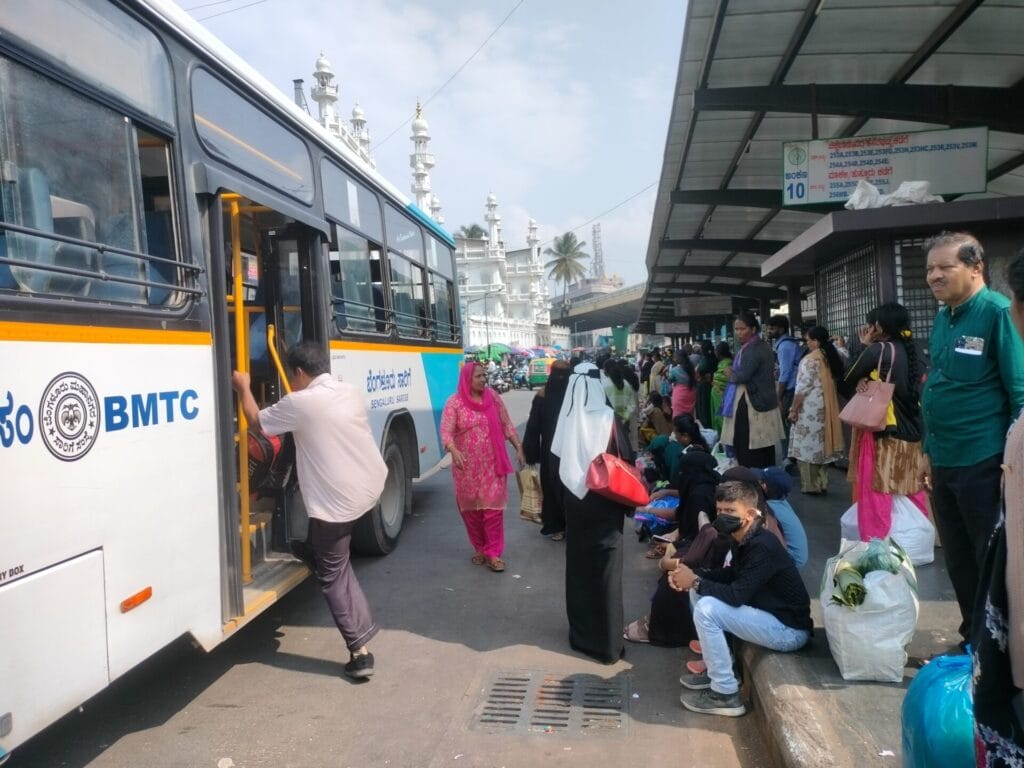
The APD’s ‘Yes to Access’ department is currently sensitising BMTC staff across terminals. “Excluding a large community from the workforce and commute is resulting in a grave economic loss, documented or not. Yet the government fails to acknowledge us as assets,” says Ashmira.
Bhagyalaxmi Madapur, co-founder and principal architect at 369 Ochre Studio, notes that while fully accessible buses may be unrealistic, reasonable accommodations at stops and terminals can be achieved with just 5–8% of the budget. “Some basic retrofitting, including sufficient spacing and ramps, floor alignment with bus boarding, tactile pavements, auditory announcements and hand railings are possible. Depending on each case, physical space available and budget allocation, additional retrofitting can be accommodated,” she adds.
“Before making transportation accessible, our roads, footpaths and bus/metro stations must be accessible. Otherwise, there is no purpose in just modifying trains and buses,” says Babu S, Deputy Director, APD. Since accessibility involves multi-departmental coordination — road, transport, welfare, street vendors, etc — it becomes easier to dilute accountability. “There is no penal process for not adhering to MoRTH guidelines. These guidelines are only suggestive, so the government will find excuses not to implement them,” says Kumar.
Most of the disability budget is spent on welfare schemes, neglecting infrastructural accommodation. To make matters worse, the Karnataka government slashed the disability budget by 80% in 2024 from ₹54 crore to ₹10 crore. “One wheelchair distribution programme will not solve the commuting concerns. Inclusive mobility plans require active political will,” adds Kumar.