Of pots and imports…

All creatures great and small, whether they come from some faraway place on our planet or make their home right near us, can be a wondrous source of fascination!

Winter is always a good season for an amateur naturalist like me; the cool weather suits me and I can certainly spend far longer outdoors without getting tired out by the relentless Indian sun. I like to go out as much with friends as possible, and come across interesting things…literally, from far and near.

One of the “far” birds that we went to see are the bar-headed geese, which fly in from Mongolia and other parts in the far north, to our relatively warmer climes.
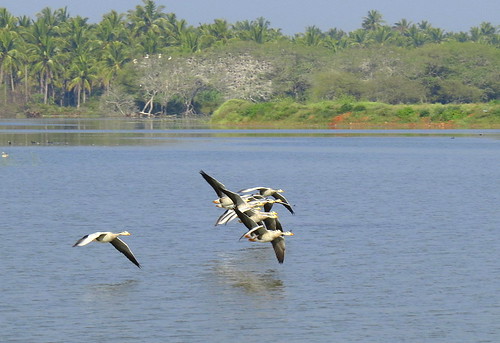
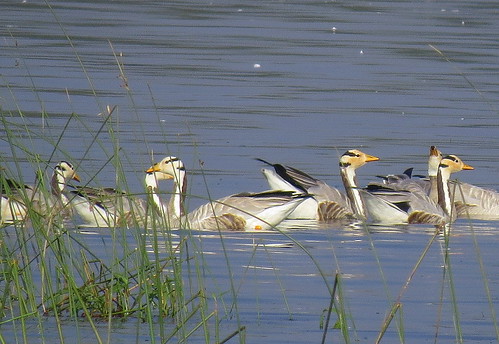
Bar-headed Geese

IMG_7489

IMG_7453

At Magadi lake at Gadag district, they arrive in large numbers; however, if you are not “chasing numbers”, lots of them can be seen at Kabini, and even nearer, at Hadinaru kere (lake in Kannada) near Nanjangud. Here is one handsome bird.
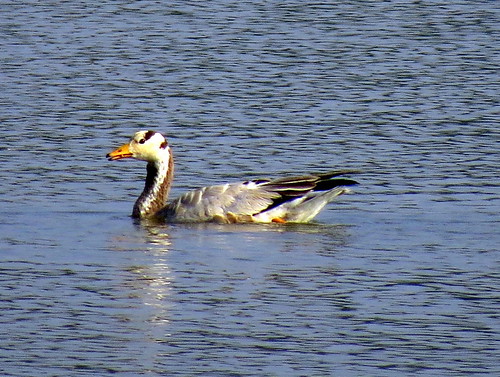
IMG_7476

The birds flying over the road from the fields, where they forage, on to the lake to settle down, is an amazing sight. One can only imagine what they must look like, flying through the high passes of the Himalaya, on their way here!

However, the nearby, and the small, can also be equally awe-inspiring and riveting. On a recent trip to the Valley School area, off Kanakapura Road near the NICE Junction in Bengaluru, we were done and were returning to our cars, when a small movement on the other side of a chain link fence caught my eyes.

It was a female

Potter Wasp

and there was no need to ask why she has been given that name. Look at the perfection of the home she is creating for her young ones!

She will find a spider or a caterpillar, stun (not kill) it, and put it in the home she has created. She will then lay her eggs on the paralyzed creature, so that her eggs, when they hatch into larvae, will have fresh meat and protein to feed on. All this for children she will never see…because once she’s put her young ones in “the pot”, off she flies, as you can see in this short video.

So…all creatures, great and small, whether they come from some faraway place on our planet or make their home right near us…are an endless source of fascination!

Leave a Reply

Your email address will not be published. Required fields are marked *

Similar Story

Beyond the parks and gardens, Bengaluru’s ‘wasteland’ ecosystems call for protection

Open Natural Ecosystems in Bengaluru harbour rich biodiversity. Take a look at what they hold and what we risk losing to unchecked development.

When we discuss urban nature, we often forget about real natural habitats. In Bengaluru, widely called the Garden City, most talks about urban nature focus on landscaped parks, roadside trees, and manicured gardens; in other words, artificial ecosystems designed for looks and human comfort. As lay citizens, we usually notice only such nature as we see around our homes, workplaces or other areas we generally pass by. While these places do have some ecological value, they mostly support a few highly adaptable species. This has strong negative implications for native flora and fauna that depend on open scrublands, grasslands, rocky…

Similar Story

The wild in the city: What citizen scientists tell us about Bengaluru’s biodiversity

Spatial and temporal biodiversity patterns, as observed by citizen scientists in the city during 2016-2025, were studied at a datajam in December 2025.

Imagine you’re out on a morning walk, phone in hand, when you spot a butterfly you’ve never seen before. You snap a photo, log it into a citizen science app, and voila! You’ve just contributed to crucial biodiversity monitoring. This isn’t just a hobby; it’s part of a global movement where ordinary people collect, record, and sometimes analyse data about plants, animals, and ecosystems. Citizen science stretches the reach of ecological research. Every observation adds to unique longitudinal datasets that reveal phenology — periodic events in the life cycle of a species — along with species distribution shifts and population…