Listen to the story and science of excavating an ancient port city

Excavations have shown that the port city known as Muziris was a part of an extensive maritime network linking the Indian Ocean with China, the Red Sea, the Nile and the Mediterranean Sea, over 2000 years ago. This talk by INTACH will tell you more about it.

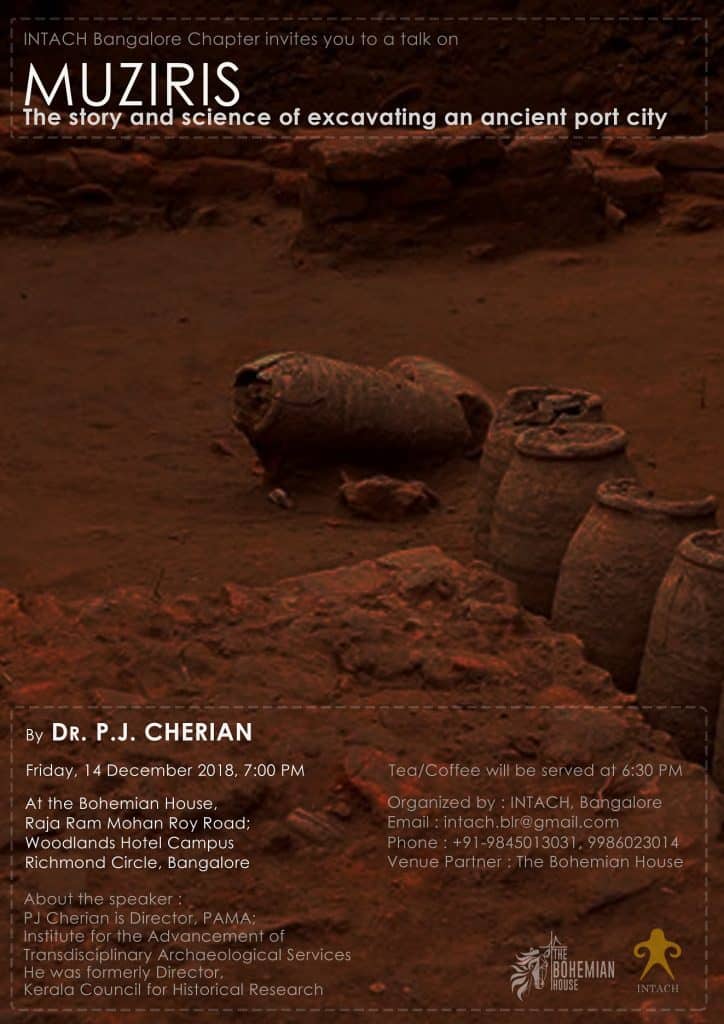
INTACH Bangalore Chapter has organised a talk on ‘MUZIRIS: The story and science of excavating an ancient port city’, by Dr PJ Cherian. This will be held at The Bohemian House, (in the Woodlands Hotel Campus), Raja Ram Mohan Roy Road, Richmond Circle, Bangalore, on Friday, 14th December, 2018, 7 pm.

With the Kochi Muziris Biennale opening on December 12th, it’s time to find out all about Muziris! Archaeological excavations at Pattanam, near Kochi, have shown that it was likely the famed ancient port city known as Muziris to the Greeks and Romans and called Muciri Pattinam in classical Tamil was a part of an extensive maritime network linking the Indian Ocean with China, the Red Sea, the Nile and the Mediterranean Sea, over 2000 years ago.

The excavations have revealed the transoceanic contacts of Tamilakam (3rd century BCE to 5th century CE) which extended from South China to Spain. Dr Cherian will also touch upon the possible role of civil society in this scientific endeavour.

Dr PJ Cherian is Director, PAMA, Institute for the Advancement of Transdisciplinary Archaeological Sciences. He was formerly Director, Kerala Council for Historical Research, in hich position he had steered the excavations in Pattanam.

Venue Partner: The Bohemian House.

The event is free and open to all. For more details, please see the poster.
Leave a Reply

Your email address will not be published. Required fields are marked *

Similar Story

Safety still out of reach: Everyday struggles of women with disabilities

Women with disabilities face increased risks in public and private spaces because of consent violations, unsafe surroundings and neglect.

Every morning, Samidha Dhumatkar travels from her home in Mumbai’s western suburbs to Churchgate, where she works as a telephone operator at a university campus. Her journey involves taking a rickshaw, boarding a train, and walking to her workplace, similar to thousands of other Mumbaikars who commute daily. However, as a person with a visual disability, Samidha’s commute is fraught with threats to her safety. In their book, Why Loiter? Women and Risk on Mumbai Streets, writers Shilpa Phadke, Sameera Khan, and Shilpa Ranade, argue that spaces are not neutral. Moreover, they are not designed equally. “Across geography and time,…

Similar Story

India’s stray dog debate puts the nation’s conscience on trial

Street dogs spark a national test — will India choose compassion or fear as law, humanity and coexistence come under strain?

At the heart of a nation’s character lies how it treats its most vulnerable. Today, India finds its soul stretched on a rack, its conscience torn between compassion and conflict, its legal pillars wobbling under the weight of a single, heartbreaking issue: the fate of its street dogs. What began as a Supreme Court suo moto hearing on August 11th has morphed into a national referendum on empathy, duty, and coexistence, exposing a deep, painful schism. Two sides Caregivers and animal lovers: They follow Animal Birth Control (ABC) and Catch-Neuter-Vaccinate-Return (CNVR). Their goal is to reduce dog populations and rabies…