Ashwin, Samreen, Shimon and Prem were just a bunch of toddlers when their parents moved to Lallubhai Compound in Mankhurd, a rehabilitation and resettlement (R&R) colony situated in Mumbai’s M-East ward. This ward has seen some of the lowest human development indices in the city and like most R&R settlements grappled with a range of social, economic and civic issues.
Rampant drug abuse, sexual harrassment, high drop-out rates among children and other safety concerns were a regular feature and the residents, reeling under dire poverty, were too caught up in the struggle for day-to-day sustenance to actually address these issues for the long term. It was in such a situation that a group of children stepped in to take things in their hands, and the results have been remarkable.

These are the conditions in which residents of Lallubhai Compound live. Pic: Nikhil Latagajanan
BASS to the rescue
The transformation was initially triggered by a group named Bal Adhikar Sangharsh Sangathan (BASS), that engaged child volunteers from the community in addressing social and civic issues such as waste management, water and safe spaces.
The group was formed and supported by the Child Resource Centre established in the community by an organisation called YUVA. In 2015, consequent to a collaboration with UNICEF, YUVA took up the cause of child rights and safety. They identified a few localities, where they conducted surveys and asked the children themselves to identify the most serious problems in their community.
“In the survey, many of the children shared that they feel unsafe even in their own houses. They don’t have any places to play. That is how the idea of Child Resource Centre (CRC) took roots; it was the first step towards creating a safe space for children where they could come and participate in recreational as well as social activities,” said Vijay Kharat, Project Coordinator, YUVA.
Lallubhai Compound was one of these settlements where the CRC was set up. Child members of the CRC came together to form BASS and were guided to take charge of issues that affected their lives.
First steps towards transformation
This initiative received overwhelming response. Children joined in large numbers, notwithstanding their parents’ disapproval. Initially, parents were reluctant to let their children go out and become a part of the initiative. For one thing, they did not know what kind of activities their children would be indulging in. Moreover, since people came from different regions and communities, parents developed feelings of mistrust and hostility towards other families in the neighbourhood.
“When I joined BASS, my family was apprehensive. Elders in my building had a hostile attitude towards me doing social work. It took time, but they eventually realised that we are trying to do good for society. Now I myself lead a group of children from my building,” says fifteen-year-old Samreen Shah.
Another fifteen year old, Ashwin, says, “When I heard about BASS for the first time I thought it was all fun and games. But after I joined the group, I learned so much about child rights”
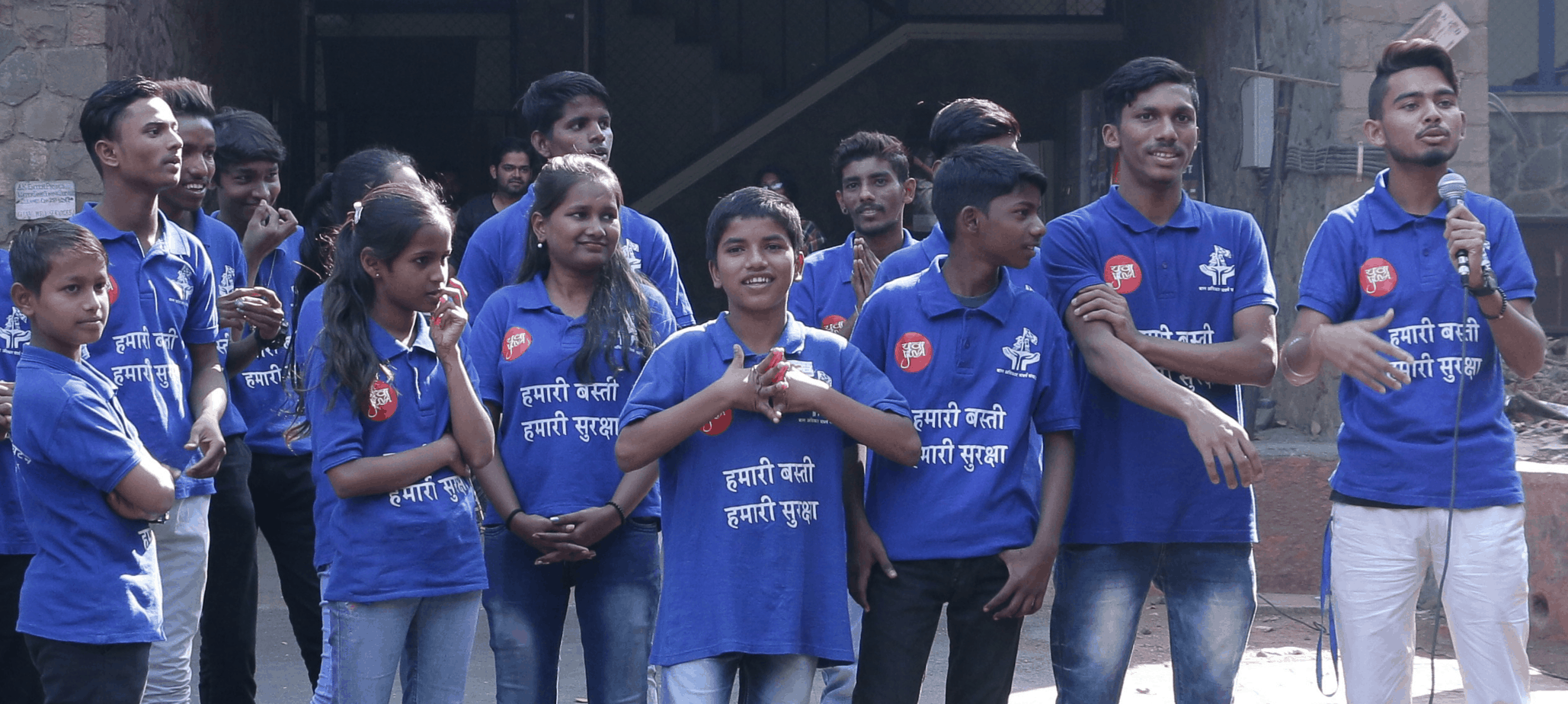
The BASS streetplay group. Pic: Nikhil Latagajanan
As BASS began its groundwork in spreading awareness among children and parents, crime rates decreased and drug problems received professional attention. Soon, adult opinion in the community also started changing as children showed improvement in studies and behaviour. They started engaging with other children about their work at BASS. In no time, parents started participating in the events organised by BASS.
“They are not just helping children but parents, as well. We attend the meetings sometimes and learn new things. My son has changed for the better and I am proud of him,” says Durga Dilip Mohite (39), mother of a BASS member.
Other subcommittees
Driven by the efforts of BASS, dwellers of Lallubhai established the Child Protection Committee (CPC) at the ward level under the provisions of the Juvenile Justice Act 2000. The CPC consists of local representatives, principals of government schools, representatives from Municipal Corporation and local police station, anganwadi teachers and parents. Apart from adult members, two children of the age between of 12 and 18 are appointed as members of CPC. Child members are chosen by the children themselves.
Other than CPC, children also formed committees at the community level to take their concerns forward. These are called Community Child Protection Committee (CCPC). Under this initiative children can set up libraries and recreational spaces where they can read, study, learn and meet to discuss group activities.
Engaging with authorities
The children of BASS approached the Mankhurd police station, regarding issues of eve teasing and drug abuse by the youth in their locality. Since then the police has started patrolling the area on a regular basis. The children have also developed a rapport with the local political representatives.
Thirteen-year-old Prem Tambe says, “Earlier, when we used to see the Municipal commissioner, we would run away in fear. But after joining BASS, the fear has vanished. We can actually face him and talk to him about our problems.”
Towards greater collaboration
Although most of the children in Lallubhai are now asserting their rights, it does not ensure the development of each and every child in the locality. Moreover, there are issues related to health, hygiene and road safety which need to be taken up. To this effect, the young leaders of Lallubhai are trying to build a city level BASS network.
Currently they have built their groups in Ambojwadi, Malad West and Bandra East. Volunteers believe that a city-wide network might put an end to wide ranging social maladies in informal urban housing settlements and child destitution.
It is a good movement. If every indian can understand these children thoughts, than there is no eve-teasing and drug abuse in india. RTE Admission is also an important for Indian Children.