This is an idea of how Chalukya Circle (CC) Junction and surrounding areas can be made signal-free with existing infrastructure. The idea if implemented will make the following four bottle necks signal free and cross-traffic free.
- Chalukya Circle
- AG’s Office signal on Palace Road
- Palace Road-Sankey Road Junction
- Miller Tank Bund Road-Sankey Road.
The following roads lead into and away from the circle.
- Raj Bhavan Road – one way from Raj Bhavan to Chalukya Circle
- Race Course Road – two way
- Palace Road from Maharani’s college side – two way
- Palace Road towards Cunningham Road – one way towards Cunningham Road
- Miller Tank Bund Road from Cunningham Road – one way
- Dr Ambedkar Road leading towards Vidhan Soudha – two way.
If the following traffic flow changes are made, the junction can be made signal free.
- Raj Bhavan Road continues to be one way from Raj Bhavan to Chalukya Circle.
- Race Course Road continues to be two-way.
- Palace Road becomes one way from AG’s office towards Chalukya Circle. No traffic allowed from Chalukya Circle to Palace Road towards Maharani’s College.
- Palace Road towards Cunningham road continues to be one way with only left towards Sankey Road and Right towards Raj Bhavan permitted. No Straight path towards Cunningham Road.
- No traffic enters Chalukya Circle from Miller’s Tank Bund Road.
- Ambedkar Road towards Vidhan Soudha is one way towards Vidhan Soudha. No traffic enters from Ambedkar Road to Chalukya Circle.
Here is how the traffic will move
1. From Rajbhavan Road traffic moves either left into Ambedkar Road or right into Palace Road at Chalukya Circle. Traffic that has to go towards Race Course will take left at Chalukya Circle go further and take a right and again a free right into Palace Road at AG’s Office Junction and take a free left into Race Course Road
2. Traffic from Race Course will have only left turn into Palace Road. They will go around the Planetarium and make a V turn into Rajbhavan Road to come back to Chalukya Circle and take a left to go towards Vidhan Soudha and Freedom Park.
3. Traffic from Sankey Road side will go around Planetarium and take a V turn at Rajbhavan Road to come to CC and then go left towards Vidhan Soudha.
4. Traffic coming from Maharani’s College will not have right turn at AG’s office junction. This will go towards Chalukya Circle and either take a free left to Race Course Road, free right to Ambedkar Road or straight into Palace Road.
5. Traffic coming from Miller Tank Bund Road will take a left at Sankey Road junction and take a V turn at Raj Bhavan to reach Chalukya Circle.
6. Traffic from Race Course going towards Vidhan Soudha and traffic from Sankey Road towards Vidhan Soudha will have to take a slightly longer route going around the Planetarium.
This will make the Chalukya Junction traffic signal free, the following traffic signals will also be eliminated:
1. AG’s office traffic signal as there will be no right turn for traffic coming from Maharani’s college.
2. Traffic obstacle at the junction of Sankey Road and Palace Road as there will be no cross traffic as all three streams of traffic will head towards Raj Bhavan only.
3. Traffic Signal at the junction of Miller’s Tank Bund Road and Sankey Road will be eliminated as there is again no cross-traffic. Traffic from Sankey Road will be allowed right turn here to access the function hall on the left but cannot enter Chalukya Circle as this road will be a dead end. This road can also be used for parking vehicles which come to drop and pick up children of the school nearby.
Modifications will be needed near the Raj Bhavan Road for traffic coming from Chowdaiah Road to make a convenient V turn. There is enough place here to make that. Although some commuters will have to travel about 500 meters more, by eliminating four traffic bottle necks which slow them down, they can reach their destination faster.
Here is the schematic representation.
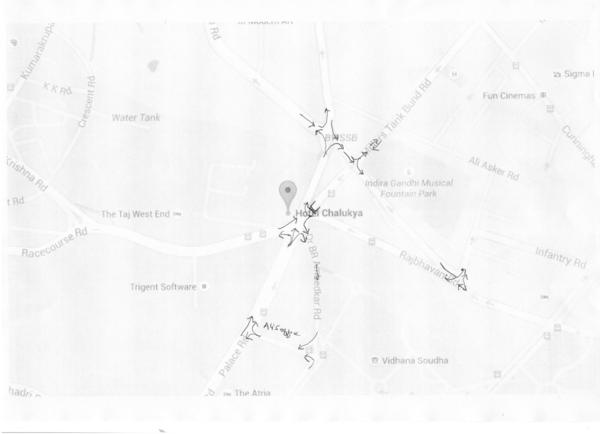
Schematic diagram of one-ways in Chalukya Circle to make it signal-free.
Related Articles
Here’s an alternative to Chalukya Circle elevated highway
Crossing Sony World signal to be made easier soon with elevated road
This seems reasonable – but what do people who want to go North on Palace cross road do (i.e towards NGMA/Mt. Carmels?). They would have to take a right at BWSSB circle and then a left at Millers Tank Bund Road (which at the moment is one way in the opposite direction) and then another left at Cunningham Road (if possible) or would have to go all the way around…
Or the would have to go to Windsor Manor circle (another massy junction) and make a U-turn there?