On Friday, November 12, Citizen Matters hosted a webinar on fire safety in Mumbai’s high rises. Following a story that covered the unfortunate fire incident at the 60-storey Avighna Park in Lower Parel, 3 weeks ago, the panel sought to discuss fire safety in Mumbai’s buildings by including subsequent fire tragedies in the city in recent weeks.
The panel consisted of Hemant Parab, Chief Fire Officer, Mumbai Fire Brigade and Chandrashekhar Prabhu, an Indian politician, architect, professor, urban planner and management expert. Arathi Manay, community anchor at Citizen Matters Mumbai and an experienced market research professional, moderated the discussion.
Read more: What can be done about forest fires in Aarey
What causes fires in buildings?
The discussion began by addressing the fire at Avighna Park in Lower Parel, and whether it could have been avoided.
“The wooden cladding in the house made the fire spread faster than usual, as opposed to ceramic or stone cladding,” said Hemant Parab. “Despite these measures (installing safer cladding materials) being cheaper than the risk of developing a fire, many homes do not have circuit breakers, leading to circumstances that make homes fire prone.” Chandrashekhar Prabhu added.
“Across cities we do not have enough fire stations and fire personnel to have adequate response time to fires. In this case, the focus must turn to prevention. Citizens have very little knowledge about responding to a fire, people either do not have the right equipment or lack knowledge on using fire extinguishers.” said Cheryl Rebello from Beyond Carlton, a fire safety community based in Bangalore.
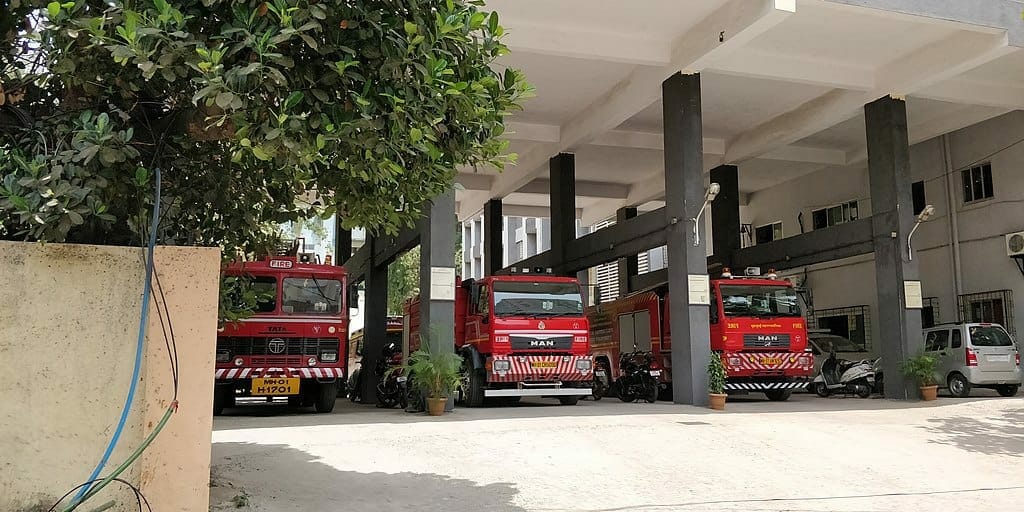
“In Mumbai we have 35 fire stations and 18 mini stations which have been added to reduce response time. We will also launch fire bikes to reach the sites faster and at an early stage. We have a 2500 strong force and necessary equipment. There is a need for awareness. We are stipulating fire safety requirements at the planning stage and issuing NOC for construction only after they are met. But we find that the system is not maintained over time. Non-maintenance is a key issue that must be addressed by the residents.” said Hemant Parab.
What should change?
Mumbai fire brigade’s tallest ladder can reach 90 mts, or 30 storeys, but there are buildings much taller, at 150mts or 50 storeys. “The permissions granted to these buildings is the problem. But putting a cap on the number of storeys is not a way for development. What we need is better safety machinery, taller ladders, as the ones in Hong Kong and New York.” says Chandrashekhar Prabhu.
According to Hemant Parab, if sprinklers and other fire-fighting systems are maintained, even in high rises, fires can be contained. The building needs to have adequate provisions to fight fires itself, such as detection systems, chutes, etc, so evacuation can begin.
On granting permissions to develop high-rise buildings, Chandrashekhar Prabhu said, “ultimately, the fire fighting personnel are at the forefront, not those who grant permissions. This is an urban planning issue which the fire brigade doesn’t have much of a say in. Planners and designers are aware of what must be done to make the fire brigade’s life easier.”
“Fire safety mechanisms must consider the psychology of people in panic and design systems in such a way that the instructions are clear. We instruct societies to conduct mock drills and comply with Fire Act and install necessary equipment to fight fires, which can be used by both residents and fire brigade” he added.
“The BMC carries out random inspections and issues notices where there are irregularities. If they don’t submit a compliance report, we carry out legal action against them. License agencies appointed by the state government carry out safety inspections and submit the findings. This has to be done by each and every building. This is a third party audit,” said Hemant Parab.
According to Hemant Parab, in Mumbai, it is not just a question of awareness but also a matter of people defaulting on their taxes and contribution towards maintenance of apartments. “This shows an apathy towards safety,” said Chandrashekhar Prabhu.
However, some efforts to raise awareness towards fire safety have begun. “Awareness drives must reach each and every resident. Fire volunteering programs take place every Saturday to train residents through the Agni Rakshak programme. More people should participate in these efforts.” concluded Hemant Parab.
It is imperative to gain the participation of experts and people in the field, when discussing such a topic. The vibrant participation from our audience, readers and concerned citizens made the event a success. This panel discussion was not meant to be a one-time event, but a starting point for the work that must be done in order to address the pressing urban issues in the city.