Once upon a time, Kudi Kunta lake, one of the oldest lakes in Serilingampally mandal, hidden among the bylanes of Masjid Banda, Kondapur in Hyderabad, was a drinking water source for thousands of residents living around it. But as has happened in many cities, this fresh water source has largely disappeared due to decades of neglect and waste dumping.
Spread across 8.04 acres (as per the Greater Hyderabad Municipal Corporation (GHMC) survey of 2014, the freshwater lake (Lake ID 3742) used to be an aquatic habitat and occasional home to migratory birds. Not any more. Dumping of toxic wastes, garbage and untreated sewage inflow from nearly residential colonies have now made the Kudi Kunta lake, also called ‘Gauthami Lake’ in HMDA (Hyderabad Metropolitan Development Authority) records, a stinking, green water body covered extensively with water hyacinth. Interestingly, this is listed as a ‘swimming lake’ in Google Maps.
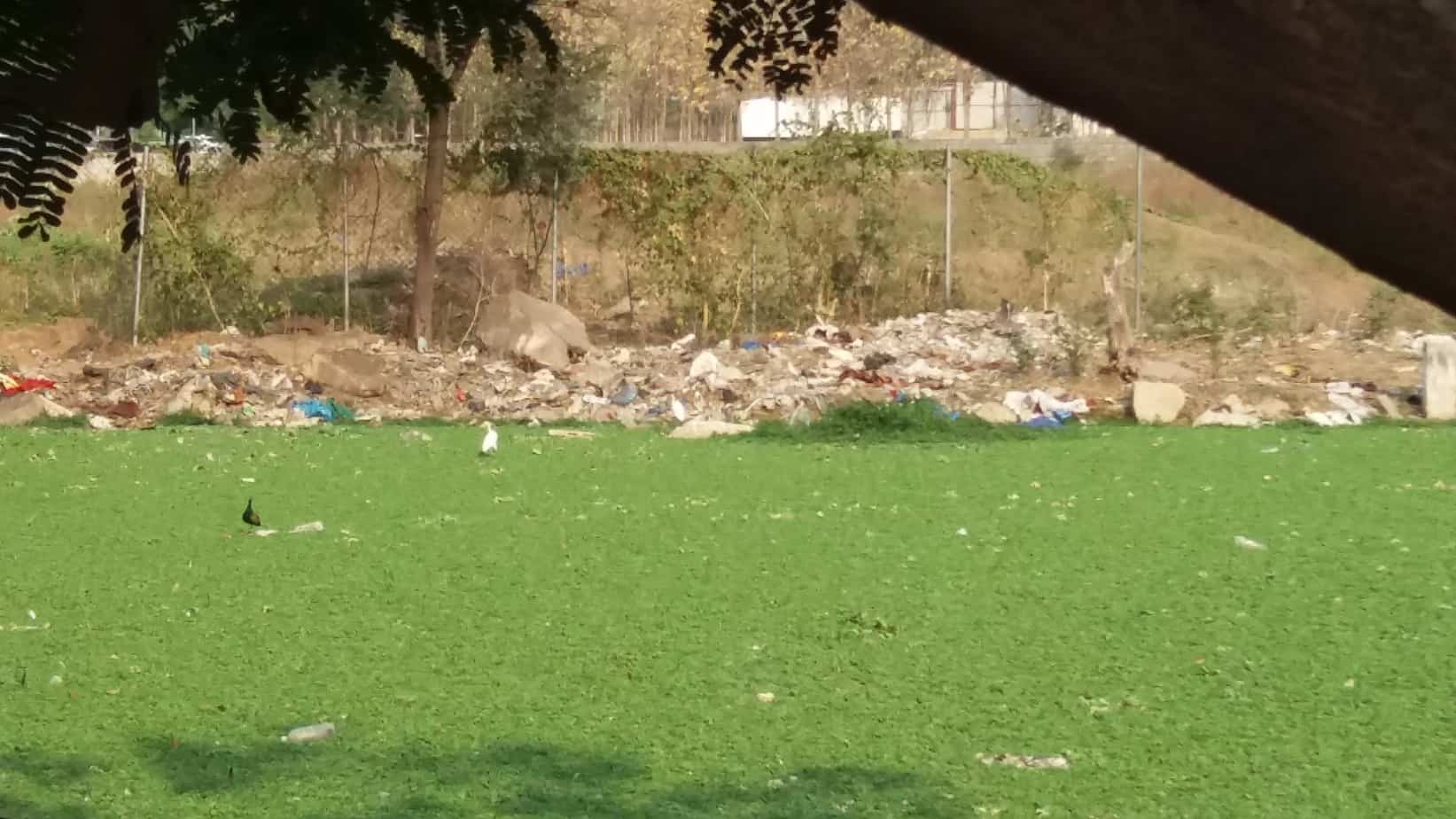
The Kudi Kunta Lake, also referred to as Gauthami Lake, has been reduced to a stinking, green water body infested with water hyacinth.
The sorry state of Kudi Kunta lake is emblematic of the state of Hyderabad’s fresh water bodies, that has now resulted in a major water shortage in the city. The Hyderabad Metropolitan Water Supply and Sewerage Board (HMWS&SB) is planning to supply water from the city’s two main reservoirs, Osman Sagar (popularly known as Gandipet) and Himayat Sagar, to meet water shortage in city areas like Rajendranagar, Gachibowli and Serilingampally, the mandal in which the lake is located. Incidentally, I live near the lake and for the first time since moving to this neighbourhood some years ago, am having to buy water from tankers on a daily basis; residential complexes that have swimming pools have shut them down.
Destination for sewage
Rita Shah (name changed), a local resident, said untreated sewage and solid waste flowed into the lake from commercial establishments and residential colonies in Masjid Banda and Sriram Nagar areas. “A significant number of residential apartments around the lake do not have a Sewage Treatment Plant (STP) in place,” said Sunil Rao (name changed). Many of these apartments were constructed after the amendments to the Environment Impact Assessment (EIA) Notification, 2006, under the provisions of the Environment (Protection) Act, 1986, issued by then Ministry of Environment & Forests (MoEF), which makes STPs mandatory for apartment complexes.
Residents from a gated community near the lake were against installing an STP now because of the additional cost they would have to bear whereas the builder should have originally borne the cost. Many of them also had a notion that the market value of their property will fall if an STP is located within the complex premises. How did the building get a No Objection Certificate from the GHMC without an STP, they asked?
When some residents of Rita’s apartment complex, which does not have an STP, approached the GHMC to connect their building’s sewage line to the main sewage line, they were asked to pay approximately Rs 6 lakh for the re-routing. Rita also pointed out that the lake, surrounded by buildings on one side and a broken-down fence on another, is easily accessible to all. “There are nefarious activities in the lake’s surroundings during the nighttime,” said Rita.
What’s the government doing about it?
Citizen groups have tried to get the authorities to clean up the lake and prevent immersion of Ganesha and Durga idols (made of inorganic materials) after festivals. Not surprisingly, the lake has become a breeding ground for mosquitoes and a source for release of toxic gases into the atmosphere. Baida Ashok, Founder & Chairman, NGO, Working on Human Development Index, who lives near the lake, raised this issue through an RTI with the GHMC. The response, from the Senior Entomologist, UMS West Zone, dated January 1, 2018, claimed that the entomology wing is undertaking regular edge cleaning works and fogging and anti- larval operations. The residents around the lake say they have seen little evidence of such activity and are sceptical of such claims.
Some long overdue restoration measures were started in early 2018 jointly by an NGO, the Society for Advancement of Human Endeavour (SAHE), and GHMC, with financial support from a corporate foundation. The clean-up effort included installation of bio-oxidation and solar powered aerators in the lake. Students from a nearby government school also participated in the conservation drive. But there has been no sustained follow up after that, except for an occasional effort by the administration and people living near the lake to clean up the water body.
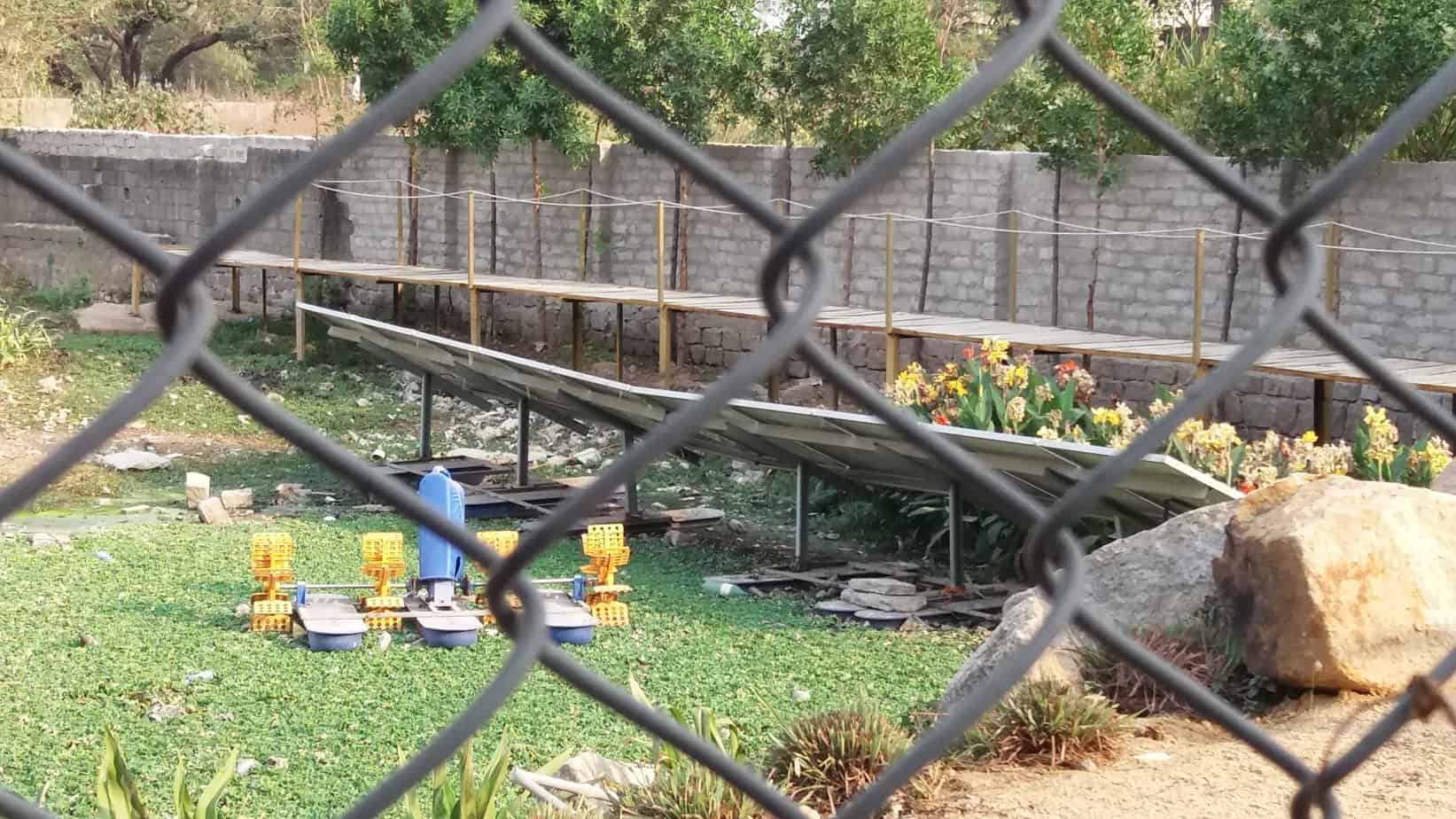
Solar-powered aerators installed as part of clean up efforts.
Interestingly, restoration of Kudi Kunta lake was included in the manifestoes of all the local candidates during the November 2018 assembly elections. Yet, none have followed up on their manifesto promises and it has been up to concerned citizens, like Baid Ashok, currently campaigning for the BJP, who has filed a number of RTI applications with various authorities, to push the government into initiating some clean up action. Going forward, “we intend to file an RTI for information if any budget has been allocated for the diversion of the sewage lines flowing into the lake, and its restoration and management for 2019-20,” said Baida Ashok.
Last January, in response to another RTI from Baid Ashok, the Deputy Executive Engineer of the North Tanks division of the Irrigation and CAD Department (ICADD), had said that drainage lines leading into the lake would be removed and connected to the main drainage line so that only stormwater flowed into the Kudi Kunta lake. The state government added it planned to develop all the water bodies in GHMC area in a phased manner and had asked the GHMC and the HMDA to work on 44 lakes at an estimated cost of Rs 541 crore. Promises that remain on paper.
High Court directions
Barring the occasional one-time effort, like in 2018, and despite all the administration’s assurances, the core issues of sewage discharge and garbage dumping in the lake is not being addressed. This is even after the High Court had intervened in September-October 2018, directing the nodal bodies to prevent pollutants entering the lakes. “The court wants the government to ensure that the lakes are resurrected, replenished and activated. Beautification is not important now. Select about 10 lakes and inform the court about the steps taken to retain its originality,” the court had ordered. The court is still waiting for a response.
While laying the foundation for the development and beautification works of 40 lakes at Neknampur on April 14, 2018, K T Rama Rao, then minister for Municipal Administration and Urban Development had promised that lakes would be restored by clearing water hyacinth and preventing other pollutants, especially untreated sewage, from entering the lakes.
The minister had further directed officials to ensure that residential units with more than 100 flats construct STPs with the cost borne by the builders. Yet, Kudi Kunta lake is surrounded by residential complexes without an STP. And no allocation was made for Kudi Kunta lake’s maintenance during 2016-2018 by the GHMC irrigation wing.
Meanwhile, the Hyderabad Metropolitan Water Supply and Sewerage Board (HMWS&SB) is seeking Rs 25,000 crore from financial agencies and banks to implement a slew of projects like the sewerage master plan, strengthen the drinking water pipeline network, constructing the ring main pipeline on the Outer Ring Road (ORR) to supply Krishna and Godavari water, and build new reservoirs at Keshavapuram and Devalamma Nagaram.
Citizen involvement
Resident associations and citizen collectives like Save our Urban Lakes (SOUL) have been campaigning for the restoration and preservation of not just Kudi Kunta but all the city’s lakes and water bodies over several years. SOUL has made numerous representations to the government on this, emphasising that active, continued and responsible monitoring needs to be given utmost priority.
“The three key elements for any long- term plan are protection, preservation and rejuvenation,“ said Chakri S, Convenor (2014-15), of SOUL. “Local residents need to play an important role in the restoration and management of a lake.
One possibility is to learn from the “Village Pond” approach in which villagers are all equally responsible for the upkeep of the pond. The entire community in an urban setting has to collectively take ownership of the lake nearest them and fiercely guard and conserve it”. But, as Dr. Jasveen Jairath, a water sector professional, and Convenor (2010-11), SOUL points out, this is only possible when there is a “large-scale awareness, sensitization to the factors affecting depletion of lakes and advocacy of government legislation to protect lakes.”