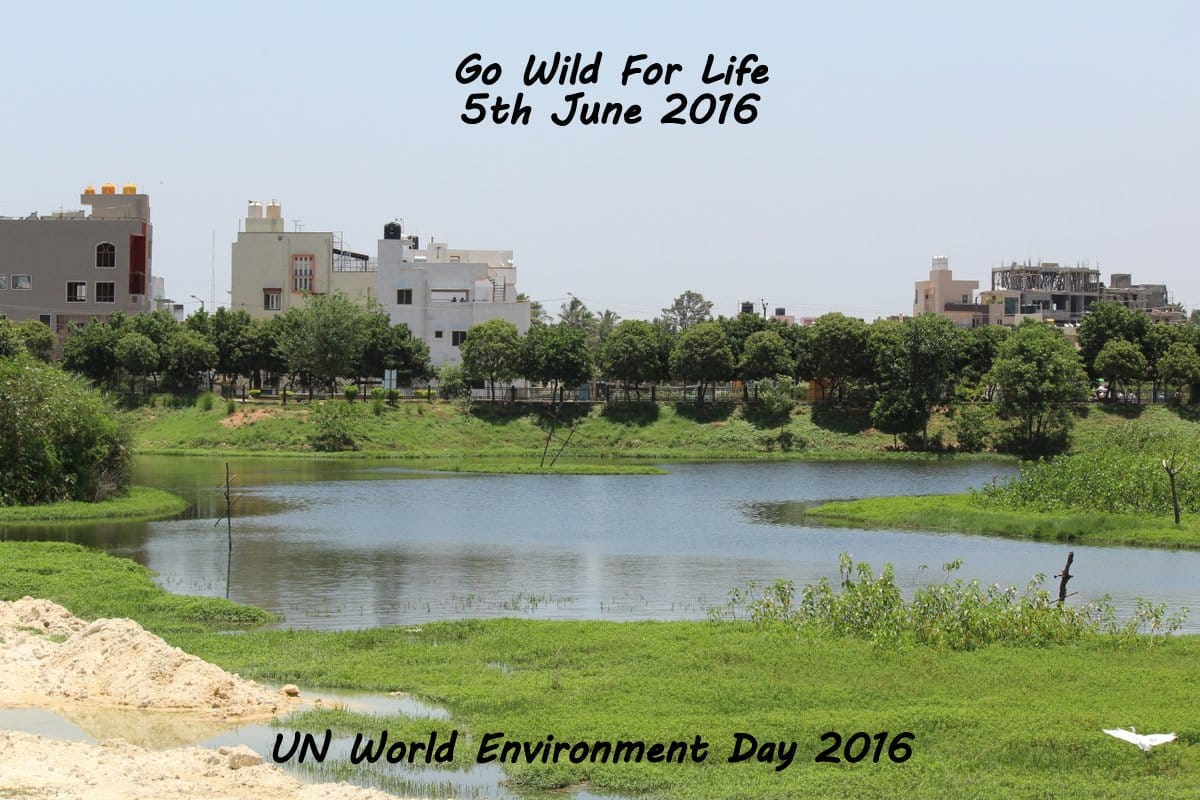
Greetings on World Environment Day

To all our friends,

Puttenahalli Lake, May 2016

For many of us, every day is Environment Day. Still, it feels good to see the whole world pause on 5th June every year and focus on raising awareness about environmental issues and concerns.

From the World Environment Day website

“This year’s theme for WED – Go Wild for Life – encourages you to celebrate all those species under threat and take action of your own to help safeguard them for future generations. This can be about animals or plants that are threatened within your local area as well as at the national or global level – many local extinctions will eventually add up to a global extinction! Whoever you are, and wherever you live, show zero-tolerance for the illegal trade in wildlife in word and deed, and make a difference.”

Some of you may be aware that I am currently not based in Bangalore. I was there recently for the summer holidays and managed a few visits to the lake. It was thrilling, to say the least, to see so much water. Also, I finally got to see some of the birds and flowers at the lake, that I had seen only in photographs shared by others. I spent a fair amount of time watching the beautiful Spot-billed Ducks and took lots of pictures. Some of these are in my blog posts… birds and flowers that may be considered commonplace, but important in the lake ecosystem. For those who have not had a chance to visit the lake, here is some of what you will see when you do.    

https://arathimy.wordpress.com/2016/05/25/residents-at-puttenahalli-lake/ https://arathimy.wordpress.com/2016/05/24/in-bloom-at-puttenahalli-lake/

Here’s hoping that the theme for this year’s WED stays with you for ever. Read more on the WED website here.p

Best wishes,

Arathi

(for the PNLIT Team)

Leave a Reply

Your email address will not be published. Required fields are marked *

Similar Story

Mumbaikars are fighting for their mangroves. Here’s how you can join them

Mumbai is about to face a monumental loss—its mangroves are being cut to build the coastal road. Citizens, however, have not given up the fight to save them.

​“What happens when we remove this natural infrastructure of the city? What happens if it floods? What happens if the air quality (index) goes really high?” asks Pooja Domadia, a member of the Save Mumbai Mangroves campaign. These are questions that many Mumbaikars have as work begins on the Versova-Bhayandar Coastal Road, which is set to affect 45,000 mangrove trees. In March this year, the Supreme Court dismissed a petition challenging the Bombay High Court order to greenlight the cutting of mangroves for the project. Is the SC decision a fatal blow to the movement? The BMC has already begun…

Similar Story

Where are the pollinators in Bengaluru?

Despite the volumes of citizen-generated data on the city's biodiversity, pollinators who sustain the urban ecosystem do not seem to be getting their due attention.

Urban biodiversity is often discussed in terms of tree cover, lakes, or flagship species, but far less attention is paid to pollinators—the insects and birds that quietly sustain urban ecosystems. In Bengaluru, a rapidly urbanising city with a strong culture of citizen science, large volumes of biodiversity data are now being generated by the public. But what does this data tell us about pollinators in the city? This article draws from a data jam hosted by OpenCity in Bengaluru that explored pollinator observations using publicly available, citizen-generated datasets. By analysing long-term observation records and spatial data on land use and…