Goodbye Bengaluru, thanks for reading!

Ten weeks have flown by and my internship with Citizen Matters has come to a quick end. Tomorrow, I will board a flight, but I will not be leaving India just yet. I am looking forward to three weeks of travel around the subcontinent to see what else this country has to offer.
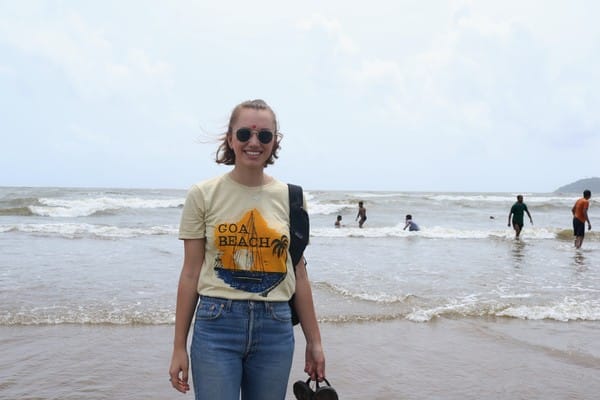
The author on the beach in Goa. Pic: Kate Clark

But soon enough, I will be struggling to nap on 16-hour flight back to Dallas, Texas.

When I picture exiting the Dallas Fort-Worth airport, driving a few miles toward my parent’s house in suburban Texas, I can already feel the culture shock.

I’ll see cows grouped behind wooden fences on the Texas country side and I’ll think of Bengaluru’s cows, so autonomous, though quite cumbersome. I’ll see Americans gripping their venti Starbucks cups and I’ll think of my roommates in Bengaluru, who subtly mocked my large coffee intake. I’ll see cars moving at an appropriate pace (as in not at a constant standstill) and drivers staying in their lane. I won’t hear a constant stream of honking – that I look forward to most. The “Indian food” will consist of naan and tandoori chicken, I’ll have to hunt for some decent South Indian grub. I will walk down empty streets and think of Bengaluru’s packed, excited, alive alleys.

I’ll miss Bengaluru.

Moving to a foreign country is one thing, but moving to a city 10 times the size you are used to makes the experience feel even more foreign. I’ve adjusted to the hustle and bustle, to omnipresent noise, to people everywhere, all the time.

I know I will come back to India, I don’t know when, but I can guarantee it will happen.

To all who have read my stories and blogs this summer, thanks. I hope you enjoyed them as much as I enjoyed writing them.

Comments:

  1. Srinivas Alavilli says:

    I certainly enjoyed your stories. Best wishes

Leave a Reply

Your email address will not be published. Required fields are marked *

Similar Story

The value of green: Why cities must invest in Nature-based solutions

Nature-based solutions make cities cooler, healthier, and more resilient, unlocking hidden value for people and the economy.

Walk through any city, and you'll encounter Nature-based solutions (NbS) everywhere: urban parks providing respite from hot streets, wetlands filtering stormwater, and trees along busy roads reducing air pollution, among others. This green infrastructure, however, is often viewed through a narrow lens—as mere providers of shade, picturesque spaces, or recreational spots.  This limited perspective has harmful consequences. When development pressures mount or budgets tighten, these natural assets become expendable and are often removed without proper analysis of their multidimensional benefits. This is where quantifying the benefits of NbS becomes essential. By measuring and monetising the value these solutions provide, we…

Similar Story

Encroachment and drainage woes: Lessons to prevent flooding in Porur Lake

A study investigates the causes of flooding in Porur, flags the underutilised potential of the nearby sponge park and suggests connecting missing links.

When the northeast monsoon hits Chennai, a foreseeable result of the heavy downpour is severe flooding in several areas, including Porur Lake. As residents living near this 200-acre water body battle inundation every year, our team set out to investigate the root causes of flooding using available data. Environmental issues have often been dealt with a one-size-fits-all approach, but our study aimed to provide specific solutions tailored to the Porur catchment area. For this, we mapped inundation patterns, land gradient, land use change and the outlay of stormwater drains (SWDs).   At a recent datajam organised by the Oorvani Foundation…