It’s a tiny single-room house nestled among similar dingy structures in a slum locality in Mangammanapalya. The house is located close to Hosur Road, which was an epicentre of garment workers’ protests that took Bengaluru by storm when the Central government notified rules for Employee Provident Fund (EPF) restricting withdrawal of the PF till the age of 58.
A cot placed on one side of the room occupies half the available space. On another corner is an old TV, the only source of entertainment. There is an open utensil washing-cum-bathing space at one end of the room and a kitchen space on the other side. With all sides occupied, there is hardly any space in between the four walls for even a person to sit down and relax.
When I enter the house a little before 8 am on a weekday, Sharada (name changed) is busy packing her lunch box. She hurriedly pours some rice and sambar on a plate and begins her breakfast. “I just have 45 minutes left to talk to you and get ready. I should leave the house by 8.45, so that I reach the garment factory sharp at 9,” she says.
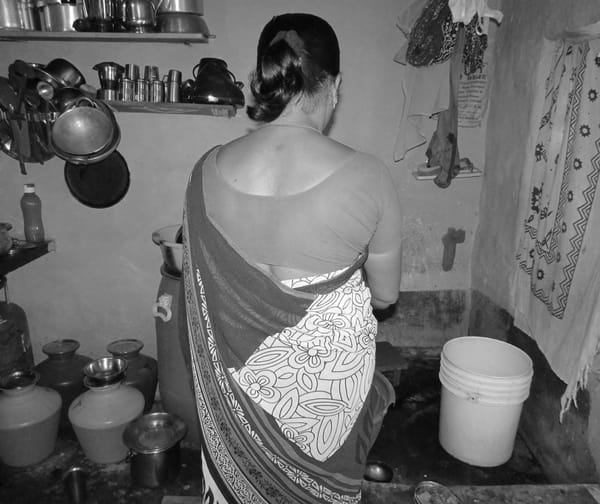
Sharada (name changed), a garment worker lives in a dingy house close to Hosur Road. Pic: Akshatha M
Meagre salary, delayed payments
A slight delay in reaching the factory, even by 5 minutes, would result in salary cut. “They (the factory owners) are very strict. I realise only at the end of the month when I get the salary in hand that my salary has been deducted because of delayed arrival,” she says. Garment factory workers like Sharada cannot afford to lose even the slightest portion of their salary when what they earn itself is meagre.
Sharada is in her early 40s and works in a branded garment factory near Hosur Road. Having been in garment industry for seven and half years, Sharada used to earn a monthly salary of Rs 7,000, till last year. Of the total salary, she used to get Rs 6,000 in hand after deductions. A year ago, the company she works for gave a salary hike to all the employees and her current salary is Rs 10,000. Of this Rs 1,100 is deducted for Employment Provident Fund and ESI.
Once in a while Sharada works Over Time (OT). She gets an additional Rs 500 for the extra work. But the problem is with the payment. “Though I am supposed to get the salary by first or second of every month, the company delays it by 10-15 days, for reasons I don’t know. Even if I work on OT, they delay in making payment. They pay the amount after 2-3 months,” she tells. Delay in payment has left Sharada helpless. She can’t really plan additional expenses in advance.
In search of livelihood
Sharada, who hails from a village in Vellore district in Tamil Nadu migrated to Bengaluru 13 years ago. She lives with her husband in the same dingy structure ever since she shifted to this city. She left behind her two sons back home in the custody of their grandparents, due to lack of space at their small dwelling.
There is no running water and toilet facility at her house. She and her husband use neighbour’s toilets and depend on nearby houses to get water everyday. The common toilet in the neighbourhood became defunct three years ago. The water supply stopped 10 years ago.
“We are struggling to live here. How do we even tell our sons to come and live with us?” she asks. While her elder son is a truck driver, younger one is a student. “Younger son goes to college, but I have no idea what he is studying. I have never been to school and I don’t understand all these things about education,” she trails. But, she diligently pays her son’s college fee which runs up to a few thousands every year.
Whatever that Sharada and her husband—a vegetable vendor—earn, is spent. They are oblivious to the concept of saving. In fact, there is nothing to save, she says. Of the amount they earn every month, Rs 1,000 goes for house rent, Rs 5,000 is meant for household expenses and rest of the money is sent to their family in hometown and to her son’s education.
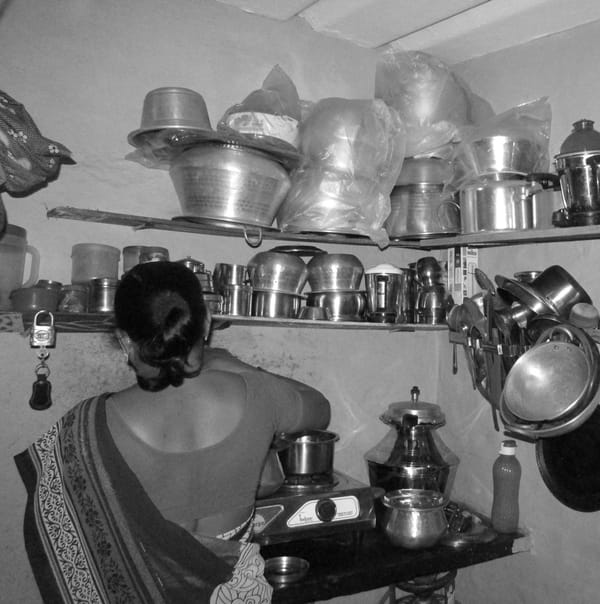
She finishes her house chores in a hurry so as to reach the garment factory at sharp 9 AM. Pic: Akshatha M
Ordeal of working in garment factory
So how is the life in the garment factory? “It’s bad,” she says. “We work like machines,” she grumps. Sharada is a tailor in the garment factory and stitches mainly men’s shirts. Her hourly task is to stitch 100 pieces. “My productivity is not the same anymore. I can only stitch 80 pieces in an hour,” she says. Not meeting the deadline draws the wrath of the supervisor. “They abuse us very badly,” she adds.
This whole thing of working in garment factory for about 8-9 hours everyday, has taken a toll on Sharada’s health. In last two years she has developed severe back pain, continous sneezing, sweating and fever. “Look at my face, it’s swollen. It was never like this before. The doctor has suggested me to quit the job. But what do I do after quitting the job?” she asks.
I ask her why work in garment factory, why not find some other job. She says she is used to this work now and has no other job skills. “I am uneducated. When I was in need of a job, I got placed in a garment factory quite easily. After working all these years, I am used to this work and don’t see any alternative,” Sharada tells.
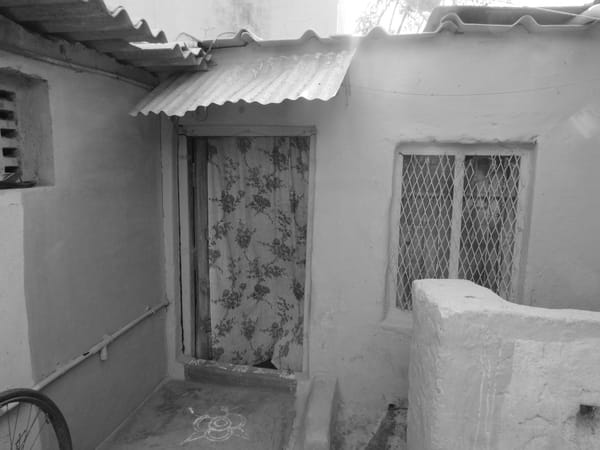
The small single room house is located in a lane with similar structures at Mangammanpalya. Pic: Akshatha M
EPF = Emergency Pocket Fund!
So, how has this PF issue affected her? Is she even aware of all this?
Of course, she is! After five years of joining the work, Sharada withdrew her PF amount in 2014. A substantial sum of Rs 70,000 helped her pay her son’s education and other emergency expenses. “After one and half year gap, this month I planned to withdraw PF again. I decided to quit my job, avail the amount and then search for a new job. But with the recent news of the employees being entitled to avail only partial PF, I am confused. Not sure what to do,” she says.
The amount, even if it is as less as Rs 25,000, would help her to a great extent at this point of time. The reason: she has to shift her dwelling. The owner of the house where she lives now has decided demolish it and construct an apartment. Sharada was told to vacate the house three months ago.
“We have been searching for a house, but haven’t been able to find a house with a rent less than Rs 4,000. We can’t afford to pay so much. If I withdraw the PF money, I will at least be able to pay the deposit for a new house,” she tells.
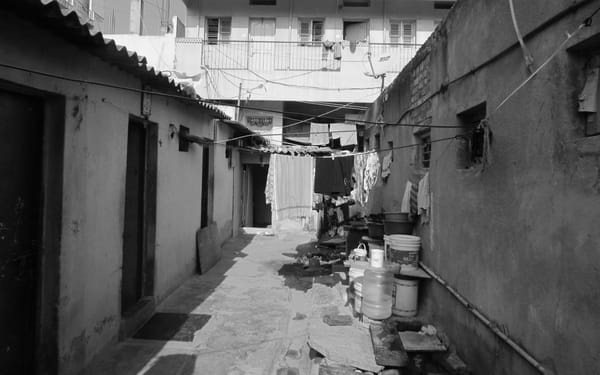
Sharada is in search of a new house, as the owner of this slum has decided to demolish the structures and give it to a developer. Pic: Akshatha M
Those like Sharada have reason to get anxious and angry when the government makes a new rule such as the one on provident fund withdrawal. The new rule would have made the life easier for employees post-retirement, but that really doesn’t matter for a large section of employees like Sharada who belong to the low income group.
I ask her about her future plans. She says she has never thought about it and frowns “whatever I earn, I spend. May be I will quit my job forever when my health gives up. I have never thought about my life post-retirement.”