The handover process with all its financial, operational and technical aspects can be hard to nail down. Yet, it is the most pressing challenge as an association prepares to run the affairs of a community.
Issues like late handover and defects within the apartment are common complaints of most individual apartment owners taking possession of their new property. At an association level, however, issues are even more complex and often ignored. The issues range from major defects, incomplete construction, lack of documentation, improper handover of maintenance corpus etc.
In a new apartment, a freshly constituted Association’s Managing Committees (MC) may lack awareness or resources or both. Issues blow up a few years down the line, often necessitating the Association to spend a large amount of money with no or minimal support from the builder!
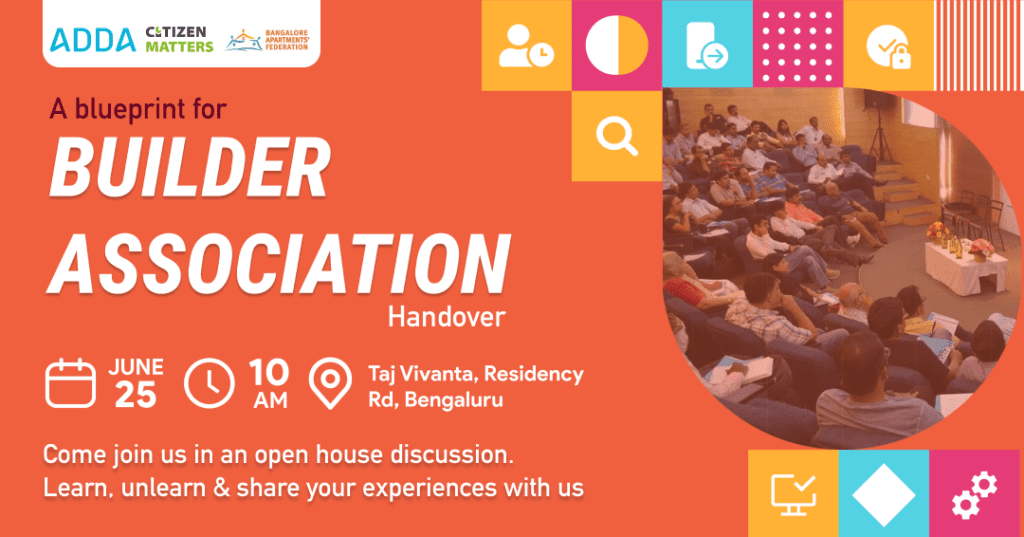
ADDA in collaboration with Citizen Matters and Bangalore Apartment Federation (BAF) is hosting an event which focuses on practical insights, comprehensive checklists and how-tos on the handover management landscape. The event is targeted toward RWAs and housing societies that are either in the process of undergoing or about to undergo builder handover.
Read more: Apartment management: Before the builder hands over
A typical multi-storied apartment building (or complex of many buildings) is a collection of multiple elements, each of which is integral to maintaining a proper quality of life for residents. It is essential MCs follow proper processes while taking over – from documenting information, to using the right tools to manage the complex to performing an audit before warranties end.
- When: Saturday, 25th June 2022, 10 am
- Where: Vivanta Bengaluru, Residency Road, Bengaluru
- Register: http://link.adda.io/workshop
Read more: Apartment management: How to avoid problems post handover
Agenda
- A checklist for builder handover
- Builder handover: Digital practices and global perspectives
- Guide to handover audit
- Panel on operational aspects during takeover: Inputs from customer service experts and MC members
- Panel on legal and regulatory considerations during handover: Inputs from developer representatives, RWAs and legal experts
Participants include Uday Simha Prakash (Founder, Nemmadi), Satish Mokhashi (VP, Prestige Property Management and Services), Rahul Raj (Director, RM Consultants), Ajith Alex George (Director, 42 Estates), Col. Narsimhan (Brigade Group) and Mithun Gerahalli (Lawyer). Experienced apartment association resources include Iswar Dixena, Gautham Kamath, Hareesh Sivaraman, Arathi Manay, and Meera K will also be part of this.