As the city lights are dimmed and the world, as most of us know it, sleeps, Shilpa Kumari (name changed) went out for work. She stood at the corner of one of the sleepy lanes of Ashok Nagar, with layers of makeup, a cleavage-exposing blouse and a firm attitude and panache, that were clearly not affected by the remarks of passers-by. However, whenever the social workers from the Tamil Nadu State AIDS Project Cell (TANSAC) tried to talk to her, she would turn defensive, and chide them. “Who says I am a sex worker?” was the constant refrain. It took more than a year for Seenu alias Sneha, a transgender field worker with TANSAC to get Shilpa to agree to a screening for HIV.
Seenu did not give up on educating Shilpa; he sensitised her about the symptoms of HIV (severe weight loss and diarrhoea among others) and advised her to never skip using condoms. It was only when Shilpa experienced the symptoms that she agreed to go to the HIV testing centre at Rajiv Gandhi General Hospital. She tested positive.
It is such gaps, such challenges of getting to the vulnerable sections in time, that are thwarting attempts to rid the city of new cases of HIV infection.
“The stretch between Vadapalani, Koyambedu and Saidapet has around 350 sex workers. A majority of them work as small-time artists in Kollywood and get into the profession to earn some additional money,” said Seenu.
“A few customers in the movie industry are against using condoms; they even agree to pay extra. They convinced me by saying that they were healthy. Today, their ignorance has led to my days being numbered,” rued Shilpa. Refusal is not always an option. “There won’t be work every day in the industry. Even on the days we work, the pay is a meagre Rs 300,” she explained.
Reaching where it matters
At least two out of ten sex workers in Chennai are HIV positive, says Seenu. According to R Selvam, District Programme Manager of TANSAC, Chennai records an average of 50 new cases every month, the majority recorded among high-risk groups: sex workers, Men having Sex with Men (MSM)and those resorting to Injection Drug Use (IDU).
There is some good news, though. Yearly statistics on new HIV cases in Chennai shows a declining trend — data from TANSAC shows that the total number of new HIV cases recorded in Chennai has been steadily decreasing over the past six years: the prevalence rate has decreased from 0.55% in 2014-15 to 0.28% in 2018-19. 489 out of 187548 individuals tested turned up positive results in 2019-20, as against 1106 among 200471 in 2014-15. This year (May-October 2019), the incidence stays flat at 0.26%.
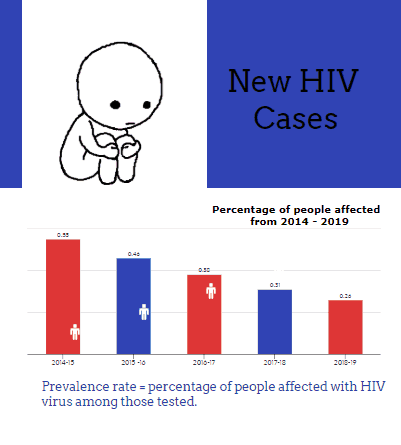
Data source: TANSAC; Illustration: Laasya Shekhar
However, it is still a challenge for the social workers of TANSAC to make the vulnerable communities (as identified above) take preventive measures.
Peers can play a big role. Shilpa is now educating her fellow sex workers about compulsory condom usage and the importance of periodic check-ups at HIV testing centres. But, as Seenu says, identifying such peer educators as Shilpa is a challenge in itself, given the social stigma.
The same stigma acts as a barrier when it comes to spreading the message among other target groups — IDUs and MSMs. Out of 1,700 IDUs screened by TANSAC in association with the Hoper foundation, 14 tested HIV positive.
“We just need to identify one group of MSMs or IDUs; they can, in turn, help in identifying more such groups. It is a time-consuming process to connect with them with the government (TANSAC). We advise IDUs to not share needles and MSMs to use condoms,” said Seenu.
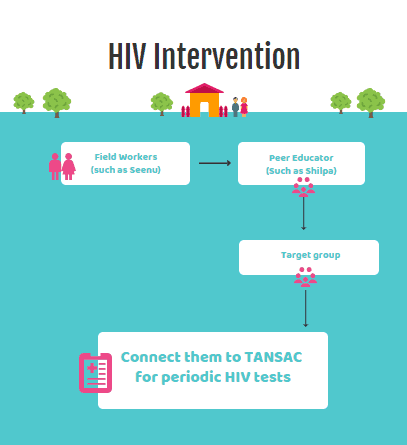
Data source: TANSAC; Illustration: Laasya Shekhar
What the numbers say
- A majority of HIV positive patients are those among the age group of 25-35 years. Officials say that this age group, being independent and married, often indulge in unsafe sex practises. “Sterilisation is only for family planning, it doesn’t prevent the transmission of sexually transmitted diseases,” Selvan explained.
- Between 2005 and ‘10 the prevalence rates were higher among males than females; however, during 2010-19, the rates were almost equal.
- A considerable number of senior citizens tested positive for HIV virus, due to late detection.
Right policy, Right way
Proactive initiatives of TANSAC deserve a mention while discussion in the reduction the number of new HIV cases in Chennai, despite the increase in population. The department has been conducting back-to-back awareness sessions about preventive measures. “This year, we have spent Rs 120 crore on awareness programmes alone, because that is the only way to bring down the virus transmission,” said R Selvam.
There are 155 HIV testing centres in the government and Public Health Centres of Chennai such as Stanley Government Hospital, Chromepet Government Hospital and Rajiv Gandhi Government General Hospital. Red Ribbon Clubs have been started in 72 colleges of Chennai, which work to heighten risk perception among individuals, create awareness on safe sex and other modes of preventing HIV infection.
TANSAC is also imparting life skills education among 11th and 12th class students in Corporation and Government schools of the city.