Katta in collegian Marathi refers to a hangout.
The Cycle Katta is a platform designed for freewheeling discussions on everything around cycling. It seeks to inspire people by getting phenomenal achievers speak of their feats. It tries to educate them about nuances on health, nutrition, technical aspects and also how public policy looks at their activity. It also aims to build a better network of informed cyclists.
It is a completely volunteer-driven initiative with once a quarter meetings, and depends entirely on the largesse of the society – which stands to benefit if cycling grows – for the physical space where the meet-up is held. There is no commerce involved of any kind – no entry fees and no honorarium to guest speakers – involved, and the expenses like tea and snacks are borne by a small group of people.
Inspiring conversations on cycling
In the last eight years, there have been nearly two dozen of such meet ups. They are typically attended by about 100 people and have also gone up to over 250, when we had a high profile guest like actor Sonali Kulkarni.
The Katta is not a cycle ride organiser but a platform to exchange thoughts on cycling alone. It has hosted diverse set of people including urban planners, cycle groups around Mumbai, the (unelected) cycle mayor appointed by a Dutch company, the person who got randonneuring to India and helped popularise endurance cycling among amateurs, and also cycle builders who have tinkered with various materials including Bamboo to create cycles.
To inspire people, the platform focuses on getting cycle tourers, who have inspirational tales to share, like a group of curious college students from Pune who planned a tour in Chhattisgarh, their abduction by the Maoists and subsequent release, or some women riders, who have done long rides in India.
Resuming Cycle Katta post pandemic
The Katta is designed as a very intimate gathering for free flow of conversations. In a way, the physical, in-person meet ups are necessary. The Covid-19 pandemic impacted us, as the lockdowns made meetings impossible. We met online, put up a few cycling tutorials to reach out to the nearly 3,000 people who follow the Cycle Katta page on Facebook.
For the first time since the ebbing of the pandemic, a Katta meet-up happened at CBD Residents Agro Society, a garden in Belapur CBD entirely developed and maintained by local citizens.
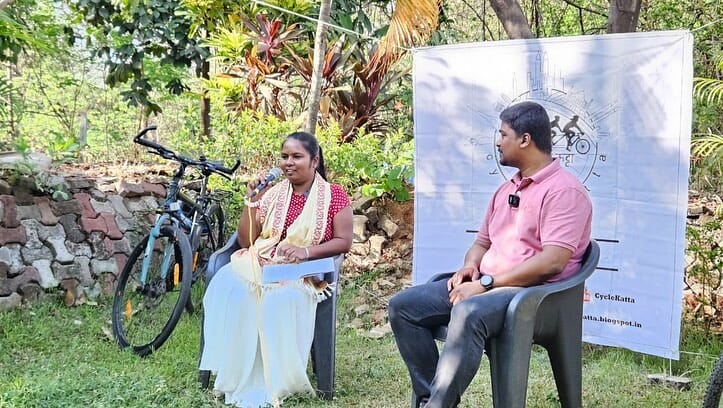
We had invited Pune’s Shashwati Bhosale to speak about her experiences of cycling solo in North East India for a period of four months, and also in the Andaman And Nicobar Islands. There was immense excitement to attend the Katta and we could also connect with newer people as the meet-up happened in Navi Mumbai for the first time.
The response at Belapur, a new venue for the Cycle Katta, was encouraging and helped establish the importance of physical meet-ups and introduced us to a newer set of people. Most importantly, it has motivated us enough to continue holding such meetings with plenty of informal discussions, an integral part of every Katta. We hope it will yield in more cycling in the future as it has in the past.
Read More: Building a culture of cycling in Mumbai
Encouraging cyclists through Cycle Katta
In the past, people have connected with like-minded enthusiasts for cycle tours or learnt some simple tricks to make their cycling either in cities or outside more simpler by attending the Katta.
A cyclist is looked at with contempt on the road, they are a nuisance. The cyclist feels vulnerable and unwanted, and we have often gathered that attending a meet-up like this inspires them enough to keep at it. Hearing from policymakers and urban planners also helps them understand how their presence on the road is desired in a very utopian way, and understanding the specific nuances about cycling in policy making arms them with essential knowledge to hold an argument better.
The Katta plans to continue with the same objective in the future as well, without compromising about its core principles, not getting enamoured by the marketing dollars which the cycle brands have at their disposal, and keeping to incrementally increase bicycling in every form in our society.