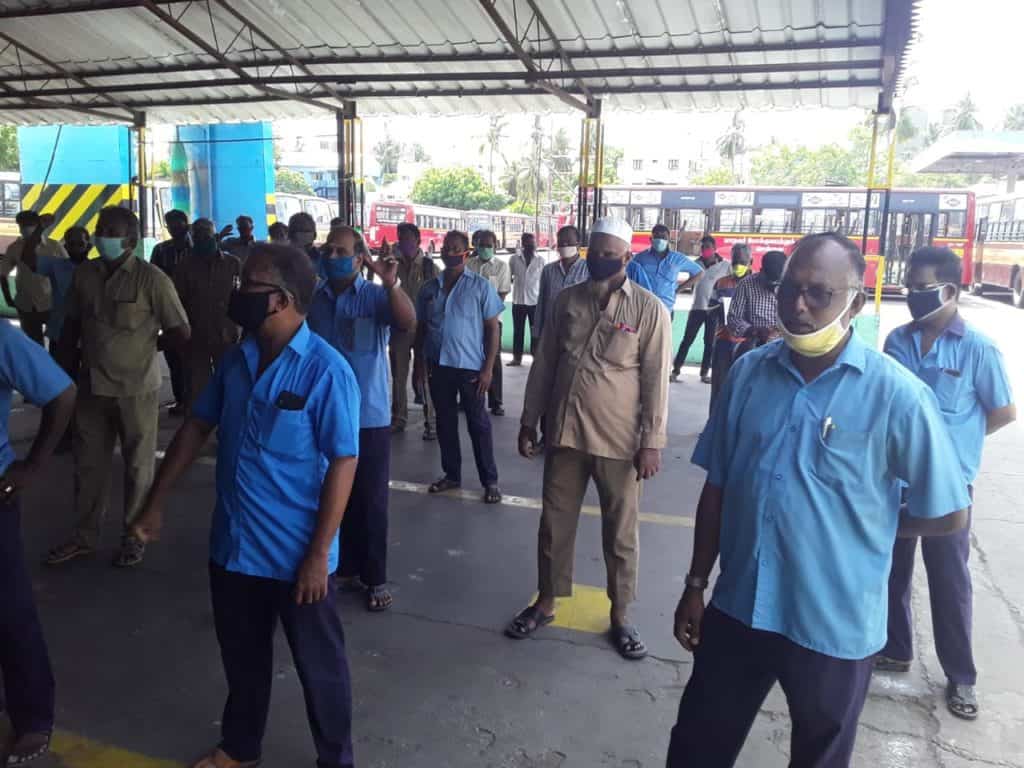
On the morning of Monday, June 15th, around 2000 drivers, conductors and mechanics belonging to the Metropolitan Transport Corporation (MTC) staged a protest in 33 bus depots of Chennai. Thousands of front line workers — conservancy workers and officials from government officials, also from the state secretariat — were stranded due to the non availability of buses. MTC has not yet resumed its services for the general public, but 300 buses are operational to facilitate the commute of front line workers.
But why did the employees protest at this juncture, at a time when the city is struggling to flatten its COVID curve and when there is a dire need for front line workers?
Unexplained salary cuts
MTC has deducted salaries of the employees for the month of April, a move that has created a crisis in the lives of many. While MTC claims to have deducted the amount based on the days of leave availed by the employees, the latter point fingers at the unfair practices of the department.
S Mathi, who has worked as a conductor for 27 years, was shocked to find that only half of the pay due to him had been credited. He has been reporting to work even during the months of lockdown, ferrying frontline workers from Perambur bus depot to the secretariat.
“I do not know the reason for the pay cut. We were given no pay slips explaining the deductions,” said Mathi.
An MTC employee is entitled to a day off in a week, 12 days of casual leave in a year and 18 days of medical leave. In addition, he/she can earn leave by working for 11 days at a stretch. Any other leave taken besides the above amounts to loss of pay.
Workers are shocked that the days that they could not report to work during the lockdown period were accounted for as leave taken and hence led to loss of pay. “We are ready to work even today. We sat at home in accordance with the rules of the lockdown, but that has been used to account for loss of pay,” said V Dayanandham, General Secretary of MTC CITU.
Lack of transparency
In another case, a worker who had been on medical leave for three months reported to work in March. Ten days later, the lockdown was announced and he had no work. “He received only Rs 8000 in April, not even half his salary. Why should workers like him be denied pay if it is the government that has suspended the services?” questions his colleague R Subramani, an MTC bus driver for 31 years.
This scenario prevails not just in Chennai, but across Tamil Nadu. There are many questions that need to be answered.
Why is the transport department indulging in pay cuts all of a sudden?
Is shortage of funds a reason?

MTC workers protest at a bus depot on Monday morning. Credits: Dayanandham
A senior official from MTC responded, saying, “By deducting salaries, MTC saved a mere 1.5 crore in Chennai. It was just a measure taken to ensure accountability among the employees. The salary deduction is linked with the poor performance of the employees,” the official said.
After discussions with some Union members, MTC branch managers had promised to credit the dues for some staff in the first week of June but did not honour the word. Transport Minister M R Vijayabhaskar denied the allegations about salary cuts and said that the employees are paid based on the average performance last year.
“There is no explanation other than that. Why is this happening only to the employees in the transport department?” questions Dayanandham.
Risking lives for what?
Besides the salary cuts, MTC workers who have been providing services to frontline workers during the pandemic are not given any special allowances. Over the past three months, protective gear like masks and gloves were distributed only once; there too, “some staff got only masks but no gloves,” alleged Dayanandham.
A total of four MTC drivers in Chennai have reportedly contracted COVID-19 so far. Their medical costs are, however, covered under the employer insurance.
“Drivers ferrying front line workers are not even paid the special allowance”
V Dayanandham, General Secretary of MTC CITU
Protestors also voiced their concern over the failure to ensure social distancing in the buses. To prevent the spread of the pandemic, the state government announced the mandatory rule of operating buses at up to 60 percent seating capacity only, with all anti-corona norms in place. However, current commuters and MTC staff deny its implementation.
“Each bus should have only 30 passengers according to the rule. But the buses are often crowded, with commuters even standing and not following the norms of social distancing,” says Dayanandham.
According to COVID workers commuting regularly, the buses get filled to capacity at the depot itself and thereafter, at subsequent stops, it is impossible to prevent others, who have been waiting for long and have to report for duty, from getting in. Most feel that unless MTC increases the number and frequency of buses, ensuring social distancing inside the vehicles will remain a pipe dream.
Buses are not disinfected regularly either, allege commuters. A conservancy worker from Alandur zone says that he has never seen a bus being disinfected. “They clean the metal surfaces once every morning before the service takes off. But is it enough?” he asks.