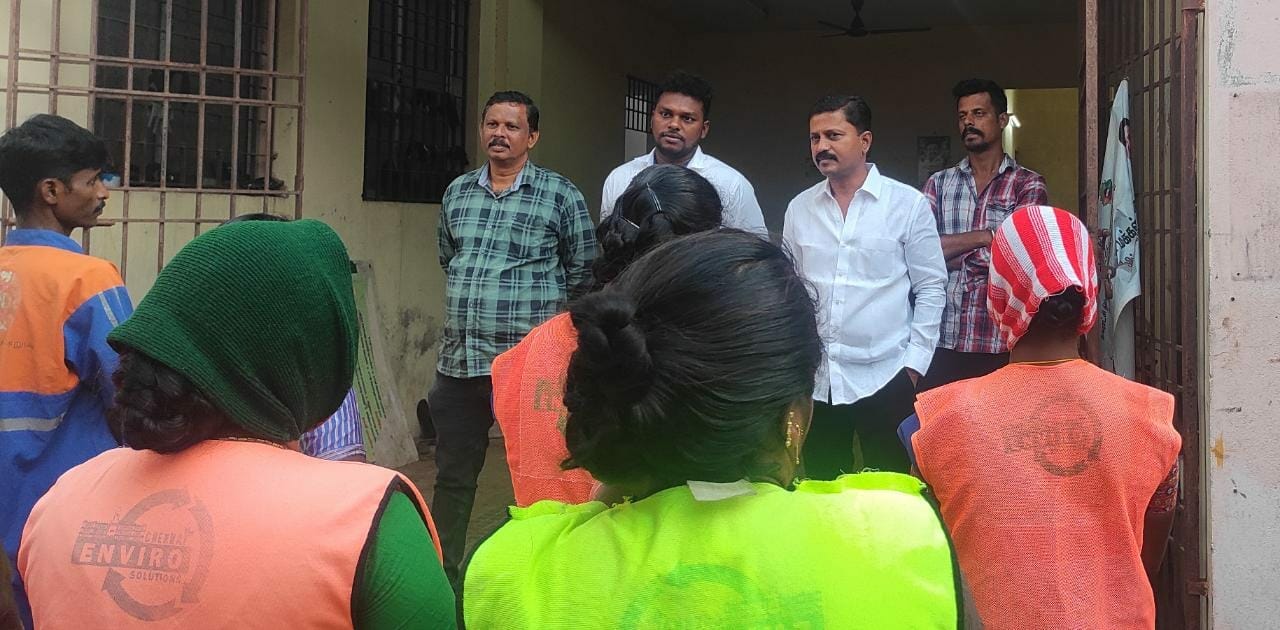
“En ward-u,” says Councillor V Kaviganesan of Ward 12, to the 26 conservancy workers of his ward who are assembled for a meeting at 6 am.
“En veedu,” respond the workers.
This drill lasts three to four times before the conservancy workers leave for work every day.
“My ward is my home” has become the motto of the civic workers in Ward 12.
V Kaviganesan of the DMK says that this is his first stint, and he wants to do his best to serve his people. He is also a practicing lawyer at the Madras High Court at the moment. Both his father and brother have served as councillors in the past.
Ward No 12
- Name of Councillor: V Kaviganesan
- Party: Dravida Munnetra Kazhagam (DMK)
- Age: 46
- Educational Qualification: B.Com, MA, BL
- Contact: 9655422212
Primary goals for Ward 12
What are your immediate targets for Ward 12?
I am working towards making the ward garbage-free. When I got elected as a councillor, I realised that solving the garbage problem would solve most of the civic problems. Therefore, I have been working towards empowering and educating conservancy workers.
We had an 18-day review session where the conservancy workers, ward members and I observed the garbage disposal behaviour patterns of residents. We went to every building and told the people to segregate and hand the waste to the conservancy workers. This has brought a great change in the mindset of people. But we have a long way to go.
Apart from waste management, I am working towards improving the Amma Unavagam, the Primary School and the Urban Primary Health Centre in Ward 12.
I closely monitor the quality and services of Amma Unavagam and have ensured the workers always wear masks inside the kitchen.
Read more: How can we revive Amma Canteens in Chennai?
How has it been working with the officials of different local bodies like the Greater Chennai Corporation?
I am very lucky to work with the engineers and officials allotted to my ward. They cooperate with the civic works I have in mind, and I also help their work out wherever I can.
How have you spent your Ward Development Fund of Rs. 35 lakhs?
We spent it on setting up rainwater harvesting systems in our ward for Rs. 20 lakhs. Stormwater drains will not recharge the ground but rainwater harvesting will.
The rest of the money went into setting up a space for people to come and share their grievances with me.
How do people reach out to you to share their problems and suggestions?
During the election period, I gave them a notepad with my name, phone number and a space for them to fill out their issues. They can either write on it and send a photo of it to me or they can call and ask me to collect it.
Apart from that, I am also visiting various areas in the ward frequently and people can approach me directly. They also have the option to call and share their issues.
Issues in Ward 12
How are you planning to improve the primary school in your area?
Currently, a very small building houses 86 students from four classes (1, 2, 3 and 4). After I assumed office, I had a shoe stand and ramp installed in the school. Apart from that, I have made sure that the breakfast provided in the school is of good quality by asking parents to eat and report to me.
I am also working towards getting a piece of land to build a bigger school. There is a land which has old police quarters and we are in the process of procuring the original documents to demolish the structure and build a new school in its place.
Moreover, this land is also opposite the new police quarters. This will ensure the safety of the children.
Area Sabhas and Ward Committees are about to happen in Chennai. Are you looking forward to these platforms?
We have been holding unofficial meetings similar to Area Sabhas. I am highly looking forward to working with people.
Also, my Ward Committee members hold responsibilities for different civic works, apart from representing their areas. For instance, Raghu Kanniappan, the representative of Area 9, monitors solid waste management and Amma Canteens and N Ravi, representative of Area 3, looks after water supply and sewerage issues.
Additionally, we have also drawn the infrastructure map of every street, with the help of civil engineering students in our area. Every manhole, street light, building, the width of the road, along with other infrastructure in the ward have been mapped. This will help us [including ward committee members] monitor the ward while discussing development projects.
Read more: Will the Ward Committees in Chennai be truly democratic?
North Chennai is a part of the city that has a high working-class population. What sort of interventions are needed to change the status quo?
Many people are unorganised labourers here. Poverty is high. To improve economically and climb up the social ladder, education is the best path forward.
Also, the notion that only North Chennai has a lot of rowdyism and hooliganism is not true, as portrayed in the movies. Crime happens everywhere.
Vision for Chennai and Ward 12
What is your vision for Ward 12 and Chennai?
Kuppai-illa nagaram (garbage-free city) is my vision for Chennai and Ward 12. There are five stakeholders needed to make this dream come true- conservancy workers, elected representatives, residents of a ward, people who pass the ward [like travellers] and the Corporation. These stakeholders need to work together and they are the linchpins to bringing true change in Chennai.
In Ward 12, the first two stakeholders have joined hands to solve the garbage problem. We have studied the conservancy workers and their needs. I have made sure that they have breakfast every day. Apart from that, I try to understand their difficulties in doing their job and sort them out. Now, they experience a sense of ownership in the job they do.
At the end of the day, I want hardly any waste to reach the Kodungaiyur landfill.
What the residents of Ward 12 say:
Dhanalakshmi, a worker at Amma Canteen, says that she wants the job to be in shifts. She has to work every day to get full wages. “I understand this is an essential service for the public. I am happy and proud to be doing what I am doing. However, we want some gaps in time to go home and come back or at least take rotational leaves.”
“I want a playground to play tennis,” says a child in the primary school in the ward. “I want to play cricket on the ground,” tells another child. Currently, their school has no playground.