Even after 10 days of the nationwide lockdown and 12 days of the statewide lockdown, the state machinery has completely failed in ensuring food security for all. Lakhs of migrant workers, self-employed persons like street vendors, auto-drivers, etc, have been pushed towards hunger and malnutrition by the completely opaque and inhuman manner in which decisions have been made.
|
Decision to stop free food at Indira canteens
Indira Canteens were opened on Day 1 of the lockdown, after the Chief Minister’s announcement that free food would be given. Next day, they were closed citing overcrowding, without making any alternative arrangement. Then they were re-opened for a days, but on April 4 supply of free food was stopped, citing complaints related to food quality. Government decided that, instead of supplying food for free, Rs 5 would be charged for breakfast, and Rs 10 for lunch/dinner.
The canteens have been a lifeline for people who weren’t able to cook, and for those who were getting only dry rations through PDS or community channels and had no money to buy other essentials like vegetables. The government’s arbitrary decision-making shows how little it cares about the marginalised sections of society.
We, at the social welfare organisation Naavu Bharateeyaru, had conducted a study of 34 Indira Canteens last week. The study showed that food was completely distributed in 33 of the canteens, and that in many canteens people had to go back as the food was finished. The government itself announced that 96,000 people were served per day last week, through the canteens.
But now, if a family of three eats lunch and dinner in a day, it’d cost them Rs 60. In a situation where lakhs of daily wagers are not earning at all, it’s heartless. The government’s argument was that food quality was suffering. How does quality depend on whether it’s the people or the government that pays? In times of crisis, why cannot government pay and ease the burden on people?
The other argument for stopping free food is that workers will be given dry food packets. Many workers, security guards and homeless people don’t have kitchens. They cannot cook; they need cooked food through Indira canteens or community kitchens. Moreover, dry food distribution has not yet started!
Even before the lockdown, the statistics of stunting and undernutrition in Karnataka was alarming. For example, the state has a high percentage of children from the SC community who are shorter (stunting – 39.1%) and thinner (under-nutrition – 40.1%) for their age. And 60.9% of children in the state aged 6-59 months are anaemic! The situation is bad among women too.
Hunger Helpline not fully functional
The Labour Department Dasoha Helpline (155214) is still not fully functional, with no way of tracking requests for food or rations. Several requests made on the helpline go unattended for days, and the helpline staff don’t know how long it’d take to fulfil the requests.
Even as the Prime Minister and Chief Minister ask for great sacrifices from working people, they have not ensured that those affected the most by these opaque, unplanned decisions are at least guaranteed minimum nutrition.
Dry Rations: Largely insufficient access
As for ration, the government proposes to do the following –
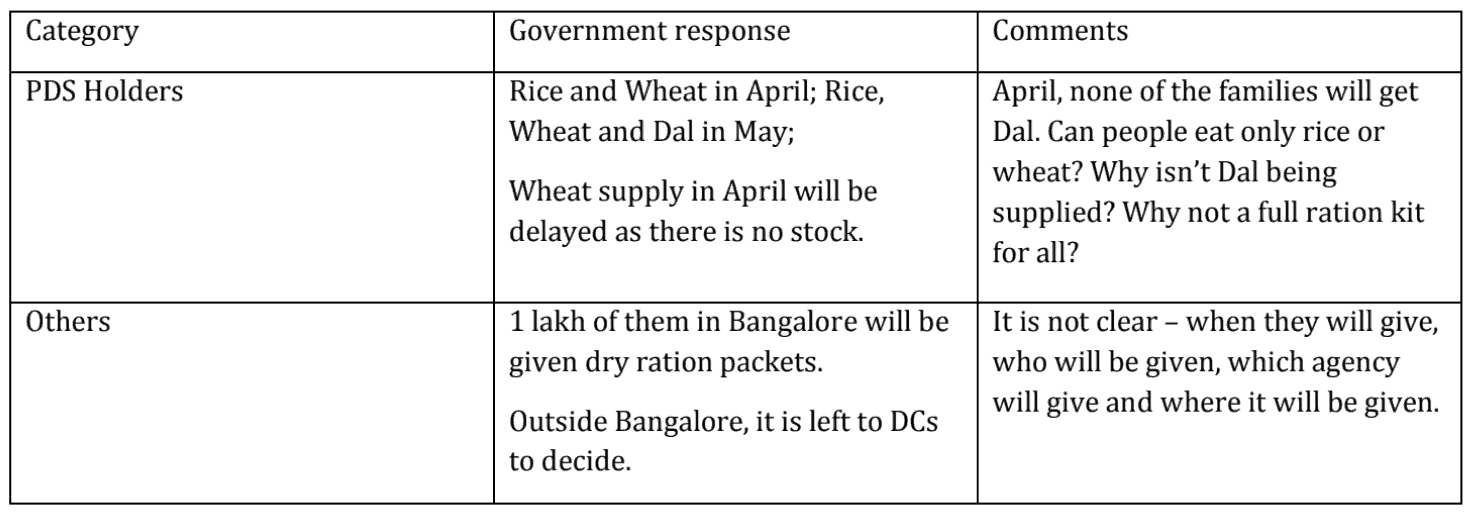
With the government food security system failing, the burden of managing the hunger crisis has fallen on the civil society organisations, who have been trying their best with their limited resources and capacities. But civil society itself cannot manage this mammoth task, especially due to three difficulties:
- Police not giving passes to relief workers
- Difficulties accessing supplies in APMC since it’s open only on alternate days and prices have been shooting up
- Not enough supplies elsewhere
Though officials have made gestures of seeking cooperation and suggestions from civil society organisations, none of the constructive suggestions have been accepted. For instance, street vendor unions have repeatedly offered to contribute to community kitchens, which will give wages to vendors and fresh food to people; but the government has not agreed or commented on this proposal. It has been more than five days since this suggestion was made to the Labour Department. Civil society groups have also been repeatedly asking for dry ration kits for all, but it’s not being done.
In the coming days, food crisis is going to become more severe unless the government goes beyond clearing up desperate workers off the streets and ensures all their urgent food-related needs are met.
We are reiterating the following measures that the government should have implemented before announcing the lockdown, in the hope that these will be given serious attention now:
- For those who are unable to cook: Provide free, fresh-cooked meals through open community kitchens by involving street vendors, Self-Help Groups. Provide free cooked food through Indira Canteens.
- For those who are able to cook: For those with a ration card, supply dal, cooking oil, salt and masala powder through PDS. For those outside PDS, supply a ration kit or allow them to draw rations based on temporary ration cards.
- Provide fruits, vegetables, eggs and meat at subsidised rates through HOPCOMS. Children and pregnant women should be provided eggs five days a week.
- Midday meals, and food that was provided through anganwadis, should continue to be supplied. If not cooked food, dry rations should be provided.
- Ensure quick implementation of Ujjwala Scheme and ensure free LPG cylinders are made available. Ensure that the poor who use private gas can also temporarily use Ujjwala Scheme.
- Milk products must also be provided.
[This article is based on a press release from Naavu Bharateeyaru, and has been published with edits]