Women’s labour is often unseen and their stories, often unheard. This unseen, invisible, and often unpaid labour is the ground upon which all ‘development’ in this monster economy takes place. We are witness to a moment in time when women are organising, fighting, and demanding their rights, questioning the very ideas of growth, progress and citizenship. In short, they are making their voices heard and making their labour visible. As part of our ongoing Satyagraha for the Sacred Economy, Gram Seva Sangh, Centre for Budget and Policy Studies along with few more organisations want to create a platform in the form of a convention that can honour and amplify their voices, their stories, and their knowledge.
This convention is designed to recognise all forms of labour that women engage in – be it in agriculture, education, information technologies, sanitation, or domestic work, whether they are cooking, cleaning and taking care of children either at home or in the anganwadi center, whether they are located in urban or in rural areas.
This convention will engage with all the challenges and troubles that women face – unfair and inadequate wages, violence at the home and workplace and in public spaces, and the complete lack of social security – to understand the lived experience and meaning of labor itself. We are also hosting this convention to celebrate, to find joy in our shared democratic value systems, to build solidarity across artificial divides, and to create a dialogue that can build a strong foundation for action against regressive forces.
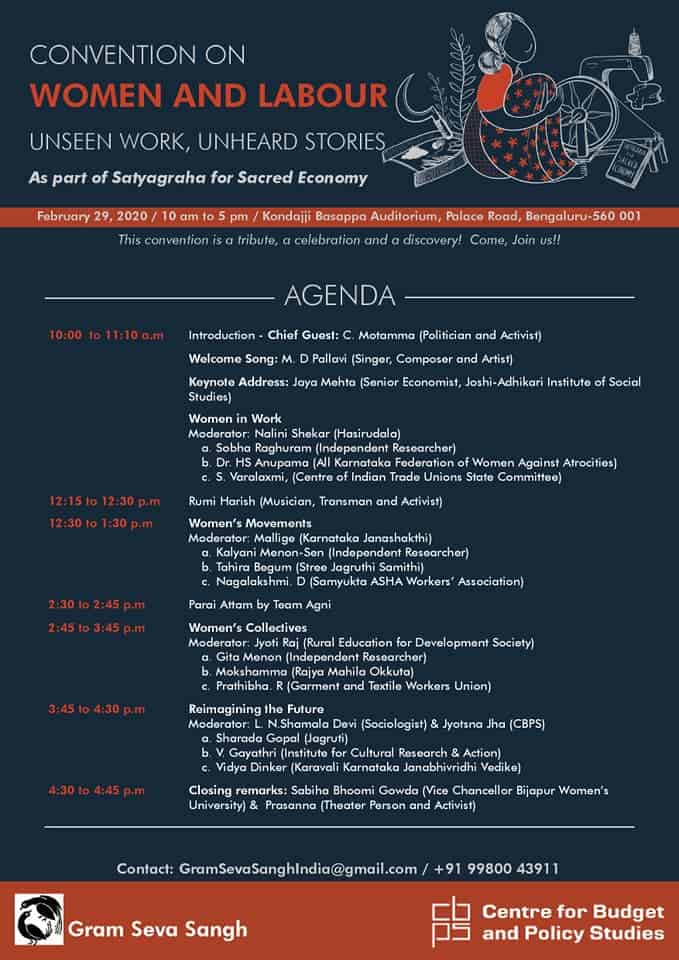
| Date: February 29, 2020 Time: 10 am – 5 pm Venue: Kondajji Basappa Auditorium, Palace Road, Bengaluru |
Here is the convention agenda with details about the sessions and speakers.
The convention is jointly organised by Gram Seva Sangh, Centre for Budget and Policy Studies, Hasiru Dala, Fields of View, Karnataka Gandhi Smaraka Nidhi, and N.S.S – State Cell. This convention is a tribute, a celebration and a discovery! Come, join us!
For more details, contact: +91 9980043911 or gramsevasanghindia@gmail.com
[This article is based on a press release from Gram Seva Sangh , and has been published with minimal edits]