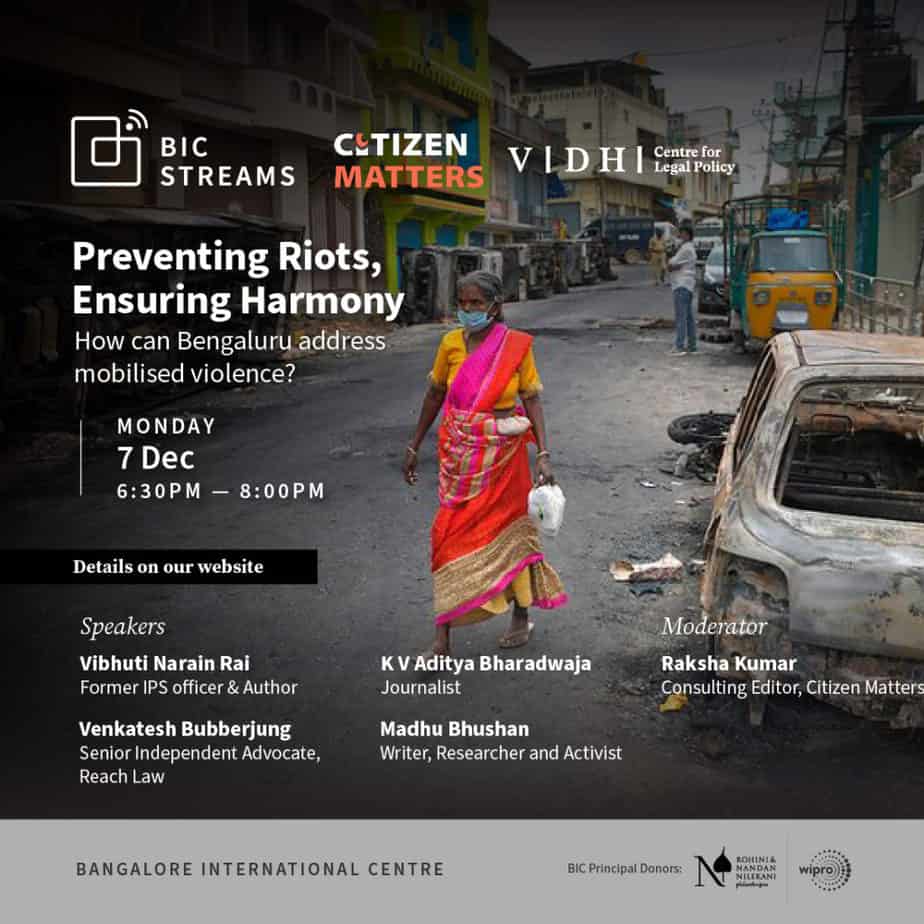
Bengaluru has seen its share of mobilised violence. Mobilised violence refers to violence perpetrated by a group of people to achieve an identified objective. There are significant socio-political, historic and economic factors that engender mobilised violence, but the inadequacy of the legal system and absence of sensible policing also play a role in preventing it.
Existing legal approaches have failed to curb mobilised violence. While some laws aim to address it by imposing restrictions on hate speech and the formation of associations or assemblies, they are often broadly constructed, vague and invariably misused. The discretion conferred by these laws to the State is wide-ranging and prone to abuse. Deficit state capacity, weak institutions that are vulnerable to political interference and lack of accountability are as much to blame for the state of affairs.
The use of extraordinary laws being to address mobilised violence has come to be a cause for alarm. Invoking the Unlawful Activities Prevention Act, 1967, which is India’s main anti-terrorism law, is a concern. Over the last two decades, UAPA’s scope has been significantly expanded through multiple amendments to allow infractions such as damaging government property to constitute an act of terrorism. Lawyers and activists have severely criticised the government for invoking the UAPA in the recent disturbances in Bengaluru and have termed it ‘indiscriminate use of a draconian law.’
Recently, there have also been calls to make those charged for mob violence pay for the damage caused to public and private property during such violence. Is seeking economic compensation from the accused a viable and prudent solution? Such a move warrants public engagement and critical discussion.
Similarly, there is need to understand the causes for the occurrence of mobilised violence. How can such incidents be prevented? What are the problems endemic to legal and policing systems in Bengaluru that result in a failure to counter mobilised violence? How can the state address mobilised violence without endangering constitutionally guaranteed civil and political liberties?
Vidhi Centre for Legal Policy and Citizen Matters in collaboration with the Bangalore International Centre is organising a webinar to discuss these issues.
Date: Monday, December 7, 2020
Time: 6:30 pm – 8 pm
Registration link: https://us02web.zoom.us/webinar/register/2516062408135/WN_rIhuRMDoSwCdFWm1kqnXDQ
The panelists are:
- Vibhuti Narain Rai
Vibhuti Narain Rai did his Masters in English Literature from Allahabad University (1971) and joined the Indian Police Service in 1975. He was awarded the Police Medal for Meritorious Services and President’s Police Medal for Distinguished Services during his 36-year long career, which included postings in the Kashmir Valley (1992-1993), SSP Kumbh Mela Allahabad (1988-89) and Uttar Pradesh as SSP and Inspector General of Police. He is an acclaimed Hindi fiction writer and has published five novels – Ghar, Shahar Mein Curfew, Kissa Loktantra, Tabadala and Prem Ki Bhootkatha. - Madhu Bhushan
After graduating with a Master’s Degree in Mass Communications in 1983, Madhu Bhushan joined CIEDS Collective as a full-time women’s rights activist involved also in working with rural and tribal communities. At present an independent activist–(re)searcher, a very occasional filmmaker and writer, she continues to be associated with CIEDS and Gamana Mahila Samuha, an autonomous feminist collective. She is also associated with various networks and organisations working on human rights and social justice including rights of sex workers, trans communities and adivasis. - Venkatesh Bubberjung
B T Venkatesh enrolled as an advocate in the year 1986. In a career spanning three decades, his body of work has involved many roles ranging from acting as lead internal counsel for a multinational construction firm to being an independent advocate with diverse litigation experience. He served as the State Public Prosecutor in the High Court of Karnataka, during which time he represented the State in numerous high-profile cases. He has a significant passion for pro bono work and outside of his work, as a litigator, Mr. Venkatesh is a well-known speaker and writer, besides authoring a number of fact-finding reports, papers and articles. His work has been featured in and inspired numerous documentaries and short films, the prominent ones being ‘Purple Skies’ by Sridhar Rangayan and ‘Let the Butterflies Fly’ by Gopal Menon. - K V Aditya Bharadwaja
K V Aditya Bharadwaja is a reporter with an experience of nine years, covering urban affairs, crime, politics and culture in Bengaluru. - Raksha Kumar
Raksha Kumar is Consulting Editor, Citizen Matters. She is an experienced human rights journalist, with a specific focus on land and forest rights, and a documentary filmmaker. Since 2011, she has reported from across the world and across India for a wide range of publications including The New York Times, BBC and Guardian. With a Fulbright Scholarship for Leadership Development, she graduated from the Journalism School, Columbia University. She has also been a Scripps Howard Fellow and a Chevening Fellow.
About the Bengaluru Solutions Series
Vidhi Centre for Legal Policy and Citizen Matters in collaboration with the Bangalore International Centre organise the ‘Bengaluru Solutions Series,’ an ongoing citizen engagement initiative to discuss pressing urban issues in the city. Each edition is dedicated to a theme, based on which a panel discussion with representatives from relevant stakeholder groups is organised. Previous editions of the series have seen discussions on women’s safety, formalising the gig economy, the groundwater situation, disappearing greenery and deteriorating air quality. For the seventh edition of the series, the theme is about addressing mobilised violence.
More details: Preventing Riots, Ensuring Harmony — How can Bengaluru address mobilised violence?
This panel discussion is part of the public engagement initiative ‘Bengaluru Solutions Series’, anchored by Citizen Matters and Vidhi Centre for Legal Policy.