K Karthik, Councillor for Ward 7 has spent a decade in politics. He belongs to the All India Anna Dravida Munnetra Kazhagam (AIADMK). His foray into politics came after stints in corporate HR at firms such as Pepsico and the Murugappa Group. In 2011, Karthik became a full-time politician, following in the footsteps of his father K Kuppan.
K Kuppan serves as MLA from Thiruvottiyur in the 14th Tamil Nadu Legislative Assembly. He contested unsuccessfully from the same constituency in the 2021 Assembly Elections.
Citizen Matters caught up with Karthik in his office at Aniruth Park, a hotel he owns in the area. He spoke of the various issues affecting the ward such as poor civic amenities and the need for improving corporation schools. He lamented the slow pace of work and expressed scepticism over the ruling government keeping its promises for Chennai.
Ward No 7
- Name of Councillor: K Karthik
- Party: ADMK
- Age: 38
- Educational qualification: B.Tech ; MSW
- Contact: 9962541122
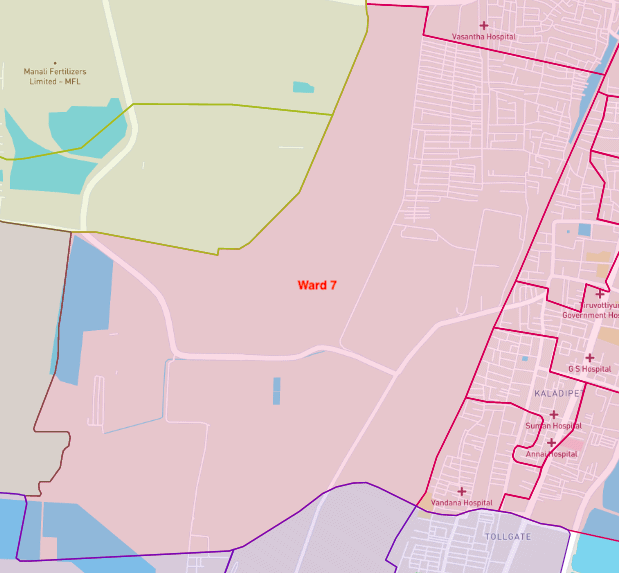
Primary goals for Ward 7
What are your three immediate tasks/targets for ward 7?
Ward 7 is one of the areas that were worst affected during rains. Water stagnation is a constant issue here. The challenge is greater as it is a low-lying area. It was during the ADMK regime in 2011 that we instituted basic stormwater drainage structures. Other key facilities are still absent here. So ensuring roads, streetlights and stormwater drains would be my immediate targets.
Apart from this, we have one more key issue that is looming large at present. Of the twenty thousand residents of ward 7, about ten thousand live in two areas, namely, Kargil Nagar and Ramraj Nagar. The government now wants these people to vacate the areas, claiming that their homes are located over waterbodies.
But this is extremely unfair; the people have resided there for more than 25 years, and no such concerns were expressed at any point during these years. Now, the government wants them to leave one fine day. What will they do? This is neither the DMK’s nor ADMK’s fault. The people have been allowed to reside here all this while and they should be allowed to do so in the future also.
In the case that the government goes ahead with its plan, are there any clear plans made for their relocation?
As I said, such a large population should not even be displaced. But even if that is going to happen, the government needs to chalk out clear plans to provide alternative housing facilities for the people. Nothing has been established so far, but it should be done.
Read more: Government should not use slum eviction to further ‘Singara Chennai’ agenda : Migration expert
How do you interact with the constituents? What kind of outreach activities have you held so far/plan to do? How can people in the ward contact you?
After I got elected as the ward councillor, my number was made available to each and every household. I also try to personally visit different areas within the ward to check the status of things, such as whether garbage from the streets has been removed.
People also come and visit me in person to discuss their issues. My party workers are also very active in this ward. They act as a channel of communication and relay a lot of information to me from the residents of this ward.
Issues in Ward 7
Industrial waste is a problem in this zone, especially given the fact that it has eco-sensitive areas like Ennore. What are your plans to tackle this issue?
Industries here predate the coming of many of the residents of this ward. The permits for them have been given a very long time back. So, their systems are old. As a result, many industries don’t abide by the various responsibilities that they are supposed to tend to.
For instance, industries are supposed to have a sewage treatment plant that treats water before it is released. Similarly, the proper disposal of the scrap waste they generate is their responsibility. These are not the government’s responsibilities, although it ends up becoming that way. But these are not adhered to. I can say from my experience of working in industries that the issues associated with them are systemic.
I think that the punishment for these violations needs to be made more severe. For instance, disposal of industrial waste is often improper – they usually end up in rivers. The industries are generating their revenue, and they must spend a part of it on these responsibilities.
Another complaint in this zone is the improper functioning of government offices and the inability to avail of services speedily. What do you think about this?
It is not just in this zone, but government offices everywhere are attuned not to work. This has become the general norm. I have sent hundreds of letters over the last four months for several issues, but I haven’t received any responses.
I was working on a letter for the repair of streetlights just before this interview. In many ways, these letters are just a means for me to record the issues, as the prevailing practice is to either delay the work or not act at all. This is a large and systemic issue.
Is there anything that you as ward councillor can do about this, specifically within your ward at least?
I don’t think so. This is a huge system. Often, the inefficiency arises from capability issues – the right people to do the work are absent. I like to get on to things and act on issues swiftly, but I face hindrances from officers who cite multiple rules and regulations.
The only way this issue can get solved is by changing the officers themselves, or by progressive efforts to change the culture.
Also read: Greater Chennai Corporation budget places emphasis on schools and infrastructure
Vision for Chennai
What is your vision for Chennai as a city?
Off the top of my head, I would say the restoration of the Buckingham Canal. This was a flourishing river that is now turned into a waste dump. Cleaning the canal would be beneficial for the people in terms of livelihood as well as an environmental angle. Every time the DMK comes to power, they promise to sail a boat in the river. If they can fulfil it in this term, that would be great.
Apart from this, I feel that we should focus on more equitable development across the city. While South Chennai has grown immensely, basic facilities are still lacking in North Chennai. This should change. From my personal experience as both a resident of this ward as well as its councillor, I can say that the Corporation’s attention to the extended areas is very poor. While the inner parts of the city are looked after well, wards such as mine that fall under the extended areas are neglected.
Another vision for Chennai as a city would mainly include an improvement in public education. In my ward, we have a Corporation school with a total capacity to handle 240 students. But the school is over-enrolled and currently has 490 students but without adequate infrastructure for them. This is the state of a corporation school in our city. The students attend school only on alternate days. What kind of education can one receive from attending school for just three days a week?
This is a grassroots issue that would affect an entire generation. The government has to look at expanding the facilities of our Corporation schools. This is especially important at present when we see an influx of students into these schools after the COVID pandemic.
What do you hope to achieve in your term as councillor?
I meet the people in my ward and I know what they lack most is access to basic facilities. So my focus would be on making good roads, providing streetlights, drinking water and good stormwater drain facilities. If I can fulfil this, the residents of my ward would be truly happy.
What the residents say
Suresh V, an auto driver in Ward 7, states that the key issue that the people face is with regard to roads. “Relaying the roads and working on proper canals and drains to rectify the problem of water stagnation would be much appreciated,” he says.
Kumar P says that as the councillor as well as his father, who was a former MLA, belong to the ward, they know its problems in great depth. He is confident of the councillor’s abilities to work on them.
One man army.