Residents of Ennore along with environmentalists organized a human chain formation at Elliot’s beach on Saturday evening even as actor and probable new politician in the fray Kamal Haasan visited the Ennore creek, to know more about the ground reality of its ash pollution and encroachment.
In contrast to the usual weekend scenes, Elliot’s beach at Besant Nagar was filled with more than 250 like-minded individuals – from kids to senior citizens – who were holding placards that explain the sorry state of Ennore Creek.
Industrial effluents from the thermal power stations here and domestic sewage from North Chennai have killed various fish species. Voicing angst over the environmental destruction in their locality, V Kalavathi from Thazhamkuppam in Ennore said, “Many fish varieties – including Sudumbu and Kelangan – that we grew up eating, have now vanished. A variety called Madave, which was as popular as Vanjaram has become unfit for consumption, as it reeks of oil smell. All we see now is bloated fish.”
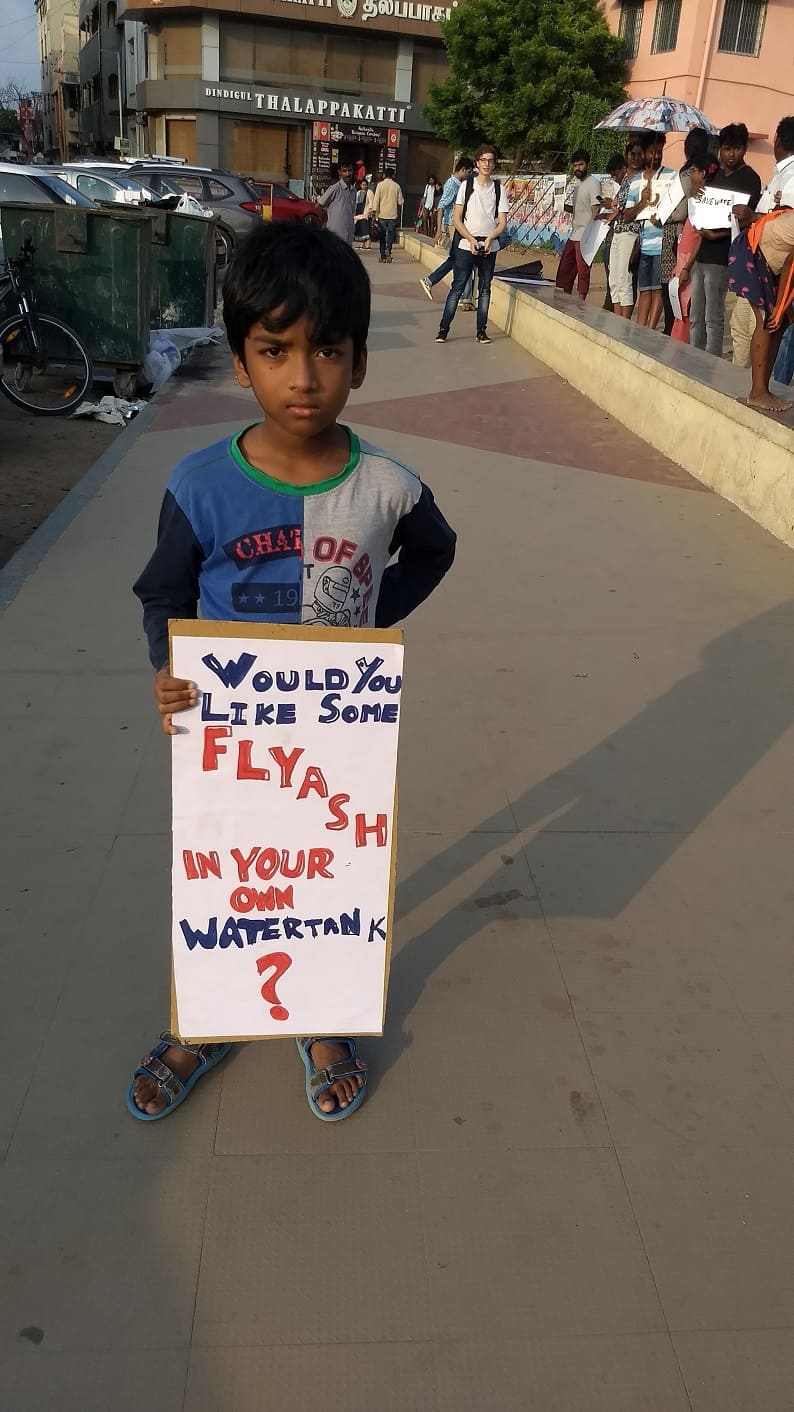
A kid holds a placard at Elliot’s beach on Saturday. Pic: Laasya Shekhar
Residents from all 52 villages in Ennore, who have witnessed the ecology die a slow death, formed a human chain, hoping that the government would react. “Our quality of life has degraded. The creek that had been our source of income is dying. How can we continue fishing if the water bodies are filled with ash instead of water?” questioned M. Koteeswari, a 49-year-old resident of Ennore.
More than 1000 acres of Kosasthalaiyar River’s backwaters have already been lost due to the deposition of fly ash by the Tangedco units. The case pertaining to fly ash pollution is pending before the southern bench of the National Green Tribunal, with the bench forming an expert committee to study the status of the ash ponds. Taking cognizance of pollution here, the bench has also asked the authorities to take up the remediation process. However, the ground reality is different.
While the district administration may be seen clearing the encroachments in one part of Ennore, trucks depositing fly ash on the banks of Kosasthalaiyar River is also a common sight. Lack of scientific disposal of effluents and state government-created rules permitting construction at a wetland have rung the death knell for Ennore.
Pooja Kumar of the Coastal Resource Centre, an environmental organization demanded that the state government take serious note of the pollution in Ennore. “Even after the state government witnessed the devastating 2015 floods, it permitted full-fledged construction of the Bharat Petroleum Corporation Limiting Oil refinery last year. The reason behind this human chain formation is to tell the government that our wetlands should not be encroached upon. Tamil Nadu government should also withdraw the 1000-acre clearance given to the Kamarajar Port,” said Pooja Kumar.
Is Ennore ready to face the North East Monsoon? Chennai Corporation has constructed storm water drains at the locality, but the macro drainage system is still at fault. “As the water-carrying channels to the sea – Buckingham canal and Kosasthalaiyar River – remain blocked, there would inevitably be floods at Ennore. In Ennore, when it rains, it floods,” noted Pooja Kumar.
நன்றி சகோதரி நானும் எண்ணூர்வாசிதான்