With the recently concluded elections, Chennai has local body representatives for the first time in six years. While much has changed in the past few years, avenues for engagement of Chennaiites with the local government has remained limited. Could this scenario change with the election of the ward councillors? How can residents be involved in local governance and demand accountability from their local representatives?
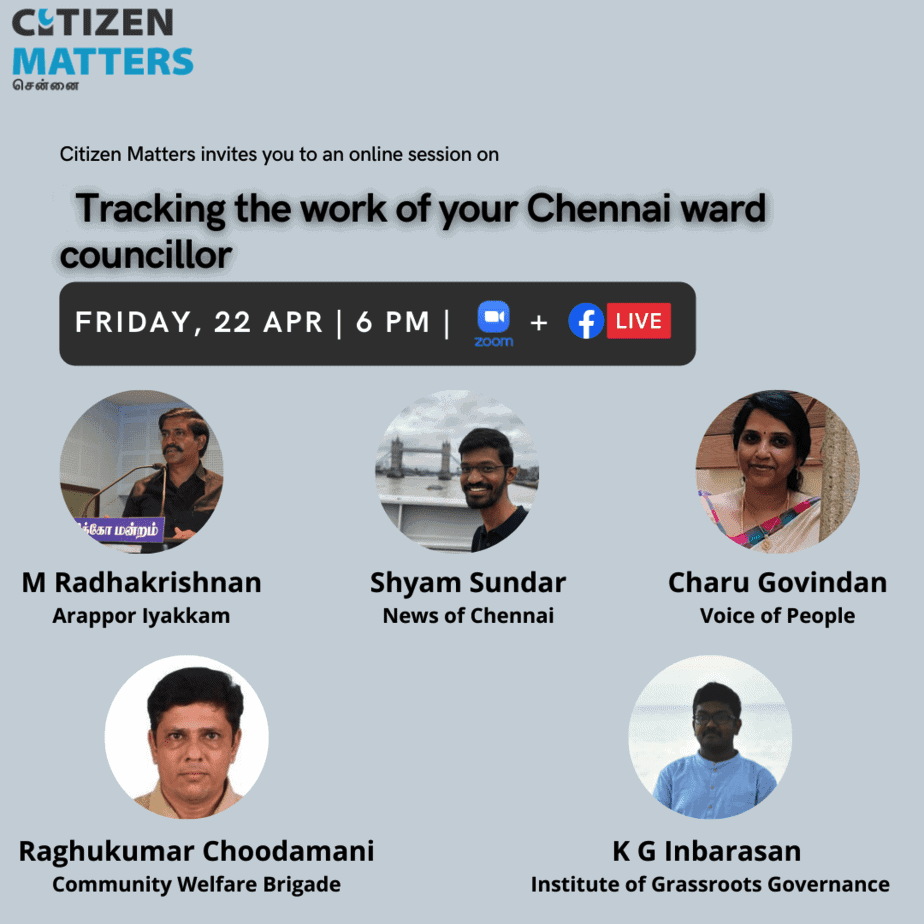
Citizen Matters hosted a webinar with a diverse panel on the ways in which Chennaiites can track the work of their ward councillors and the avenues available for their participation. The panel comprised M Radhakrishnan of Arappor Iyakkam, Charu Govindan of Voice of People, Shyam Sundar of News of Chennai, Raghukumar Choodamani of Community Welfare Brigade and K G Inbarasan of the Institute of Grassroots Governance.
Below are some excerpts from the discussion.
Citizens as a shadow local body
Radhakrishnan M, Member of State Committee of the anti-corruption watchdog Arappor Iyakkam spoke about the importance of effective local governance and how Chennaiites can make their voices heard.
“Only after the floods of 2015 have we realised the importance of local bodies and local representatives. When we have issues that affect daily life such as roads, water, basic health facilities, we recognise the importance of local government.”
He pointed out the need for decentralisation and devolution of power, especially in light of the growth of the city. Chennaiites, along with various civil society organisations, can work as a shadow local government by monitoring the various schemes that have been implemented at the local level.
He raised the issue of audits of stormwater drains that have helped some parts of the city avert flooding. The taxpayers contribution is directly reflected in the availability of various services and creation of infrastructure in the city. Only with effective local governance can such outcomes be achieved.
Shyam Sundar created an application and social media page called News of Chennai. The app and page serves as a centralised repository of information on civic issues and happenings in the city. News of Chennai was born out of the experience of creating a similar repository during COVID-19.
Shyam stated that involvement of residents by providing access to timely and verified information will increase their participation in local issues. The demographic that uses the app are between the age group of 16-35. “People feel the need for such verified information that can help them take the next step. While some government departments put out such information in an accessible manner, many do not and that is the gap that apps and pages such as mine fulfill.”
Read more: Chennai in 2022: The time for participatory governance is now!
On devolution of power
K G Inbarasan of the Institute of Grassroots Governance has been working with the gram panchayats of three districts. IGG is also involved in training and capacity building for local governance.
“Lessons from rural local governance that can be translated into the urban setting would involve the creation of ward committees and areas sabhas. The creation of these and sabhas is dependent on the state government. The provisions for the same are already enshrined in the law. The devolution of power to residents can happen through the involvement of residents through these avenues.”
Charu Govindan of Voice of People echoed the need for ward committees and areas sabhas, “A welcome news on this front is the state government’s promise that these platforms will be created for the involvement of residents at the local level. At the same time, it is important for Chennaiites to ensure that these announcements are followed through in a timely manner.”
Charu added that the provisions in the law state that the ward committees and area sabhas should be created within three months of the election of the local body. Their functioning should begin before six months. Following through on this timeline should be insisted upon by citizens and civil society organisations. Public consultations must be held before rules are framed for the creation of ward committees and area sabhas.
Read more: Why citizen engagement will be vital for the success of Chennai as a smart city
Involvement of residents
Radhakrishnan urged residents to be more aware of what is happening in their surroundings. “One does not have to be part of an organisation or group to assess effective functioning of local government. They can monitor things like road milling, increase of height of roads, stormwater drain construction and availability of services in places such as the local Urban Public Health Centers.”
The services rendered by the local government can be audited by the general public with the help of civil society organisations or resident welfare associations. Tenders can be accessed online to see what civic works are being carried out in their locality.
Raghukumar Choodamani, founder of Community Welfare Brigade spoke about his involvement in ensuring access to services and proper civic infrastructure. “ The lesson from this work is that persistence is key. We have been engaged with civic authorities even when we did not have an elected local body. Issues such as getting a road median have been causes that I have taken up. Some of the problems have taken over 5 years to reach a resolution”.
Transparency by local body the need of the hour
Transparency and sharing of information by the government will help gain the trust of the people. Development of wards through ward development fund, an allocation of Rs 35 lakhs per councillor per year is a good place to start such an effort, stated Charu. “The local government can create a website that puts out the information on spending of such funds and what infrastructure or services have been rendered through it. We have smart city but we also need smart wards for development.”
Shyam reflected a similar sentiment and called for local representatives and civic authorities to find ways to share crucial information and updates. “Some officials use social media very effectively to help information reach people. Through Facebook, Twitter and Whatsapp, much needed details can be shared with people right from helplines to updates on civic works. This will help residents keep track of the work being done by the local government.”
Follow the complete discussion here: