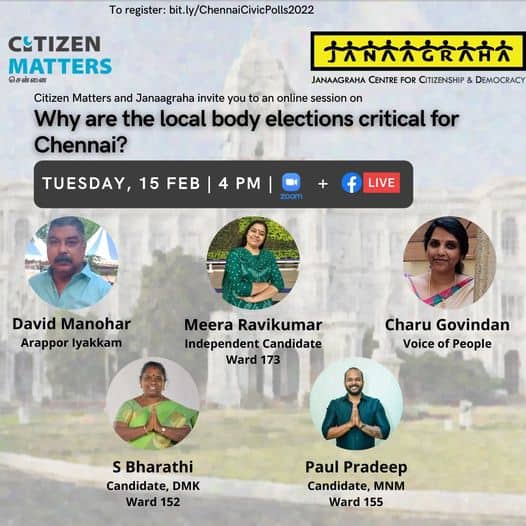
As Chennai gets set for local body polls for the first time since 2011, many issues faced by the city and how an elected council might offer long-awaited solutions for the same, warranted a discussion. On February 14 2022, Citizen Matters and Janaagraha Center for Citizenship and Democracy brought together a diverse panel of candidates in the fray in this election and prominent voices from civil society organisation to delve into the complexities of local governance and how Chennaiites can hold the elected representatives accountable.
The panel was comprised of activist David Manohar of the corruption watchdog Arappor Iyakkam, Charu Govindan of citizens collective, Voice of People, S. Bharathi of the DMK, Candidate from Ward 153, Meera Ravikumar, Independent Candidate from Ward 173 and CN Paul Pradeep of MNM, Candidate from Ward 155.
Batting for Votes
The candidates each made a short pitch on why they feel that they should be elected councillors of their respective wards.
Paul Pradeep stated that his motivation for contesting the elections had its roots in the disastrous Chennai floods of 2015. When his locality suffered the devastation caused by the floods, the local representatives were not available to come to their aid. Active youngsters in the area and NGOs were mostly engaged in rescue and relief. As a result of this, Paul decided to contest for the next local body elections. He stated that he has made great efforts to truly understand the scope and powers of the local body representatives and would leverage his knowledge for the common good.
Bharathi S of the DMK made her case based on the work that has been done by her and her party. She said that she has been a resident of the ward for many decades and is familiar with the day to day issues faced by the residents. She argued that the previous government had failed to improve civic amenities including providing good roads and improving waste management. She posited that since the DMK is the ruling party in the state and has carried out good work, people should put their faith in the party and her track record to vote for her.
Read more: Independent candidates to make a statement in the local body polls in Chennai
Meera Ravikumar said that independent candidates such as herself have improved the standard of discourse during the campaigns by talking about the real problems faced by the wards. She pointed out that there has been complete lack of transparency and accountability in local government. Residents are unaware of what projects are being carried out in their ward, who the contractors entrusted with the work are and how to raise their grievances; this has led to many issues mushrooming over the past few years. Meera hopes that her candidature will help turn attention towards improving transparency, pinning accountability and a greater voice for the residents in local governance.
Citizen participation in local governance
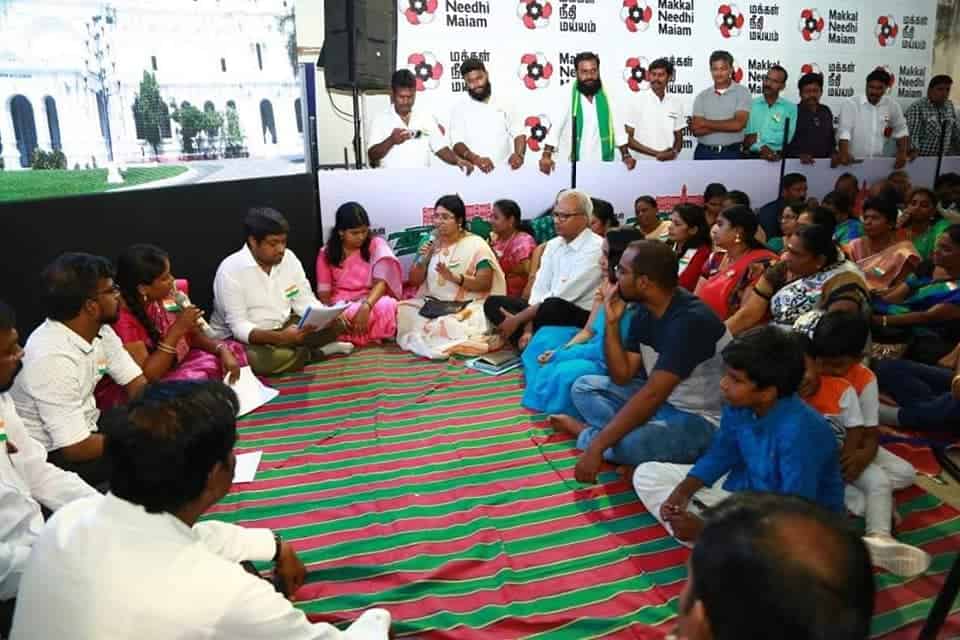
Another key theme that was discussed by the panel was the need to create avenues for citizen participation. Srinivas Alavilli of Janaagraha shared the examples and learnings from Bengaluru and Mangaluru in setting up and operationalising ward committees where citizens can participate in the governance process.
Read more: What can Chennai learn from Kerala and Bengaluru on citizen participation in urban governance?
David Manohar of Arappor Iyakkam lamented that most political parties have not bothered to release proper manifestos that will help voters make an informed choice. He stated that having avenues such as ward committees and area sabhas will bring residents, officials and representatives to a common platform.
Charu Govindan of Voice of People reiterated their demand for setting up robust ward committess and area sabhas. She added that the responsibilities of Chennaiites doesn’t end with casting of votes but there should be a large movement that demands instutionalisation of ward committees and area sabhas once the election is over.
To follow the complete discussion:
While you hinted the pros and the luxury of having long-term tenure for counselors in chennai city in constrast of other cities like bangalore or mumbai, deeply pondering on this notion, allowed me to think the down-side of this. If a counselor doesnt perform well, citizen have the power to relect someone else. It is like notion of tenure-track position academicians are often given to prove themselves.
Sharing my thoughts for individual contemplation 🙂
Congratulations to Citizen Matters from bringing out the list of the new councillors ward wise.
It would be appreciated if their ( councillors) respective Mobile nos, WhatsApp nos and mail id is also provided.
Please keep up the good work you are doing.