Fatal accidents and accident deaths drop by 11.84% and 11.52% respectively in Chennai
There were 499 fatal road accidents and 507 deaths in 2022 in Chennai, a drop in numbers from the past year. According to Police Commissioner Shankar Jiwal, a team of experts zeroed in on accident hotspots by identifying areas with three to five accidents within a span of half a kilometre. The team also studied the reasons for accidents and considered mitigation strategies.
As per the strategies being implemented, roads are being improved at a cost of Rs. 1 crore in Chennai. Since most road accidents happen to two-wheelers and pillion riders, stringent penalties are imposed on people riding without helmets. Although 85% of two-wheeler riders wear helmets, only 13% of the pillion riders comply with the rule in Chennai, says the police commissioner.
Drunken driving, wrong-side driving, bike racing and rash driving are some offences being targeted by the police to ensure people adhere to traffic rules.
Source: The Hindu
Read more: Poor administration turns Padur roads into accident hot spots
Study: People prefer learning about public transport from friends and family in Chennai
Citizen consumer and civic Action Group (CAG), an NGO working towards protecting citizens’ rights, has conducted a study on accessing public transport information in Chennai. The study finds that many people find word-of-mouth from friends or relatives and other passengers most reliable. CAG interviewed 506 people who travelled in suburban and MRTS trains, Metro trains and MTC buses.
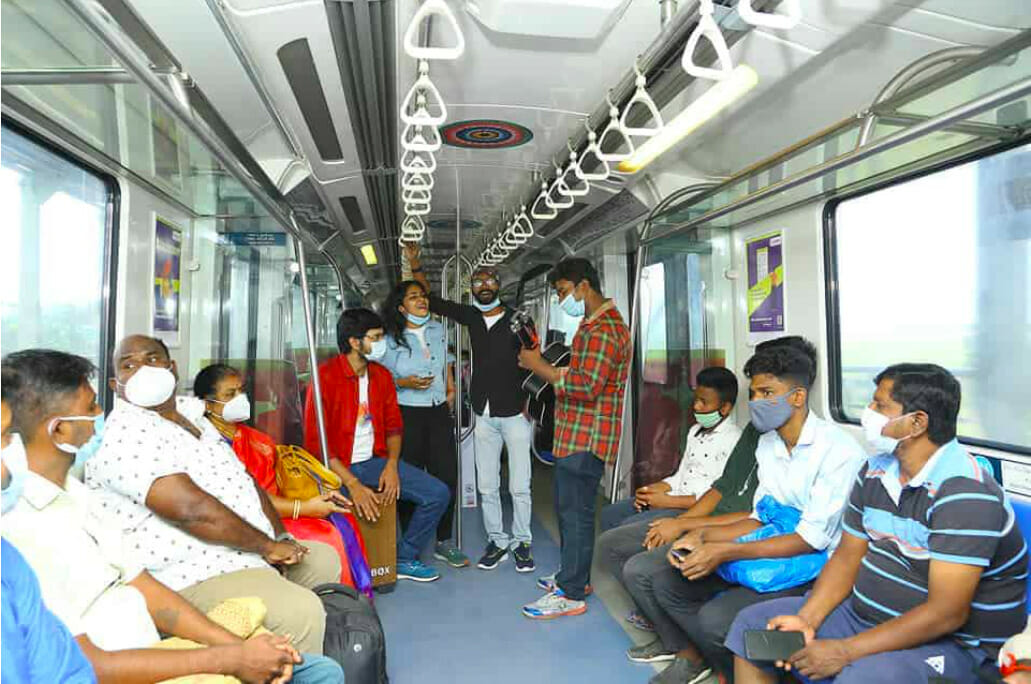
The study also reveals that less than 25% of the respondents used the internet to search about public transport systems and only 21 out of the 506 people made use of mobile apps. Many people preferred using public transport over private transport due to the former being low cost. However, younger people preferred private transport in Chennai.
Furthermore, the study recommends public transport departments invest in different and multi-lingual modes of communication (websites, apps, signboards, etc.) to provide real-time data and set up feedback mechanisms for regular users.
Source: DT Next
Woman dies in a road accident near Maduravoyal in Chennai
Shobana, a 22-year-old software engineer, was riding her two-wheeler with her brother as the pillion rider when a lorry which came on the wrong side ran over her bike after she hit a pothole on the Tambaram-Maduravoyal bypass road. She was declared dead on the spot, while her brother was injured.
The Poonamallee traffic investigation wing concluded that both were not wearing helmets when the accident occurred on January 3rd, 2023.
The bypass road, which comes under the maintenance of the National Highways Authority of India (NHAI), runs up to 32 km.
The civic body repaired the roads and closed the potholes post the accident on the bypass road.
Source: The Times of India | DT Next
Read more: Can public transport in Chennai be improved through better communication?
Construction and operation of buildings to emit 232 million tonnes of carbon dioxide till 2040
According to a study conducted by a group of researchers from the Indian Institute of Technology in Chennai (IIT-M), a quarter of the total emissions would come from the construction sector in Chennai. This includes activities from the manufacture of raw materials like cement and steel to the energy used by functioning buildings.
To attain our emission target, it is important to analyse future emissions and track them backwards, recommend researchers.
The study finds that switching to renewable energy can reduce carbon emissions by 115 million tonnes from 231.9 tonnes by 2040. Moreover, the research recommends that low-carbon cement and the reuse of demolition debris can also make the future look less bleak, in terms of emissions.
Source: The New Indian Express
WRD plans to build more surplus channels in the Adyar basin
The Water Resources Department (WRD) is coming up with a detailed project report to construct more water channels in Adyar and Kovalam sub-basins. WRD officials plan to have 32 channels that connect to Pallikaranai marshland. This is to help South Chennai mitigate floods.
There are only a few water channels in the sub-basins, like Kovilambakkam, Velachery and Adambakkam, currently. In order to connect surplus channels, encroachment was a stumbling block. But, if the land belonged to WRD, it is easier to build the channels.
WRD officials are planning to build 10 water channels in south Chennai as part of Phase I.
Source: The New Indian Express
[Compiled by Padmaja Jayaraman]