Recently, Chennai has lost many trees to rains, cyclones and civic work. But the act of preserving existing tree cover and carrying out urban greening activities is only happening in pockets of the city.
There have been instances of tree felling for work on stormwater drains across the city. Many avenue trees were lost in areas such as K K Nagar. Very little has also been done to protect old trees in the city, with the instance of the felling of a centuries-old baobab tree on Greams Road being a prime example.
In order to prevent a repeat of such loss of trees, residents of Gandhi Nagar kept a watch on the work in our area. Despite this, we lost some saplings to SWD work and some of the trees were lost to roots being cut during the course of civic work.
We have endeavoured to maintain a channel of communication with officials to restore or repair the damage to the trees in the area.
One such instance has brought about a success story of the transplantation of a tree that was victim to the stormwater drain work and resultant damage. Residents and officials worked together to ensure that a large tree was able to find a new lease of life.
Read more: Tree survey in Chennai helps citizens take care of neighbourhood green cover
Old trees fall in Adyar due to SWD work
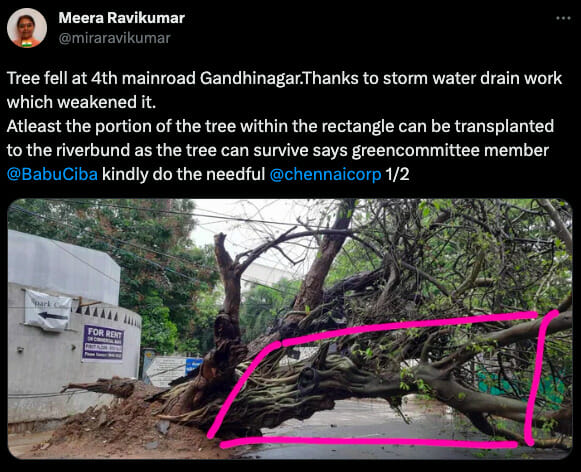
An African sausage tree, known as marai suraikai in Tamil, has been a constant in the area for many decades. But the tree fell on hard times recently, with a persistent fungal infection that had weakened it. The work on stormwater drains in the area made the tree’s condition worse by weakening its roots. The tree had also been bearing a second, smaller Fig (ficus) tree that had started growing on it, with the full load being borne by the African sausage tree.
The tree continued standing for some weeks, albeit very precariously.
When the city saw sudden rains in June, the tree, which had managed to hold on for some time, fell. Residents who had kept a watch on its state alerted others to the development.
The protocol when a tree falls is that the civic body fells it completely and cuts it up. But the residents wanted to see if at least one of the two trees could be salvaged. In consultation with experts at the NGO NIzhal, it was concluded that the Fig tree stood a chance if it were to be transplanted. The fungal infection in the African sausage tree made it so it would not survive the transplantation process.
Read more: Here’s what you must know before you plant another tree in Chennai
Efforts by residents to ensure tree transplantation from Adyar
The residents banded together to ensure that the tree would at least have a shot at a second life. With the tree having fallen on the busy Adhithanar Road, the area had to be temporarily cordoned off and the traffic had to be rerouted.
Residents got in touch with the officials of the Greater Chennai Corporation to ensure that the tree isn’t cut up but moved in a condition that would allow for transplantation.
I took to Twitter to post pictures and detail the situation and bring it to the notice of the relevant authorities. We also received support from the Horticulture Department in the effort to transplant the tree.
The process of transplantation took over a week, with the residents and officials working in closer coordination. On June 28, the tree was finally transplanted to the Kotturpuram tree park and got a new lease of life.
The persistence of residents played a key role in this successful effort, making it the first such instance of a successful tree plantation in the city.
Now it remains to be seen that the tree receives the necessary aftercare, and medication for any possible infection and ensures that the new conditions it is in allow it to thrive and grow.
What residents can do to protect trees?
- Residents must be constantly vigilant about the status of trees in their neighbourhood
- Residents can work with the civic body to ensure the timely pruning of trees
- Any signs of infection must be reported to the authorities so the tree can be assessed
- Residents must also take care to ensure that they do not cause damage to trees by hanging lights, adding sign boards or cutting off branches without proper permission
- Residents must also hold authorities accountable for the re-plantation of lost trees and other greening efforts in the neighbourhood