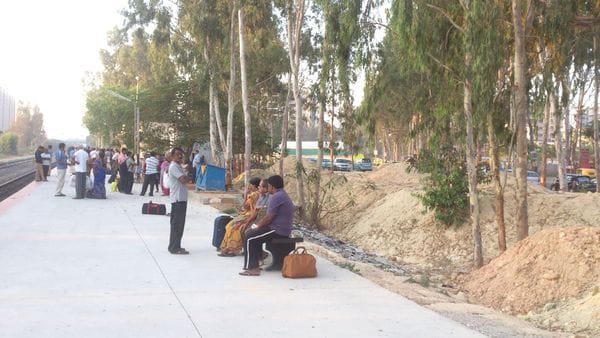
Commuters awaiting their train at the Carmelaram station. Pic: Shinoy Prahladan
Carmelaram station is a small station on the Bengaluru-Hosur line just off Sarjapur road. Several long distance trains to Tamil Nadu and Kerala, as well as few passenger trains, run on this line. Many of these trains stop at Carmelaram. A huge crowd boards and alights at the station due to the sheer convenience resulting from the location.
Recently, the railway authorities have done some work in the station, by lengthening, raising and concreting Platform 1 and providing a little better shelter and lighting. However, there are still many problems at this station.
Firstly, the line is a single track line which has facilities for trains to pass only at these stations. On many occasions, for the trains to pass, the passengers of a train arriving from Hosur side are forced to disembark on to Platform 2. Platform 2 is a short, tiny bump in the ground and passengers are forced to descend down to the last rung of the steps at the coach doors to land on the platform.
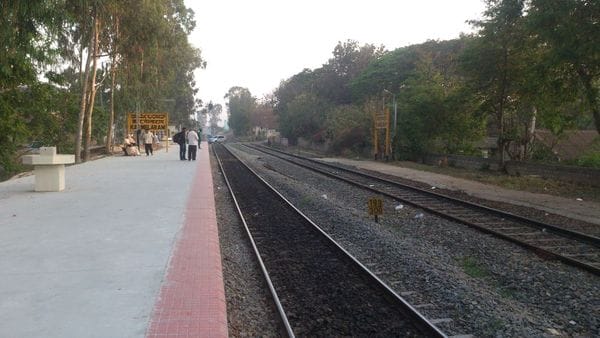
Observe how the platform on the right ends. Passengers may indeed have to disembark on to track jelly. Pic: Shinoy Prahladan
Some coaches stop beyond the platform and passengers have to drop on to shrubbery or track jelly. At night, there is no lighting on PF2. The only way to depart the station is from PF1, for which passengers have to either walk down to the level-crossing at one end and cross the tracks on the PF1 or cross the tracks and climb on to PF1. That climb is near impossible for the elderly, the infirm or the less athletic.
After going through a fairly harrowing experience, this author had filed a grievance with the railway board. The response was to the effect that Carmelaram is an E-Category station, which means it is a bare bones station. Hardly any amenities or improvements can be expected until the station moves out of this sorry bracket.
So, what is an E-Category station? Now, this is a difficult definition to find an answer to. A simple google search will yield multiple definitions which I realised depends on the year the document was published. I am basing my data on this link from Indian Railways, which appears to be most up to date.
There are six categories of stations: A, B, C, D, E and F. An E class station is a non-suburban station with an annual earning less than Rs 1 crore. In comparison, an A class station has earnings of Rs 6 crores and above. This means that the station should have an average earning of Rs 27,398/- per day.
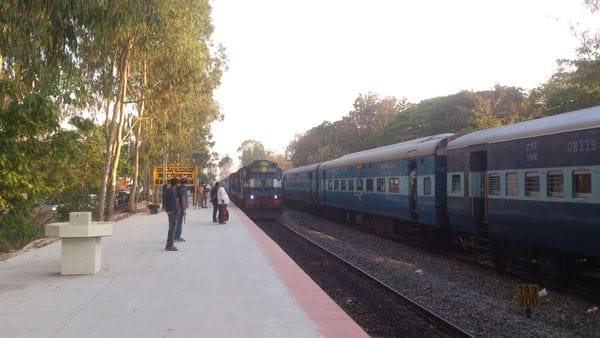
Bangalore-Ernakulam Intercity Express on Platform 1 and Yeshwanthpur-Kannur Express arriving on Platform 2 of the Carmelaram station. Pic: Shinoy Prahladan
Now, if the average price of a long distance train ticket is Rs 150, then 183 passengers should travel from that station every day. There are four long distance trains stopping at Carmelaram every day: Bangalore-Ernakulam Intercity Express, Mailaduturai Express, Yeshwanthpur-Kannur Express and Tuticorin Express.
Now we need 46 passengers to board each train with a ticket exceeding Rs 150. It does not look that difficult now, does it? Of course, with a few more amenities and parking, the railways can easily earn more money from this station. By allowing the Kochuveli Garib Rath to stop here, they can ease the rush at Banaswadi which resembles the outside of a cricket stadium before arrival of this train.
However, here comes the big challenge. With the advent of computerised reservation and the small impact on fares due to the “telescopic” nature of railway fares, most passengers book their ticket from either City or Yeshwanthpur although they invariably board at Carmelaram.
People interested to see an improvement in Carmelaram station could start by booking their tickets from and to Carmelaram. Follow that up by demanding that the railways upgrade the station. Hard data along with demands from the public will surely yield results.
Related Articles
Catching an early morning train : it takes a lot to achieve this!
Train accident near Anekal kills 9, injures 16 people
Citizens bat for new train to Whitefield, to ease traffic congestion
Good one, Sanjay. I’ve put up the article on my apartment’s Yahoo Group in Bellandur for wider awareness.
Thanks. If everybody traveling from the station would just start buying tickets from the station, it will really help. I had family members traveling today and by default, I had started to book the ticket from SBC. Fortunately, caught myself in time and booked from CRLM
Good Article ,previously K R BalaSubramanyam wrote a article on the Carmelaram station and how MNC near the Station are ready to chip in using CSR resource for Development of Station so the Employees of MNCs nearby can utilize the Station to commute to Bengaluru and near by area . Railway especially SWR Showing No interest in development of the Station . If CRLM Station is developed it can help a lot in Suburban Rail Service .