Butterfly journeys

It's that time of the year when the Blue Tiger makes its way to the Western Ghats. Keep your peeled for these butterflies as they flit past you when you are out and about.

We witness a beautiful aerial stream of butterflies between March and May, and once again between September and November. These butterflies are not, like other wildlife, only to be found in the forests; you can often see them floating around you, and past you, as you walk in the city. 

The most common butterflies that migrate twice a year are the Blue Tiger, and the Common Crow. The Common Crow is a dark brown, almost black butterfly; but the Blue Tiger is a blue jewel! 

You can see them clustering on some plants even in uncultivated fields.
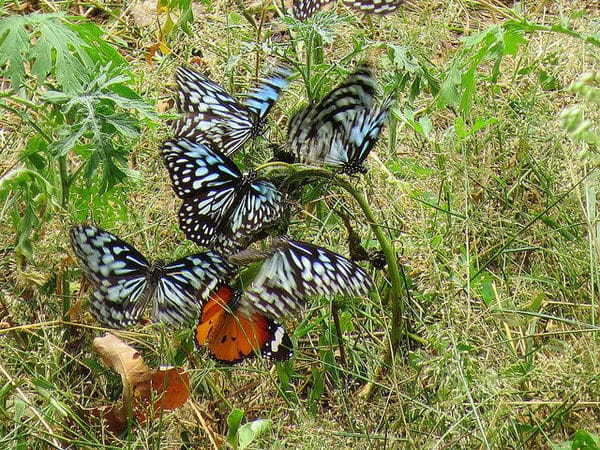
The butterflies migrate to the Western Ghats to breed, and it’s amazing to think that it’s the progeny who return. 
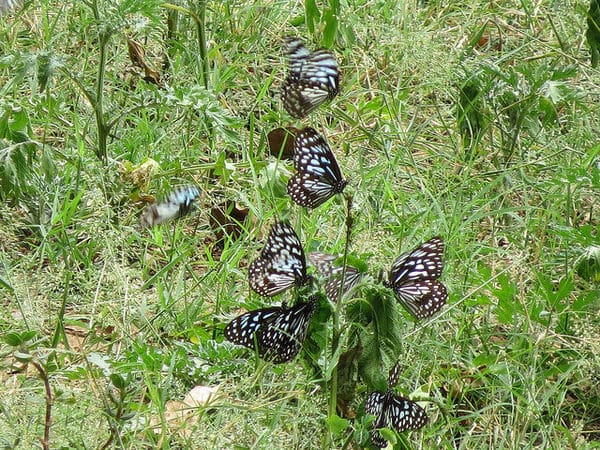
Several thousand butterflies, of course, fail to complete the journey, and become food for predators, or decompose back into nature, thus completing the cycle of life and death.  

Here’s a video I took, of Blue Tigers flickering in large numbers as they fly about an open area. 

Another interesting fact is that the scientific name of these butterflies is ‘Tirumala‘… A tip of the hat to the Lord of the Seven Hills. 

So look around and notice the winged travellers as you walk around our city at this time!

Comments:

  1. Deepa Mohan says:

    This post is dedicated to my Nature guru, S.Karthikeyan, who will never agree that he’s very knowledgeable about butterflies. 😀

Leave a Reply

Your email address will not be published. Required fields are marked *

Similar Story

Bengaluru’s flowering Tabebuia Rosea trees: Think green, not just pink

Cities must not confuse beauty with ecology; Bengaluru’s pink weeks are lovely, but unchecked ornamental planting could make the city prettier but less alive.

Late each winter, Bengaluru briefly transforms into an Indian Kyoto, as roads blush pink, office parks turn photogenic, and social media buzzes with claims of a local “cherry blossom” season. But the star of this spectacle is not cherry at all. It is Tabebuia rosea, the pink trumpet tree, a neotropical ornamental whose native range runs from Mexico to Ecuador. What seems like a harmless aesthetic win is, ecologically, far more complex. The history Bengaluru’s pink canopy is not new. Much of it can be traced back to the 1980s under forester S G Neginhal, who drove a major greening…

Similar Story

Inside Chennai’s AQI: Why hyperlocal monitoring of air quality is crucial

Official data masks Chennai's toxic air. Citizen Matters travelled with the IITM team to map variations in air quality. Watch the video to know more.

Across cities, official Air Quality Index (AQI) readings often overlook local hotspots. Chennai has eight Continuous Ambient Air Quality Monitoring Stations (CAAQMS) that function 24/7 throughout the year. But this isn’t enough to map particulate matter. Air changes every few metres, as researchers from the Indian Institute of Technology-Madras tell us. Seasonal variation, construction, vehicular movement, and proximity to industries also change the air we breathe, In 2022, over 17 lakh people died in India due to air pollution (PM 2.5), according to a Lancet study. With better hyper-local air data and public awareness, citizens and policymakers can target pollution…