Bengaluru’s first Indie Comix Festival (ICF) showcased a host of self-published, alternative stories from over twenty comic book artists. The free, all-day event was held Bengaluru on May 20th, 2018, at the Rangoli Metro Art Centre. Art in Transit project of the Srishti Institute of Art Design and Technology collaborated with ICF to host the festival.
On display were a wide range of comics from tiny 10 rupees pop-up comics to original comic covers costing up to 3000 rupees.
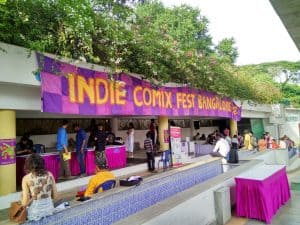
A host of stalls
Started by a group of volunteers with aim of bringing independent, self-published comic writers and readers together, the event was dazzling with original artwork. All the stalls showcased comic books, in different languages. There were occasional hand-designed collectibles such as postcards, magnets, and badges. With no merchandising, the focus remained firmly on the comics, and interaction with the creators.
The Indie Comix Fest website offers details of upcoming events as well as summaries of previous ones.
With mainstream comics, like those of Marvel and DC, dominating the current comic book scene in India, the voices of independent creators are often drowned out. Such independent comic book events are much-needed for lesser-known artists, students, and even hobbyists to showcase their works.
Over 20 comic book artists participated in the event with close to 15 stalls. Art in Transit launched two anthologies by different artists: one about Bengaluru and the other about Cubbon Park. Also worth mentioning is the beautiful handcrafted Indian mythology and social issue based comics in Kannada by H A Anil Kumar. Some works had strong messages, be it Appupen’s political satire ‘The Snake and The Lotus’ or ‘Misfits’ by Kaveri Gopalakrishnan that talks about social perceptions about women’s bodies and appearances. These subversive narratives encourage readers to think and step out of their comfort zones. Not all the themes were serious though. There was the quintessential sci-fi/heroes in space comic book called Space Junkies by S K Arunachalam and a delightfully personal account called Noodle Schmoodle by Jyotsna Ramesh, a Bangalore based designer, and artist.
Another attraction of the event was talks and lectures by some of the participating artists, called Sunday Talks: Appupen’s detailed overview of silent comics; Falah Faisal’s edgy take on how and why he created the indie superhero ‘Musal-Man’; Garima Gupta on the philosophy and artists of Kadak Collective; Padmini Ray Murray’s academic discourse on comics in digital spaces; discussion on comics between Vasvi Oza of Blue Jackal and Arun Prasad, a comics archivist; Amitabh Kumar’s revelatory research on Indian snuff literature in the 90s/Papi Nevla; deadtheduck on self-publishing. Videos of these lectures are available on INDIE COMIX FEST Bengaluru Facebook event page.
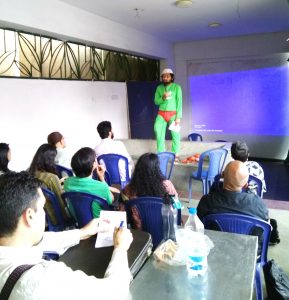
Indie superhero ‘Musal-Man’
Apart from comic book stalls, Viva La Vida, a global art experiment to collect graphic stories from people all over the world, provided an opportunity to all participants to draw a day in their lives. It was interesting to draw a typical day in my life and browse through what other visitors had created. A poet sat in a corner, with an old typewriter – he composed on-the-spot poems for people, who were free to pay “as they pleased”. There was an artist who made customised art and drawings on rice grains, and of course the ubiquitous caricature artist.
As the sky darkened and the day came to a close, I went home with a big stack of comic books in my arms, some memorable conversations running through my mind, the feeling of “why doesn’t this happen more often?!”, and the anticipation for the next event.
Nice coverage of the event. It is good to hear about events focusing on comic books and independent art.