The Bicycle is the simplest solution to the world’s most complex problems. As Chris Broadman says in The Guardian, “Pick a crisis and you’ll probably find cycling is a solution”. Cities across the world, including Italy and Spain which have registered high COVID fatalities, are enabling cycling in these troubled times.
Berlin, Bogota, Auckland, Budapest, Mexico City are rolling out “emergency” cycleways to boost bicycle use during the COVID pandemic, besides planning an increase in their city’s permanent cycling network. Calgary, Vancouver, Oakland, Philadelphia, Denver, Minneapolis, have opened up some streets only for cycling and walking.
In New York, San Francisco, Berlin and across the UK, bicycle shops are considered an essential service and allowed to remain open. France has declared that post their lockdown “the bicycle will be the principle means of transport enabling social distancing.”
The World Health Organization (WHO) also recommends cycling during the COVID-19 crisis. According to WHO:
- Better bicycle accessibility can support economic recovery after COVID-19
- Bicycling can improve public health and quality of life
- Bicycling infrastructure can help cities become more resilient to future shocks
In Bengaluru, the cycling community, doctors, environmentalists and urban planners have joined forces with Dr Arvind Bhateja, cyclist and neurosurgeon, and Bicycle Mayor Sathya Sankaran, to ask the government to revive cities with the bicycle post lockdown. Their message – let’s not go back to old habits; let’s use the bicycle to reduce traffic and stress, improve health and air quality, and to renew our cities.
The campaign #ResetBengaluruWithCycling asks the government to:
- Declare bicycle sale and repair shops as essential services immediately, so that they wouldn’t have to be closed during curfew hours/Sundays.
- People on bicycles shouldn’t need a pass to move around during curfew hours/Sundays.
- Dedicate neighbourhood shopping streets for walking/cycling only, so as to provide adequate space for physical distancing. We are identifying these streets through crowdsourcing.
- Dedicate lanes on major roads for bicycle movement.
The campaign has received wide response from citizens and civic/urban experts.
Speaking in support of the campaign, Sudeept Maiti of WRI, who is an urban designer and cyclist, says,
“The pandemic has shown the need for our cities to be more resilient. Here is an opportunity to pedal into a resilient, safe and pollution-free city. It’s time for Bengaluru to reset and redefine what a people-friendly city can be.”
Sonal Kulkarni, a Bengaluru-based urban transport planner says,
“This pandemic is an opportunity for city managers to make cities a sandbox for resilient solutions for citizen circulation. Transit management plays a big role going forward and solutions like cycling can now be given a fair chance. The protocol post lockdown should circle around providing space on city streets for walking and cycling in a big way as these modes limit radial distance while providing adequate social distancing.”
Bengaluru Police Commissioner Bhaskar Rao supported the campaign, and said that citizens should come out and cycle.
Former Bengaluru Police Commissioner M N Reddi also tweeted that a campaign should be started to introduce bicycle lanes in the city.
Proposal submitted to authorities
The Bicycle Mayor has submitted a list of neighbourhood roads to authorities, with a proposal to make these roads vehicle-free and to allow only pedestrians and cyclists for three months or until such time the city is declared COVID-free.
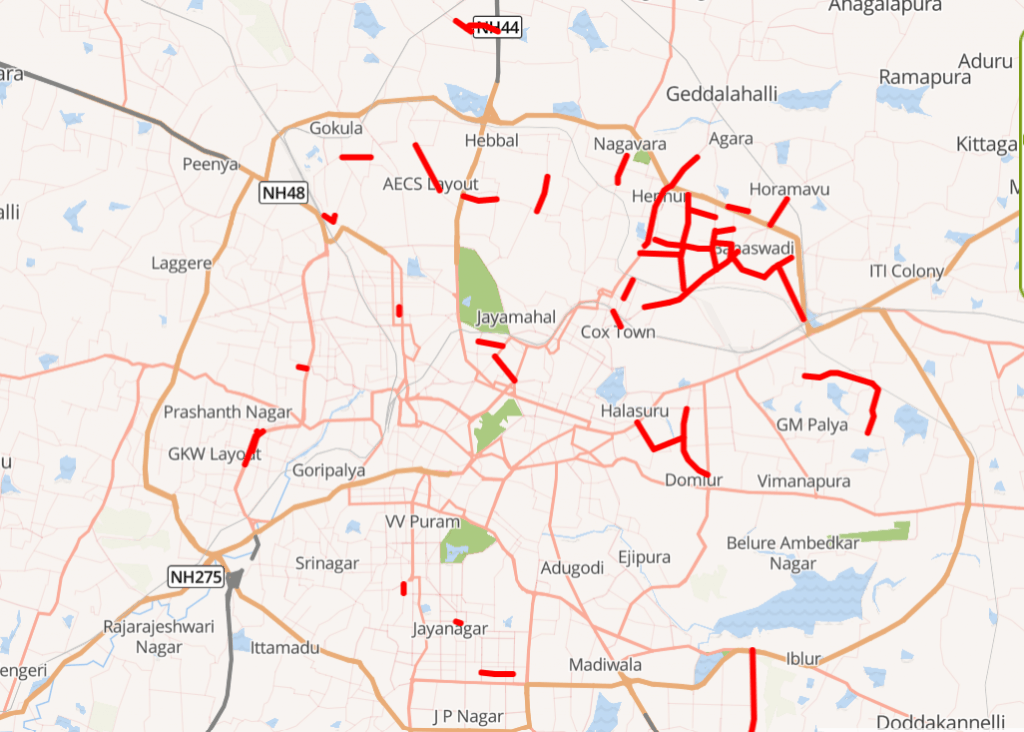
As of now, 193 roads have been identified. View the detailed list here.
We have also requested that a lane on main carriageways be dedicated to cyclists on the following roads for three months or until such time the city is declared COVID-free:
- Outer Ring Road between Silkboard and Tin Factory – 18 km
- Whitefield Main Road from Tin Factory to Hope Farm – 10 km
- Hosur Road from Madivala check post to Bommasandra Indl Estate – 16 km
- Jigani Road from Hosur Road to Bannerghatta Road Junction, Jigani – 8 km
- Tumkur Road from Soap factory Metro Station to Jalahalli Cross – 5 km
Great initiative, definitely need to enhance cycling culture in the City. However, I don’t quite understand on what basis these 193 routes have been decided. Looking at the map there’s no obvious reason and most routes have disconnected and loose ends. Identification of a proper connected network, with nodes at metro stations for example would be ideal.