Way back in 2007, a Comprehensive Traffic and Transport Proposal was given by Government of India. As per that, we had the Phase 1 Metro in Bengaluru, which is now being constructed, feeder Monorail / Light Rail, Bus Rapid Transit and Suburban Rail. This can be found here: CTTP 2007
From 2007 till 2015, the population has grown tremendously. So many vehicles have added to Bangalore Roads. New comers to Bangalore, especially bachelors who come from other cities come with some clothes and documents after they get their first job or in search of the job. Initially they manage with City Buses, then upgrade to a Bike / Scooter. They get married, move to an independent house/flat from a PG or shared room accomodation and then buy a car. Nowadays with good purchasing power, people are directly going to an Entry Level Sedan or a B-Class hatch such as Swift / i20. Gone are the days when people used to buy second handle Maruthi 800 as their first car. They will also buy a Scooter for wife to drop the kid to school. If wife is also working, a second women friendly hatchback such as i10 or Celerio. They also bring in their aged parents from remote city.
A single person moving to Bangalore is having such a big foot print. Imagine, there are 1 Lakh plus people getting added to Bangalore every year.
This population is getting added in core Bangalore itself. If we take planned Metro cities like London / New York / Boston, mainly people live in Suburbs and work in Metro cities or work in Suburbs itself. Bangalore is not planned that way. We live in the Metro city and work in Metro city!
Suburban Rail becomes the core transport infrastructure with vehicle restrictions in the core city by charging heavily on car parking, entry tolls and congestion pricing like in London and Singapore. CTTP 2007 recommended Suburban Rail which forms the core of this kind of living. When we can travel from Tumkur to Bangalore in 1 hour, travelling from Banashankari to ITPL takes 2-3 hours. Rent in Tumkur is almost half of the rent in Banashankari. Real estate developers should look into these kind of suburbs and develop real estate and also push or in other words ‘lobby’ Government to push Suburban Rail.

Then comes the BRTS on the Outer Ring Road. We have the Eastern Outer Ring Road from Silkboard to Hebbal almost signal-free. Except for few glitches like the K R Puram Flyover, we could have a full-fledged Bus Rapid Transit System. This is a highly sustainable mode of transport compared to Metro or any other rail-based transport which needs years of construction. Ahmedabad could make 89 kms of BRTS in two years. We could have only 10+7 – 17 kms of Metro in almost eight years! Government of Karnataka is afraid of failure of BRTS in Delhi. However BRTS is successfully implemented in many other cities in India, China, Curitiba and Bogota.
We could also have BRTS on wide one-way roads of Bengaluru such as JC Road, KG Road, Tank Bund Road, Mission Road etc. A volvo service with dedicated bus lane is as good as Metro.
Monorails that never tookoff
Then we have the Western Portion of Ring Road for which Monorail / Light Rail was proposed along with closer to Bangalore portion of Magadi Road to Prasanna Theatre. Finally it was decided to have Light Rail and a DPR was prepared by a UK based consultant, as you can read here.
Monorail was also proposed between Foodworld Junction in Katriguppe to National College Circle Metro station. It remains in paper. We had so many proposals on Monorail from Scomi such as this:
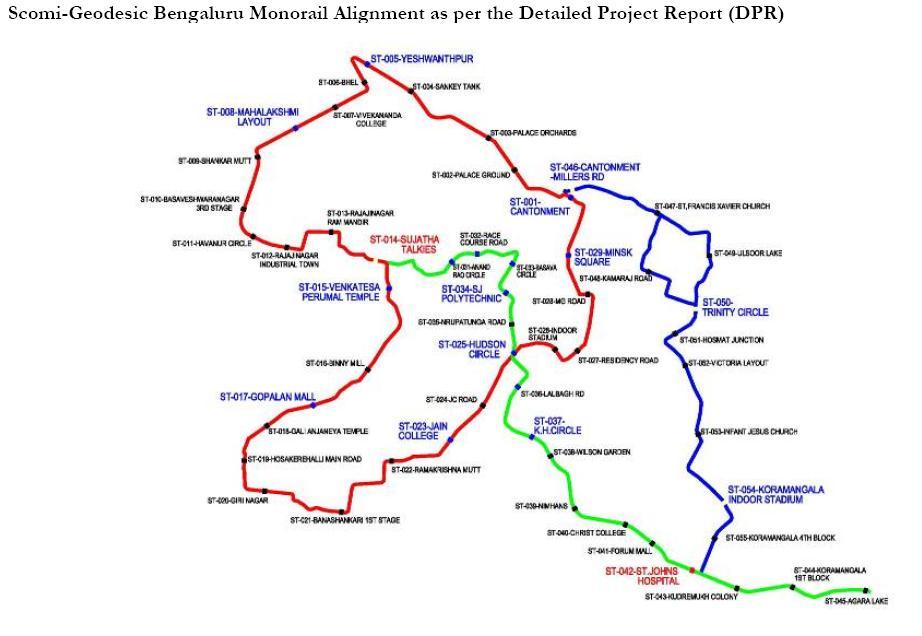
There was also a proposal of monorail from Majestic to Agara, as reported by newpapers.
However, there has been no progress on any monorail projects. Mumbai started the project of monorail in 2008 and already has the monorail running.
Government of Karnataka’s practice has been to simply plan for Metro across the city, which is supported by many. I hope our grand children might be able to travel in Metro, but by that time Bengaluru might not be a city to move around. Techies might get work from home option, but what about others who have to travel to their work? This has been the fate of Bengalureans. Travelling two kms here takes 30 minutes.
Entire city has been dying from the traffic. Where is the end? People travelling to Vidhana Soudha from Kumara Krupa with red beacon on car cannot realise this. Government of Karnataka has to open its eyes towards CTTP 2007 as well as other sustainable transport options and start working on it parallely.
Monorail has failed worldwide. It is history. LRTS is a better option.