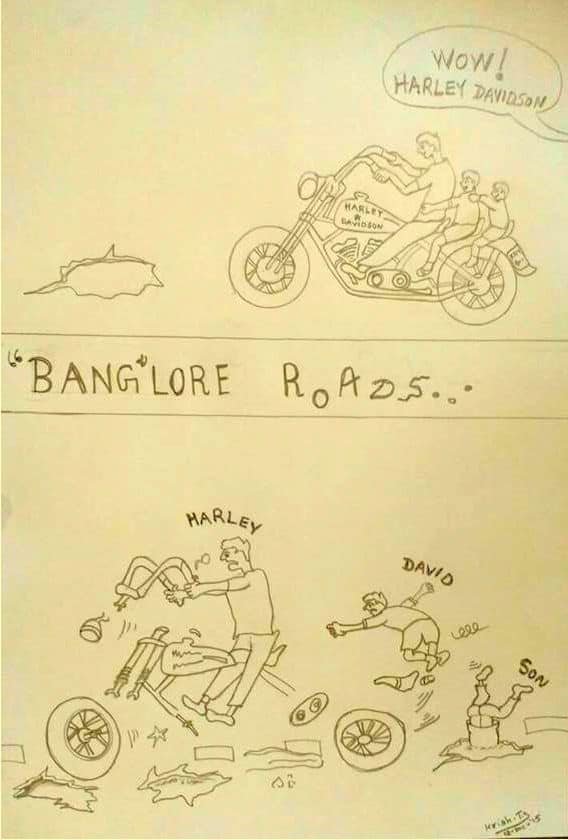
Super bikes and Bengaluru roads, visualised by a cartoonist.
So what does it mean to open a superbike in a city where roads are a death trap even for the normal ones?
I have been a biker from the time I was in college. The feeling of being free with the air in your face was an unparalleled experience and I was hooked after my ride. My first bike that was a Yamaha RX and there was no looking back from there on.
I have owned a number of bikes—the Royal Enfield Thunderbird, Duke 390, Kawasaki Ninja 650, Yamaha R15 , Kawasaki Ninja 1000 and the Triumph Daytona 675r. This wish list is never ending.
Superbikes, as any serious biker will tell, are unsuited for everyday use on Indian roads. These are not made to be ridden in bumper to bumper traffic. They are meant for high speed roads. They generate a lot of heat and it gets very uncomfortable if you are stuck in traffic. When I did commute to office on them, I’d leave very early or very late to avoid peak hour traffic.
Now I shudder at the thought of riding them through the city. The abysmal condition of the roads deteriorates with every shower and another layer of asphalt is washed away. It leaves a gaping gap that we optimistically call a pothole. They are closer to craters in shape and size in my opinion.
To add to this mess, they are filled with water after the showers and there is nothing that allows you to guess how deep you are going to go in. You just trust your bike and hope for the best. Paradoxically, the speed limit for a bike in India is 50 kmph and we barely reach that on regular roads which do not allow for speeding. So it is a catch 22 situation for us.
One can say that it is futile to argue about city road conditions through the prism of superbikes given their speed and power or the fact that even regular vehicles don’t have acceptable roads. But we need to wake up and smell the coffee. Biking has become a very popular hobby among the young crowd. Bengaluru is on the list of companies looking to capture a slice of the growing market. Most brands have a showroom in the city – Harley Davidson, Kawasaki, Honda, Triumph, BMW even have service centres right here in Bengaluru. Just look at the number biking groups based out of Bengaluru alone!
The hobby is still at a nascent stage in our country. Racing a superbike is a responsibility where you respect its power. It is very easy to allow oneself to get carried away and be foolishly challenged and get hurt. Invest in protective gear because it is better to sweat than bleed (this is true for even those people who don’t have superbikes). Get to a school where they teach you how to ride responsibly. Public roads are not a race track. Don’t mistake them for them to be one, because you will not only end up hurting yourself, but also others.
So the powers to be who are in-charge of infrastructure in our city – while the emphasis is on public transport, mobility in the coming times could also be about super bikes and powerful cars. Granted, we can’t accommodate all of their requirements in a city like Bengaluru, but while we are racing (pun intended) towards a future, why let our infrastructure be a relic of the past?
So true Shashidhar ….
The deplorable condition of our roads overlayed by the civic authorities apathy and the dangerous driving styles adopted by many motorists make biking anything but pleasurable and safe.
Such a pity ….
Don’t you know we are having a democratic governament in our nation and a population of 1.35 billion out of which nearly 80% are not capable to race at all? The main responsibility of our governamemts are to cater the needs of the majority not a race Le tracks motor vehicles. No doubt transportation place major role to attain the responsibility of governments to cater the needs of spread out 1.35 billion population. Our governments arecncentratimg on National higheys and State High ways than heavily used city internal roads. So instead of race through the city internal roads have patient driving to maintain them as Relics .