How does a national downturn affect a small, local market in this city? If we want to understand that, we should probably look at the Pudupet spare parts market.
The nation-wide auto sector slowdown has hit the livelihoods of many traders at Pudupet, a second hand vehicle-parts market off Egmore. There has been a slump in metal prices due to the slowdown, a factor that has probably had the most damaging impact on the Pudupet traders.
“There has been a steep fall in metal prices: Iron price has declined to Rs 16 from Rs 25 and aluminium costs Rs 63 per kilo today against Rs 98 from three months ago,” said Sheik Abdul Khader, a trader at Pudupet Market.
The butterfly effect
The iron and steel industry is reeling under the impact of many macro components today. Most importantly, vehicle prices have shot up leading to a fall in sales, and hence curtailment of production. The manufacturing slowdown has reduced demand in the metals industry, triggering a fall in metal prices.
“The industry relies on two major industries — automobile and construction. Due to a series of central government regulations such as mandatory All-time Headlamp On (AHO) rule, transition from BS III to BS IV, mandatory ABS / CBS rule and mandatory 5-year insurance rule, the input costs in the manufacturing processes of vehicles have increased. The prices of almost all vehicles are almost 40 per cent higher than what they were three years ago. As the burden invariably falls on the consumers, there are less takers for the vehicles. The slowdown has not only affected the automobile manufacturers, but also the iron and aluminium suppliers (part suppliers),” explained S Ben Raja, a former journalist turned business analyst.
Real estate has also been sluggish following passage of Tamil Nadu’s Real Estate Regulation Act, 2016 and ban on the sale of agricultural lands. “The drop in the construction business affected all the industries associated with it, including the country’s metal industry,” added Ben Raja.
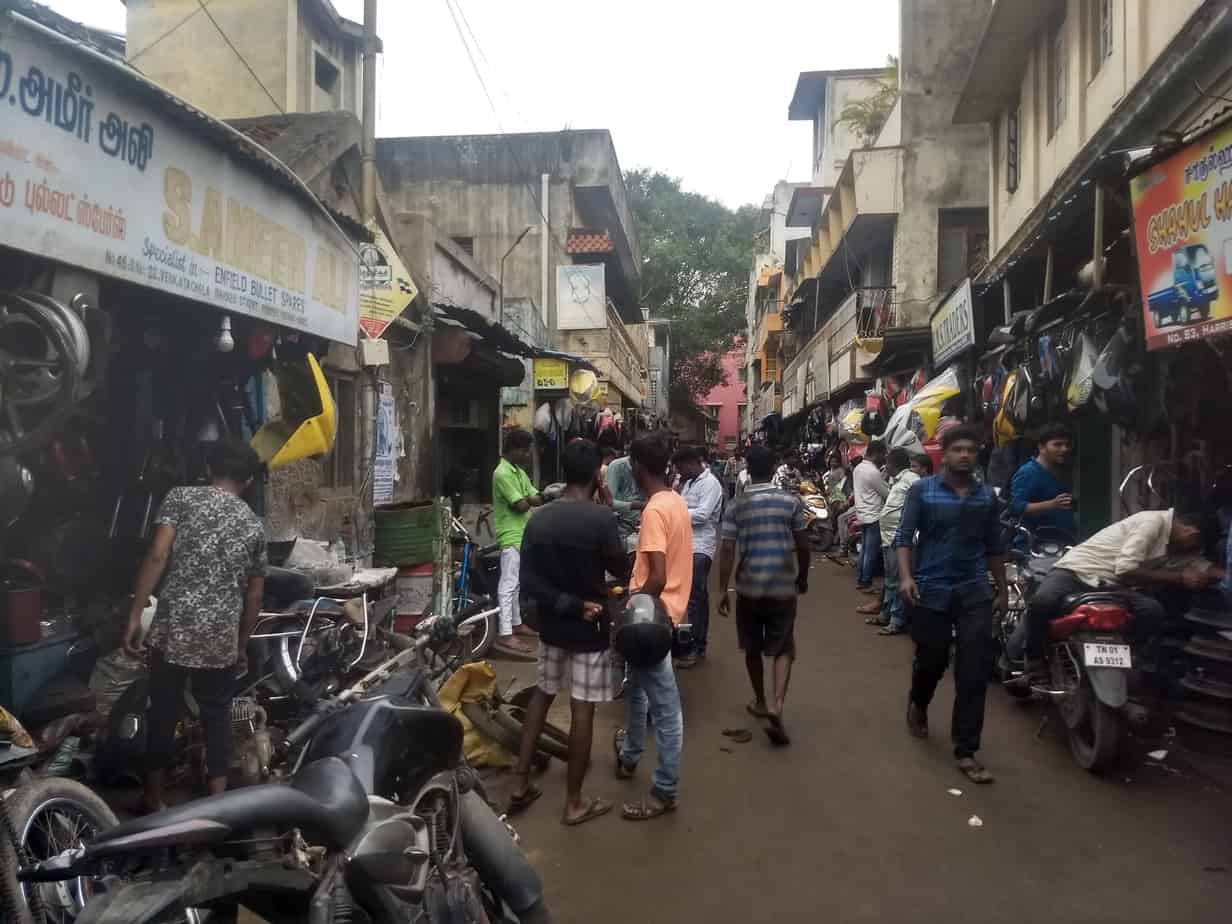
A view of the Pudupet two-wheeler market. Pic: Laasya Shekhar
Traders on the spot
But how does this affect the traders here in Pudupet? Business in this market is solely dependent on citizens selling their second hand vehicles. These vehicles are dismantled and their spare parts are sold after repairing and cleaning. However, fewer people are willing to sell their defunct vehicles here now, says Sheik Abdul Khader.
“We set a price for the vehicle based on the cost of the metal (read, iron) component. Where we paid Rs 4,500 for a car in July, we can only pay less than Rs 3000 now because of low metal prices. This is naturally stopping many citizens from selling their vehicles,” explained Kumaravelu V, a trader, who sells headlights at the market.
Describing his plight and that of fellow traders, Kumaravelu said, “We used to make good money. But now, most traders’ businesses are riding high on debts.”
S A Kaladurai, a 49-year-old mechanic speaks as he dismantled an old Indica car. “I used to dismantle a car everyday and take home a grand. Now, days go by without work,” he rued.
A major shift on the cards
A fortnight ago, on September 15th, the state government unveiled the Tamil Nadu New Electric Vehicles Policy 2019, which is expected to give a big boost to the EV ecosystem. The government offers 100 per cent road tax exemption and waivers on registration fees to EVs under the central government policy.
Now, the moot question is: are the Pudupet traders ready to embrace the change? The answer is no. Traders and employees say they have not thought of any strategies to deal with the transition. “All I know is how to repair engine parts in cars,” said Lokesh A, a 22-year-old mechanic, who has studied till class eight.
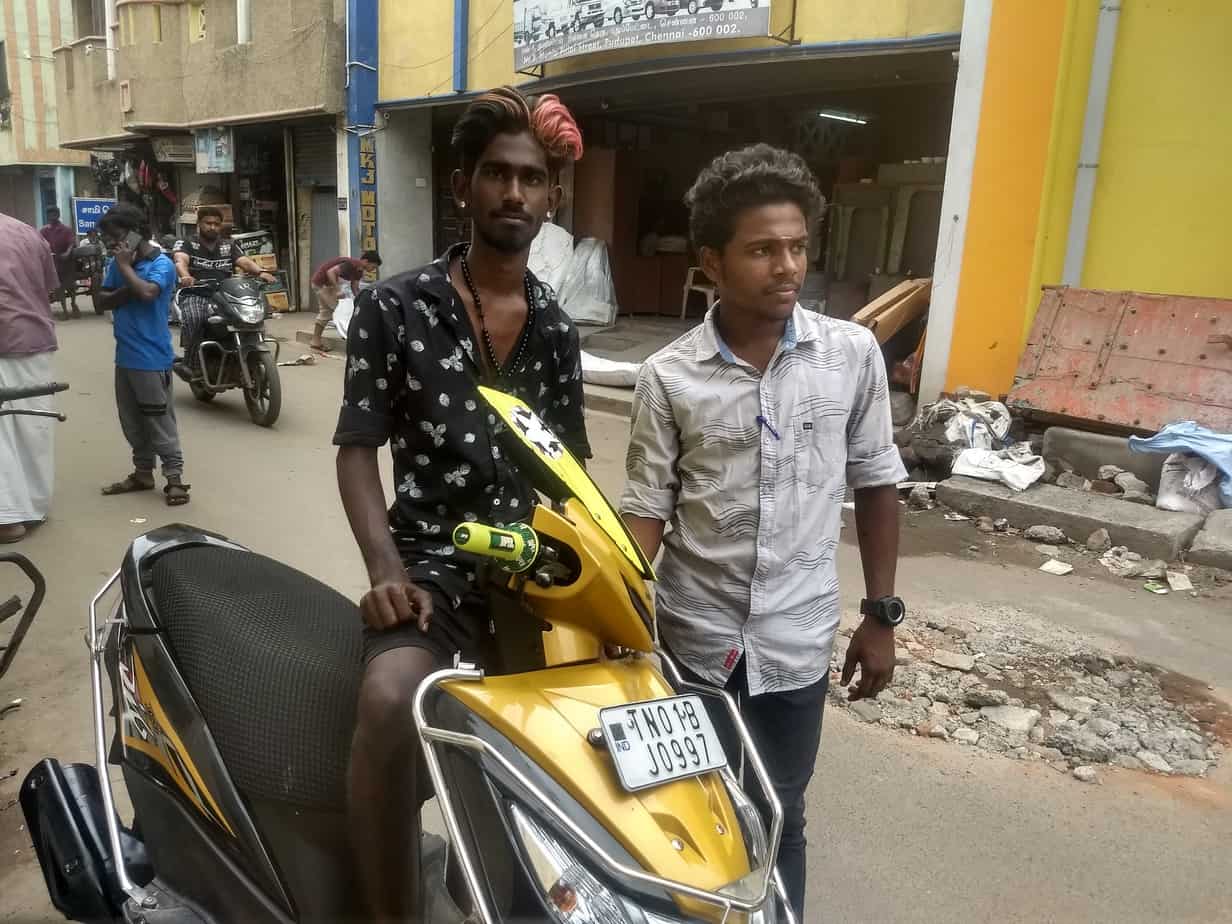
For many youngsters such as A Lokesh (left), repairing spare parts and dismantling vehicles is the only skill known. Pic: Laasya Shekhar
Many passionate workers such as Lokesh are dependent on the spare parts from petrol and diesel vehicles. “The boom in electric vehicles will rob many traders and uneducated mechanics like him of their livelihood. We will still get the spare parts from electric vehicles, but it won’t be profitable. While a petrol and diesel car has 280 spare parts, an electric one barely has 40 parts. Just imagine how many spare part owners would have to close the shutters,” said Thulasiram, member of Motor Vehicle Spare parts owners association.
However, experts put forth an optimistic view. “Traders should think of evolving, because electric vehicles are the future. Once electric vehicles come to the market, they will learn to repair them in no time,” Deepak Mohan, CEO of Ozone Motors.
He also said that the transition would be smooth and slow. “Only ten per cent of vehicles in the state are expected to go electric in the next five years. Also, the MSME is announcing courses for electric vehicles, a scope for these mechanics to grow,” said Deepak.