At a time when terms like ‘green’ or ‘eco-friendly’ are carelessly bandied about, it is indeed heartening to find a focussed, action oriented initiative. The ‘Be the Change Conference – Food, Health and Climate Change’, on December 4th-5th is being organised with specific objectives:
• Saying No to processed foods in schools
• Make an appeal to NCERT (the central agency that also publishes textbooks) and state education boards to include healthy eating in relevant syllabii
• Regulation of processed and genetically modified foods
The conference is organised by the Bhoomi Network, a network of concerned individuals who strongly believes that food and health, along with climate change, are expected to become crucial issues in the future. These issues will affect our children’s lives and learning potential.
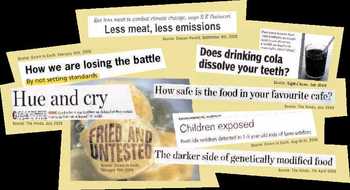
Courtesy: Bhoomi Network.
A unique opportunity for parents, students, educators, institutions and organisations, this conference will bring together some passionate and brilliant thinkers in these areas, to share their understanding and research findings and deliberate on positive ways forward.
The conference includes presentations and discussions that will address a range of issues related to food, health and climate change – for parents, educators, children, educational institutions and all concerned citizens. For instance,
• How processed foods affect children’s behaviour and learning abilities. By Dr Shekar Seshadri
• How can we work towards healthier eating in schools and families. By TS Ananthu and Sumitra Gautama
• What every Indian citizen needs to understand about food and agriculture today. By Dr Vandana Shiva
The conference will provide opportunities for interacting with heads of institutions and educators, professionals and NGOs for meaningful discussions and action. There will be organic food at the conference and there will also be food for soul, in the form of a Sufi music programme by Mir Mukhthiyar Ali.
Bhoomi Network for Sustainable Living, a non-profit, was started in Bangalore in 2007 by KNA Foundation for Education. Initiated by Seetha Ananthasivan along with other other like minded individuals, Aruna Kalahastri, Jayawanth Bharadwaj, Ramesh Sivaram, Rajesh Thakkar, Ram M K and Neeta Thakur. Seetha is a trustee of KNA Foundation, a charitable trust and the executive trustee of Prakriya Green Wisdom School.
For more information, contact:
Bhoomi Network
Email: bhoomi[dot]network[at]gmail[dot]com
Address: #70, Chikkanayakanahalli Road, Off Sarjapur Road, Carmelaram Post
Phone: 28441173, 9243460658
Bhoomi Network seeks to support individuals and organisations working on programmes related to food, health and climate change. The Network particularly identified this as a focus, since most of us connect sustainability with renewable energy, transport or waste management; most often, ignoring the inherent connections between food and climate change.
Simultaneously recognising the importance of schools as nodal points for disseminating ideas regarding food, health and climate change, Bhoomi Network offers programmes and projects for teachers and students. It has already been working with children of Prakriya school on projects like: Creating a pond ecosystem (2005), Understanding sustainable development (2006), Saving a lake eco-system (2007), and eco(dry) toilet, paper recycling, organic gardening (2008). In December 2008, the Network organised an Earth Citizenship Seminar where a dozen schools participated and children presented papers on ways to be an earth citizen.
At the Bhoomi Conference this Friday, Bhoomi Network would be releasing the first issue of its magazine – Bhoomi – that will share various kinds of resources (on food, health and climate change) – for schools and colleges and individuals. Subscription to the magazine entitles subscribers to attend monthly meetings and workshops of the Bhoomi Network.
A docudrama on “Junk Food” produced by Bhoomi Network will also be released during the conference. The Network hopes to continue making documentaries on related issues and make them available through their website.
Post-conference, the Network would be looking to appeal to NCERT and state school boards regarding reviewing the syllabus on food, where at present there is no information about the food situation today. They hope children will get to learn early on, facts about processed and junk foods, chemicals in processed foods and in food crops, real issues of nutrition and so on. ⊕