Tasked with creating an app that addresses a ‘community problem or issue’, five Bengaluru girls won $10,000 (approximately Rs 6.4 lakh) at Technovation, an international technology entrepreneurship competition, to further develop their app designed to keep waste off the streets of Bengaluru.
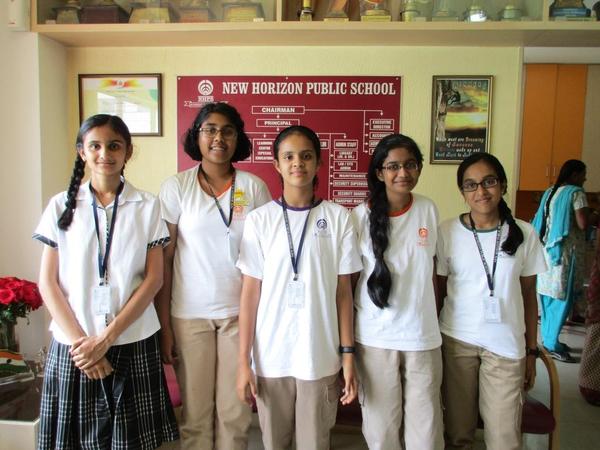
Team Pentechan. From left to right: Mahima, Sanjana, Swasthi, Anupama, Navyasree. Pic: Holly Thorpe
Anupama N, Sanjana Vasanth, Mahima Mehendale, Navyasree B and Swasthi P Rao, all of 14 years and in Class 9 at New Horizon Public School, won the prize money when they took first place in the competition in San Francisco. They competed in the middle school division under the team name Pentechan.
Their app, called Sellixo, allows users to buy and sell dry waste in one of three categories: paper, metal and plastic. Ads are posted with description of the waste, expected amount, as well as the seller’s contact information. Buyers can then select an ad and make the purchase. The team said the app targets a variety of audiences: apartments, scrap dealers and even recycling centres. Currently, the Sellixo prototype is available only on Android platforms, and is free to download. As on July 9th, the app had reached over 1,000 downloads. You can view the pitch for the app here.
What’s next for Sellixo?
The prize money that the girls have won will act as seed funding to develop the app further. Until the team members turn 18, Technovation will maintain the app. “They will just be keeping the app alive,” Anupama said. “Then we can decide if we want to take the app forward.” The girls stated they were still waiting for details on this process.
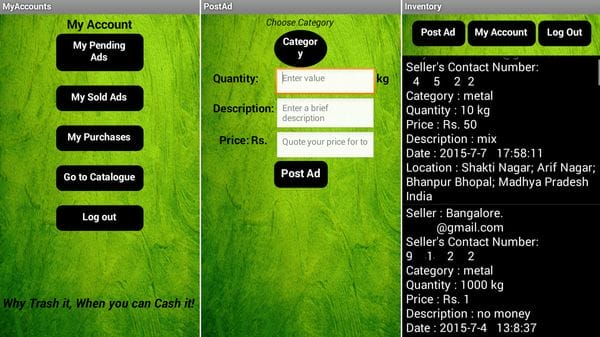
Screen-grab of the Sellixo app in its current avatar
They plan to add a number of new features, including an in-app chat feature, a virtual wallet which would allow for online payment, and photo capabilities, so sellers can post pictures of their waste. In addition, they want to incorporate a user rating system to deter misuse and bad behaviour.
They also plan to add two new categories: e-waste and biomedical waste. These categories would give people a place to dispose of items they might normally throw out with dry waste. “People don’t know what to do with it,” Navyasree said. Biomedical waste such as used syringes or expired tablets can be dangerous if thrown out with regular waste, and e-waste such as old electronics or batteries can be harmful to health if disposed of improperly. “We learned in Biology last year that they usually burn it and it releases harmful fumes into the air,” Sanjana said, “and that the burning of e-waste is actually more harmful than the normal burning of dry waste.”
The team also plans to add more languages to the app. Currently it is entirely in English, but they said including more Indian languages—such as Hindi, at the very least—would make it more accessible to users.
The development process: Why waste management?
The team was selected by their school to participate in an after-school program led by WeTech (Women Enhancing Technology), a programme through the Institute of International Education that aims to connect girls and women to careers in technology. WeTech connected the girls with three volunteer mentors from the international investment banking firm, Goldman Sachs.
Over the course of the six months leading up to the competition, the team brainstormed and designed everything: the business plan, app idea, and even the name ‘Sellixo’, which directly translates to ‘sell waste’.
Apps/websites for waste management
I Got Garbage (Bengaluru)
www.igotgarbage.com
facebook.com/IGotGarbage
BinBag (Bengaluru)
www.binbag.in
facebook.com/getbinbag
Recycle Guru (Bengaluru)
www.recycleguru.in
Kabadiwalla (Bhopal, Indore, Jabalpur, Gwalior and Damoh)
www.thekabadiwala.com
facebook.com/thekabadiwala
Kuppathotti (Chennai and Pune)
www.kuppathotti.com
facebook.com/KuppathottiOnlineTrash
“There was one day where the internet was not working and we could not do any coding. So we decided to come up with a name,” Sanjana said. After experimenting on Google Translate, the group found a nice, easy-to-pronounce word: ‘lixo’, or ‘waste’ in Portuguese.
But the app didn’t always have an environmental focus. It was only after a few scrapped ideas and some advice from their mentors that they considered waste management. Before developing Sellixo, the girls had considered an app that would allow eateries to deliver leftover food to orphanages. However, survey results and complications with respect to how to safely deliver day-old food deterred them from pursuing the idea.
They then contemplated an app that would allow people to take photographs of empty spaces and receive recommendations on what could be planted in that space. It was from there that they began to consider other environmental impacts. “As you can see, waste is dumped on the road. It is a widespread and very relevant problem, not only in India, but also for many developing countries,” Sanjana said.
“This was just a dream before Technovation”
For Anupama and Sanjana, the competition was a gateway to a career they had already planned on pursuing. “I’ve always wanted to be an engineer and this was a practical insight into the IT sector. This was just a dream before Technovation happened,” Anupama said. For the others, while a career in tech may not be their main focus, it has become a possibility. “Before Technovation, it was not an option,” Mahima said. “After this, I started to like technology.”
Pentechan competed against two teams from the US and one from Mexico, whose apps addressed issues such as wellness and youth obesity. They were one of 75 teams from India to compete. The teams gave their final pitch at Yelp Headquarters in San Francisco on June 24th 2015. The event included networking opportunities and workshops for all teams that made it to the finals.
A team from National Public School, Indiranagar in Bengaluru also made it to finals in the high school division for their app cAppAble, which helps disabled individuals find employment. The winners in the high school division, from Nigeria, also created an app focusing on waste management.
Sanjana said: “When I was small, I’d see all the waste and think: “Why aren’t they doing anything?”, and now I end up doing something about it.” The girls hope the app can be expanded beyond Bengaluru to other cities in India, and other countries dealing with waste management problems.
Related Articles
Carpooling in Bangalore: Apps and websites to get you started
Don’t panic – these mobile apps can get you out of danger
Bangalore Traffic Police – a new Android app for Bangalore’s road users
Great!! Another one I came across was http://www.encashea.com