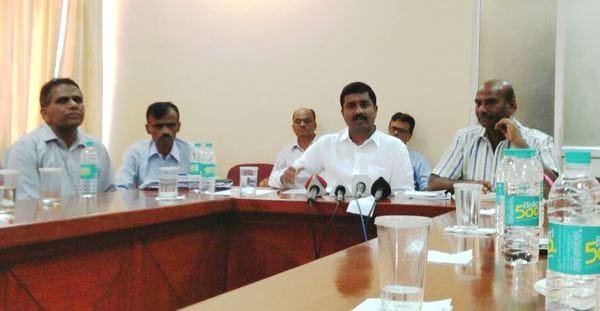
BBMP taxation committee chairman Shivaraju addressing media. Pic: Shree D N
Bruhat Bengaluru Maha Nagara Palike (BBMP) has started pre-budget consultations with various sections of society including nongovernmental organisations, resident welfare associations and journalists. The consultation with journalists was done in Malleshwaram on March 16, 2016.
Chairman of Standing Committee on Taxation, M Shivaraju chaired the meeting. He said journalists had their eyes and ears on the ground and knew what was wrong where, hence capable of advising based on ground realities. Many journalists from electronic and print media were present in the meeting.
The inputs given by the journalists for budget and in general:
- Bengaluru’s outskirts urgently need more and more saplings to be planted, because the tree cover of the city is deteriorating day by day. Budget needs to be allocated for this.
- Existing parks need to have more trees planted. 323 parks in the city do not have borewells. There should be good facility to provide water for the plants.
- The trees planted should have strong roots, should have low maintenance and should not fall during rains or wind.
- The species chosen to plant should yield flowers and fruits, to attract birds.
- Planting trees in sites of 40X30 ft dimension and above while constructing houses should be made compulsory in the plan itself.
- BBMP buildings and parks should start harvesting rainwater seriously to set an example for the public. Budget should be allocated for this.
- Plans should be made to bring back the lost birds to Bangalore’s terrains, in consultation with experts.
- Tenders and DPRs should also be in Kannada to make it easy for all those who want to understand what’s in it.
- Cleanliness should be improved in BBMP-run markets, to attract more and more people directly to markets.
- Every ward should have a ward committee to make it easy for the administration to monitor the works being done.
- There should be some emergency fund given to every ward, to fill the broken potholes or broken equipment in park, on an urgent basis, instead of waiting for years to fix them.
- Emergency funds can also help the clean up drives in the areas that refuse to self-fund the drives, unlike the Ugly Indian model where the clean ups are self-funded.
- Pourakarmikas inside BBMP limits should be given a workshop to make them understand how to segregate waste.
- Door to door waste collection should happen daily or once in two days, to avoid dumps.
- The city should have a solution for slaughterhouse waste. An abattoir, incineration/ disposal plant needs to be set up in Bangalore for this. Currently BBMP has outsourced the collection of animal waste to agencies, but no one knows what these agencies do with the waste. Sometimes the waste is being dumped in the stormwater drains or abandoned places leading to stench.
- Every ward should have community composting solutions. Corner areas in parks in every ward can be used for this. Budget should make provision for this activity.
- Plastic ban should be implemented effectively. BBMP Sahaaya website should have an option to report plastic ban violations.
- More toilets are needed across Bangalore, and there should be provision for maintaining existing toilets. There should be budget allocated for this. Paid toilets are not maintaining cleanliness. This should be brought on track.
- BBMP schools need to be improved. Teachers should be given uniforms, and parent-teacher meetings should be conducted every month. Incentives should be given to poor parents to attend these meetings. Diaries should be maintained for students. The teachers in these schools are highly qualified unlike private schools, this strength needs to be capitalised.
- BBMP students need to be given scholarships in every semester.
- Subcontracts in markets should be controlled, because it is a loss of income for BBMP.
- Slums areas should be provided proper water and sanitation facilities. Health related facilities should be there near slums, because people in slums are not aware where they can go to get their problems sorted.
- Street vendors are now forced to pay bribes to police as there is no licensing system yet. Start the procedure of regularising street vendors and issuing id cards for them.
- Betterment charges should be paid by everyone, including powerful corporates. That will increase the revenue collected by the BBMP.
- Stray dog menace needs to be controlled.
- Include measures to promote Kannada in administration.
- Include conflict of interest clause in SWM contracts, especially in door to door garbage collection autos. In some wards, health inspectors hold garbage autos and there is no one to question them when they don’t come to pick the waste.
- Stop diverting funds meant for welfare programmes to other schemes. Instead include it in the next year’s budget for welfare programmes.
Shivaraju said the BBMP budget will be presented later this month or in April. The funds from the state budget and the central budget will be consolidated and the consultation inputs will be considered and consolidated before the budget. He added that the revised property tax rates will bring an extra income of 600-800 crores to the BBMP.
Related Articles
Property tax to be hiked, BBMP budget will be realistic: Mayor
The tax hole BBMP does not talk about
Bangalore is underserved, because it is undertaxed