How can I find my name in electoral roll?
Here is the final voter roll published in the website of Chief Electoral Officer (CEO), Karnataka: http://164.100.80.163/Teachers_Grd/a1.html
Where are the voting booths?
The names of all voters and their respective voting booths are available at http://ashwinmahesh.in/mlcvote.htm. (Lok Satta compiled this list with data from CEO office.) In another tool http://mlc2012.herokuapp.com/, on entering your name, you can get the address and map to your booth.
What is preferential voting?
In the preferential voting system, voters should rank candidates in their order of preference. You have to put ‘1′ against the name of the candidate you prefer most (this vote is called first preference vote), ‘2′ against the name of next preferred candidate and so on. Ballot paper will have only names of candidates and not party symbols.
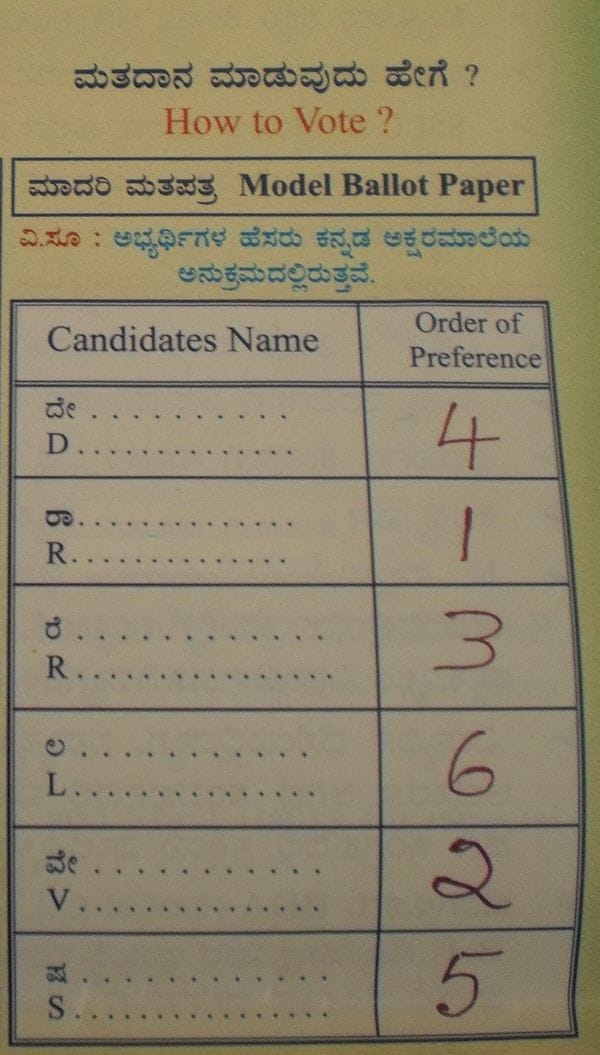
Sample ballot paper. Courtesy BJP
You need to carry any government recognised ID card while going to vote – it is not mandatory to carry the voter ID card.
During counting, if a single candidate gets more than 51% of the first preference votes, he is elected directly. If there is no such candidate, another system is used. The least competent candidates – those who get the lowest number of first preference votes – are removed one by one.
When one candidate is removed, all the first preference votes he got, is transferred to the candidate who was ranked second by voters in those ballot papers. Candidates are eliminated this way until one winner emerges. It is not mandatory for voters to rank all candidates. If you want to give your vote to one candidate alone, you can rank him/her as ‘1′, and not rank anyone else. In that case, if your candidate is not elected, your vote will not go to any other candidate.
Voting is on Sunday, June 10th, between 8 am and 4 pm. The counting starts on June 13th and will be completed by 15th.
⊕
sir i have registered my name in the list but nor i got my voter card nor i have my name in the list why our indian govertment is so careless about fresher’s in future it will affect our life so atleast get our voter id it is 3times i have applied