My Bhumi, a Bangalore-based NGO, in conjunction with the Karnataka State Pollution Control Board (KSPCB) is working to promote an eco-friendly Ganesh Chaturthi celebration this year. Supported by Friends of Lakes, RR Nagar Cares, One Bangalore Lakes and other groups and individuals, the focus is to reach out to children through their schools, and educate them about the connection between eco-friendly Ganesha idols and lakes in Bangalore.
Children are being encouraged to get their parents to buy unpainted clay idols. If the brown idols cost more than the colourful ones they are used to, then they can go in for smaller idols to fit their budgets. By making Eco Ganesha more “trendy” than other statues, an effort is being made to change the idol stereotype.
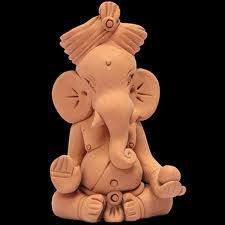
A clay idol
There are insufficient public places to immerse the idols. The lakes are few, many with immersion restrictions and many without water. After the immersion, BBMP officials have to actually break the idols to immerse them and even after this, many idols are abandoned.
The KSPCB chairman will be visiting about five schools in Vidyaranyapura and surrounding areas in the coming week, and address the children and teachers. At this weekend’s Hasiru Santhe, Friends of Lakes (FOL) will be setting up a stall to promote Eco Ganeshas.
The competition
To participate in the competition children need to submit a photograph of the Ganesh Chaturthi celebration with a two-para write-up on how they managed to celebrate the entire festival in an eco-friendly manner. At the top of the write-up, please include the following participant’s information:
Name of child
Age
Name of school
Standard in which studying
Home address
Contact phone number
Entries can be sent either by email or post/courier. The details for each mode of sending are as below:
By email –
Email the pic, write-up – ho@kspcb.gov.in
Write “Eco Ganesha Competition” in the subject line
Entries should reach on or before 1st September 2014
By post/ courier –
Send hard copies of the pic, write-up to – Karnataka State Pollution Control Board
“Parisara Bhavan”, 4th & 5th Floor,
#49, Church Street, Bangalore-560001
Superscribe the envelope “Eco Ganesha Competition”
Entries should reach on or before 5th September 2014.
Further details can be got from Ms Madhuri Subbarao, My Bhumi <madhuri_subbarao@hotmail.com> / mobile 8867700133.
Here’s to an Eco-friendly Ganesh Chaturthi celebration!
Check here, for a list of shops that are selling eco-friendly Ganesha idols this year.