Alahalli Lake & Neighborhood Development Trust (ALNDT) has organised a lake cleaning activity on Sunday 25th August 2013, 7a.m. to 10 a.m. The public is requested to spare some time to help and support the trust’s efforts to bring life back to this lake.
This Sunday’s target jobs:
– Cleaning the bund area
– Removing the plants which are covering the fencing
– Tree plantations on the bund
– Removing the parthenium and other wild bushes that have grown around the lake.
Volunteers can come with comfortable clothing and closed shoes. And if possible, with an apron and whatever gardening tools they have. Arrangements for tea/coffee and snacks have been made.

A view of Alahalli Lake (Pic: ALNDT)
Alahalli Lake, also called Avalahalli Lake/ Anjanapura Lake, is in South Bangalore, in the JP Nagar 9th Phase area. It is situated between Anjanapura and Alahalli on Amruthnagar Main Road, around 2.5 km from Konanakunte Cross, off Kanakapura Road. A part of the Hulimavu Lake Series, the lake is about 21.25 hectares, and currently under the custody of the Bangalore Development Authority (BDA).
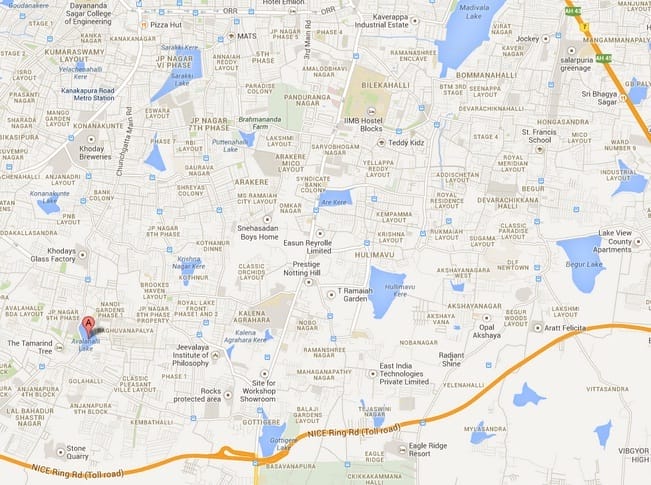
Location of Alahalli Lake (referred to as Avalahalli Lake on googlemaps)

Hulimavu Lake Series (Source: Envis)
According to Anand Yadwad, 40, Managing Trustee of ALNDT, the lake is fairly secured, having been fenced several years ago. The fence is still in place and with only a couple of access points for people to enter the lake area, the place is almost free of unscrupulous dumping that is faced by many other lakes in the city. However, subsequent to the fencing, the lake has received little attention from the authorities. No desilting or deweeding has happened in the last 10 years, as Anand can remember. Also, with new constructions in the lake area, a lot of sewage now flows into the lake, something that ALNDT is looking to stop.
About a year ago, the entire surface of the lake was covered with water hyacinth, which has slowly dried out. Presently, water is visible in about a third of the lake. Though not in prime condition, the lake provides the much needed open space in the area and its ecosystem supports lots of ducks and other water birds.
Let us sustain this water body! Join the effort.
Event Details
Place: Alahalli (Avalahalli) Lake
Date: Sunday 25th August 2013
Time: 7-10 a.m.
For further questions: Anand Yadwad, <anand.yadwad@gmail.com>, 9880244380
ANLIT is a registered trust, formed in Dec 2012, with seven trustees: Anand Yadwad, Chidambara H.S., Nithya Reddy, H.R. Shreenivas, Suresh Krishna, Vijitha Subbaiah, and Vinatha Reddy.