Fifty-five-year-old Gnana Bharathi, a scientist at the Central Leather Research Institute and a wheelchair user for over two decades, rarely takes the bus anymore. Chennai’s bus stops and termini, he says, are designed in a way that makes independent travel “nearly impossible”— from reaching the stop safely, to getting onto the platform and finally boarding the bus — without physical risk.
So, when the Greater Chennai Corporation declared the Vivekananda House Bus Stop on Kamarajar Salai as an accessible, ‘model bus stop’, he decided to try it.
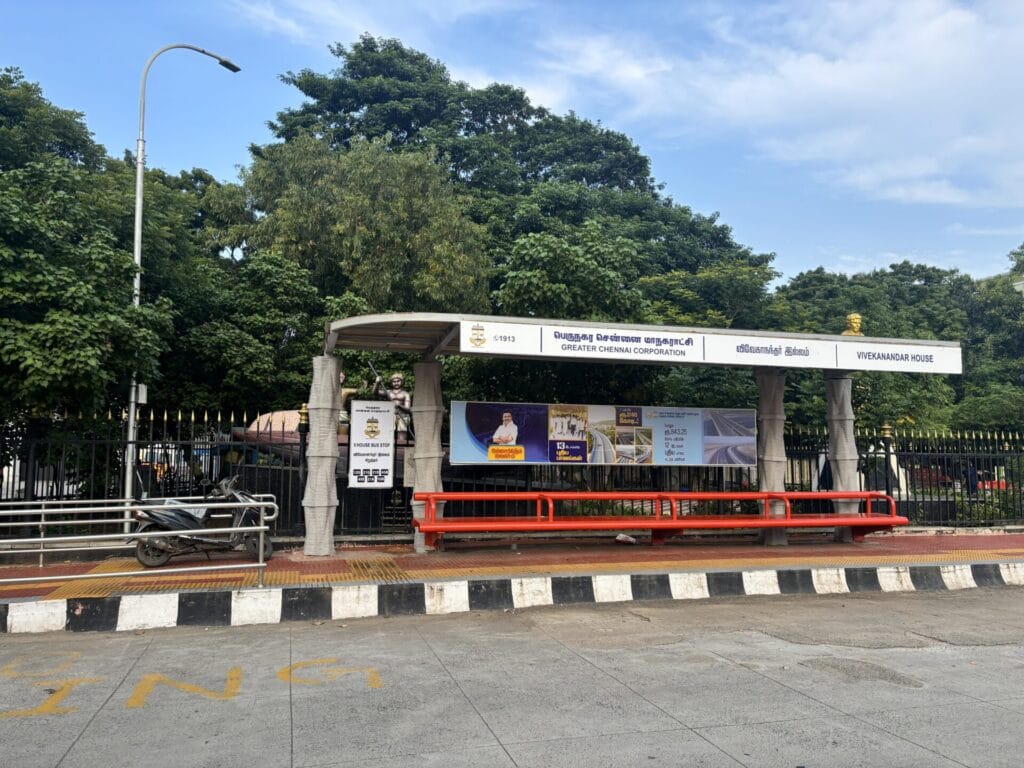
“When I arrived at the location in my wheelchair, I couldn’t even access the stop,” he tells Citizen Matters. “The ramp leads directly from the road into live traffic. It was dangerous for me even to try going that way. The platform is over a foot high, instead of the mandated maximum height of 30 cm. Strangers had to lift my wheelchair and help me onto the stop. We may live with disabilities, but it is the State that creates barriers.”
If this is the reality at a ‘model’ stop in the State’s capital, what does it say about the rest of Chennai’s transport infrastructure?
The Ministry of Road Transport and Highways (MoRTH) released the Accessibility Guidelines for Bus Terminals and Bus Stops in 2023 to ensure the safety and mobility of people with disabilities. However, our field investigation across major bus terminals and bus stops across the city reveals that accessibility exists mostly on paper despite repeated petitions, RTIs, and even legal battles led by disability rights groups.
What are the guidelines to be followed?
The guidelines identify key user groups whose needs must be addressed: wheelchair users, people with limited mobility, persons with visual or hearing impairments, elderly and infirm persons, pregnant women and children.
MoRTH simplifies accessibility into 13 broad categories, covering: planning and general accessibility; parking and approach routes; ramps and pathways; entrances and doors; circulation spaces such as corridors, floors, stairs and lifts; service counters; accessible toilets; lighting and signage; safety and emergency features; bus boarding and alighting design; shelter design; maintenance systems; and regular accessibility audits.
Its 194-page manual includes a checklist for auditing ramp slopes, tactile paths, entry levels, platform heights, door widths, lift dimensions, counters, parking arrangements, and signage. It builds on the broader Harmonised Guidelines and Space Standards for Universal Accessibility in India, 2021, which apply to all public infrastructure, not just transport. Even these have been largely ignored.
While MoRTH provides transport-specific detail for bus stops and terminals, the harmonised guidelines carry a legal mandate under the Rights of Persons with Disabilities (RPwD) Act, 2016. The Act directs all public buildings, including bus stops, depots, and transport hubs, to comply with these standards. Accessibility is therefore a legal obligation, not a choice. The MoRTH document translates these requirements into practical design instructions to ensure every commuter, regardless of ability, can use Chennai’s bus system with dignity and safety.
Read more: Accessibility: Mumbai’s lifeline can make lives of people with disabilities easier, but how?
Based on these guidelines, Citizen Matters created a checklist to examine multiple bus stops and termini in Chennai.
Can persons with disabilities navigate Chennai’s bus stops?
Bus termini checklist
| Requirement | Koyambedu | Broadway | T Nagar |
| Accessible parking close to the entrance (within 30 m) | Yes | No | Yes (limited) |
| Ramps with non-slip surfaces and handrails on both sides (height 750–900 mm) | No | No | No |
| Tactile guiding/warning tiles along main routes | No | No | No |
| Entrances step-free or ramped with door width of 1000 mm | No | No | No |
| Ticket and information counters at a height below 800 mm with knee space | Yes | No | No |
| Accessible toilets with grab bars, alarm cord, and 1800 mm turning radius | No | No | No |
| Audio and visual announcements for bus schedules | Intermittent audio and display only in the front | No | Intermittent audio |
| Clear, high-contrast signage with Braille or embossed text (height 900–1800mm) | No | No | No |
| Waiting area seating (450–585 mm height, some with armrests) | Yes | No, poor condition | Not accessible |
| Drinking water and vending machines at reachable height (800–1200mm) | Yes | No | No |
| Staff trained to assist passengers with disabilities | No | No | No |
| Level boarding bays or ramps/lifts for wheelchair users | No | No | No |
| Protruding objects avoided or clearly marked | No | No | No |
| Lighting minimum 100 lux at platforms and ramps | Yes | No | Couldn’t determine |
Broadway Bus Terminus, Parrys Corner
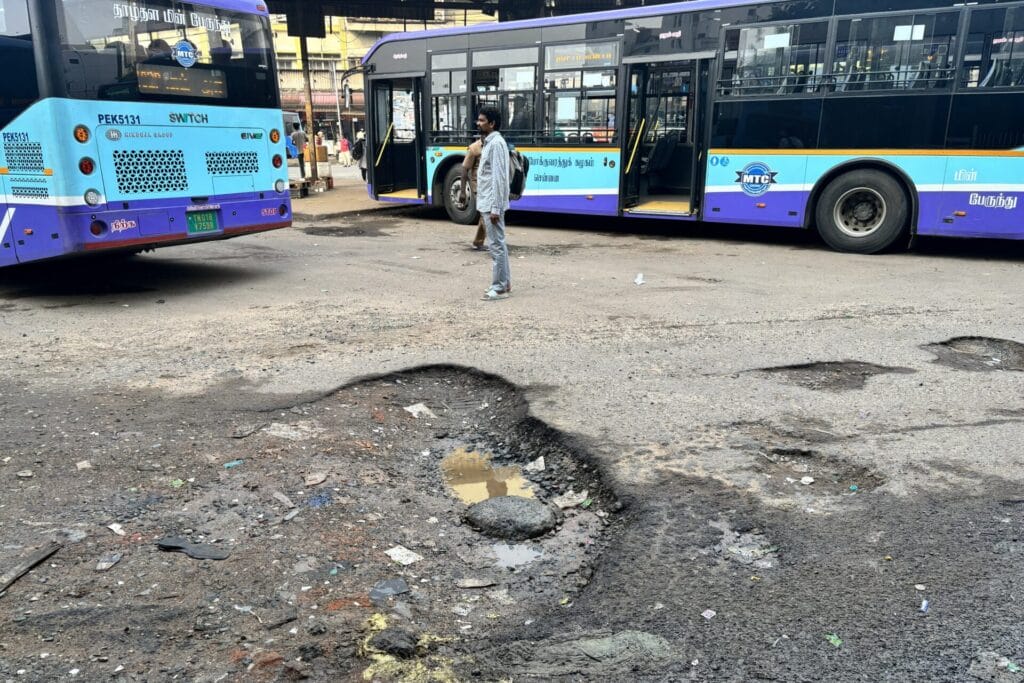
Twenty-five-year-old Jeeva, who is visually impaired, stands at the Broadway Bus Terminus, listening intently for clues to help him find the right bus. He faces major barriers that require him to seek assistance from others just to board a bus. “The buses don’t stop in one assigned place,” he says quietly. “Sometimes, they change route names mid-way, and the digital display switches in seconds.” He adds that without accessible infrastructure, it’s almost impossible to navigate a bus terminus.
Even basic requirements for persons with disabilities are missing. “The audio announcements are only to signal doors opening and closing, which we can hear anyway. Why not make stop announcements? In some buses, they play music, which is fine, but also use the speakers to tell us where we are.”
Broadway, one of Chennai’s oldest and busiest transit hubs, handles nearly 850 buses daily. Yet the terminus is chaotic — buses park haphazardly, directions to bus bays are unclear, and platforms are crowded with hawkers and encroachments. Commuters must weave between moving buses, making the journey risky, especially for the elderly, children, pregnant women, and people with disabilities.
Recently, illegal dumping of vegetable and food waste inside the premises has added to commuters’ woes.
T Nagar bus terminus
While Broadway is chaotic, T Nagar lacks inclusive facilities. R Balachander (84) from Adyar would visit his daughter weekly, taking a bus to T Nagar and from there an autorickshaw to North Usman Road. It was tiring but manageable. Over the past five years, he has stopped.
“It feels like double jeopardy,” he says. “Bus timings are unclear, waits are long, and there’s no shelter. I travel in off-peak hours to get a seat, but waiting in the heat is unbearable.” The return journey is worse: “I move slowly and can’t stand for long, but there’s nowhere to sit. There’s no signage for Adyar buses. The buses come from different directions, and I fear being hit.
His struggle reflects the accessibility issues at T Nagar Bus Terminus, built in 1973 and now slated for a ₹254-crore renovation by the Chennai Metropolitan Development Authority (CMDA). Despite its spacious entrance, commuters can feel the gaps immediately.
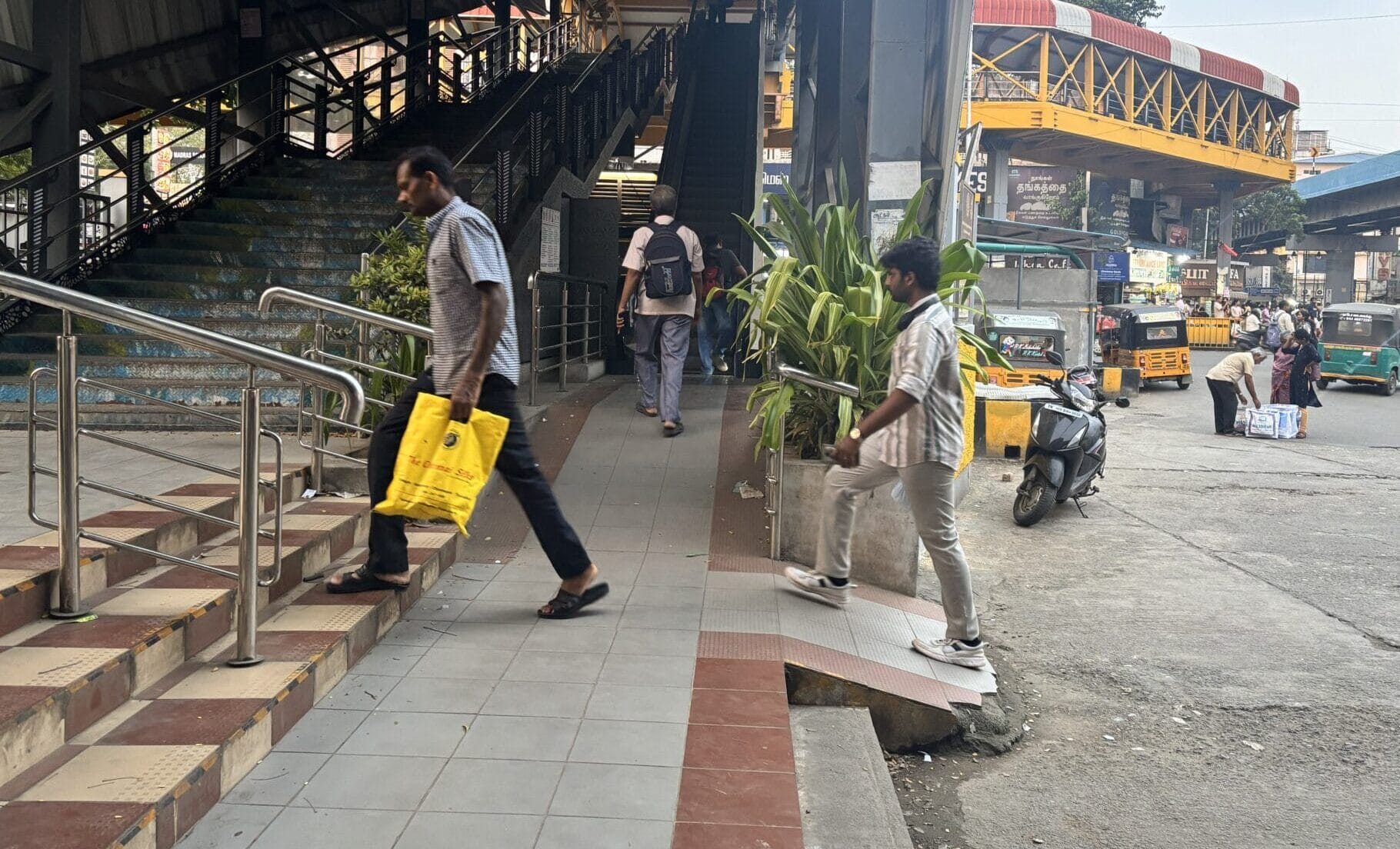
The platforms don’t have ramps. No signboards indicate correct bus bays and alighting areas. There are LED displays marking designated waiting areas, but commuters say buses often don’t stop there. Once in a while, timekeepers make announcements for bus drivers and conductors.
Parking facilities are limited and not inclusively designed, with only a small, narrow two-wheeler lot attached to the bus terminus. A feeding room was locked, and the terminus itself has no toilets. The newly-built skywalk to the Mambalam Railway Station includes entry/exit points with ramps and public toilets, but the toilet for persons with disabilities was closed.
Bus stop checklist
| Requirement | Vivekananda House | Ripon building |
| Platform aligned with low-floor buses, kerb ramp gradient below 1:12* | Almost | No |
| Non-slip flooring and shaded waiting area | Yes | No and yes |
| Seating (450–585 mm height, stable and back support) | Yes | Yes |
| Route map and signage in accessible height (900–1800mm) | No | No |
| Audio announcements or alerts for the visually impaired | No | No |
| Tactile path leading from the footpath to the boarding point | Yes | No |
| Lighting 35–40 lux at night | Yes | Yes |
| Drop kerb for wheelchair/senior access from the footpath | No | No |
| No obstacles in the boarding area | Yes | No |
| Maintenance of tactile tiles, kerbs, and markings | Yes | No |
(*A 1:12 kerb ramp gradient means that for every 12 inches of horizontal run, there is a 1-inch vertical rise.)
Koyambedu bus terminus
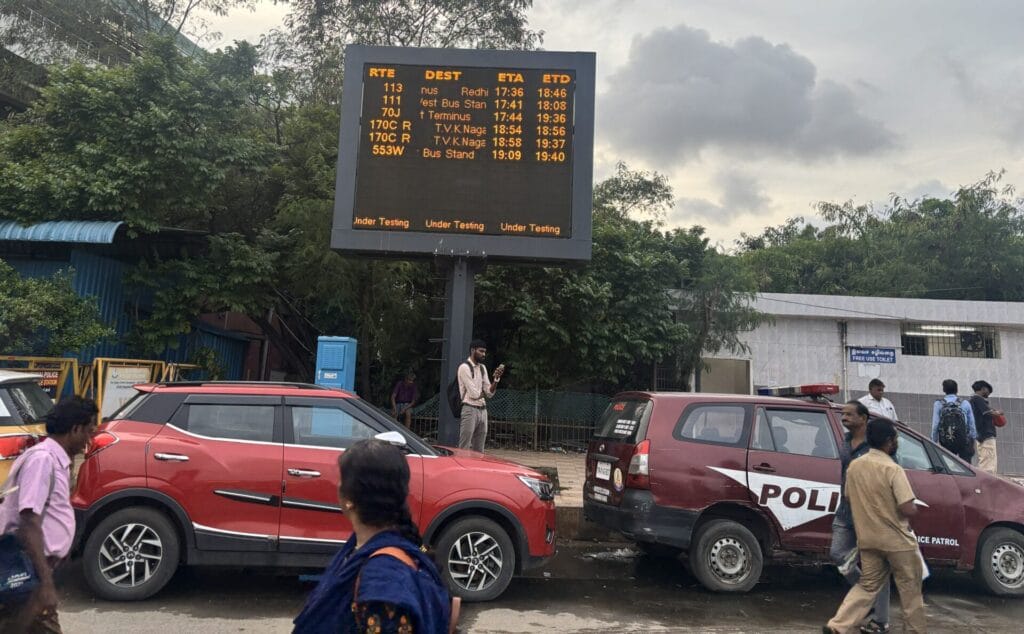
The Koyambedu bus terminus, though newer and strategically located beside the Puratchi Thalaivar Dr M.G.R. Bus Terminus, which was once Chennai’s busiest hub for outstation travel, falls far short of MoRTH accessibility standards. While it offers accessible parking close to the entrance, adequate lighting, waiting-area seating and counters at a suitable height, many of the core features required for safe and independent movement are missing.
Entrances are not fully step-free, and level boarding facilities for wheelchair users are absent. Staff lack disability-awareness training, and unmarked protruding objects pose further hazards. For a major transport hub built in the era of universal design, Koyambedu remains misaligned with even basic accessibility requirements, in contrast to the accessible metro station entrance within the same premises.
Vivekananda House bus stop
This recently renovated “model” bus stop was upgraded just a few months ago at a cost of ₹18.73 lakh as a pilot to support the introduction of low-floor buses. It incorporates several features, including adequate seating, a covered shelter, Kassel kerbs (kerbs that help buses align closely to the platform), and a lowered platform height to improve access to low-floor buses. However, the facility also reveals significant design shortcomings. The ramped access points, for instance, open directly onto the carriageway rather than onto a dedicated platform, creating an avoidable safety hazard.
Gnana Bharathi also points out the absence of parking facilities and usable footpaths that hinder mobility. “How else would I be able to get here?” he asks.
Central Metro Bus Stop
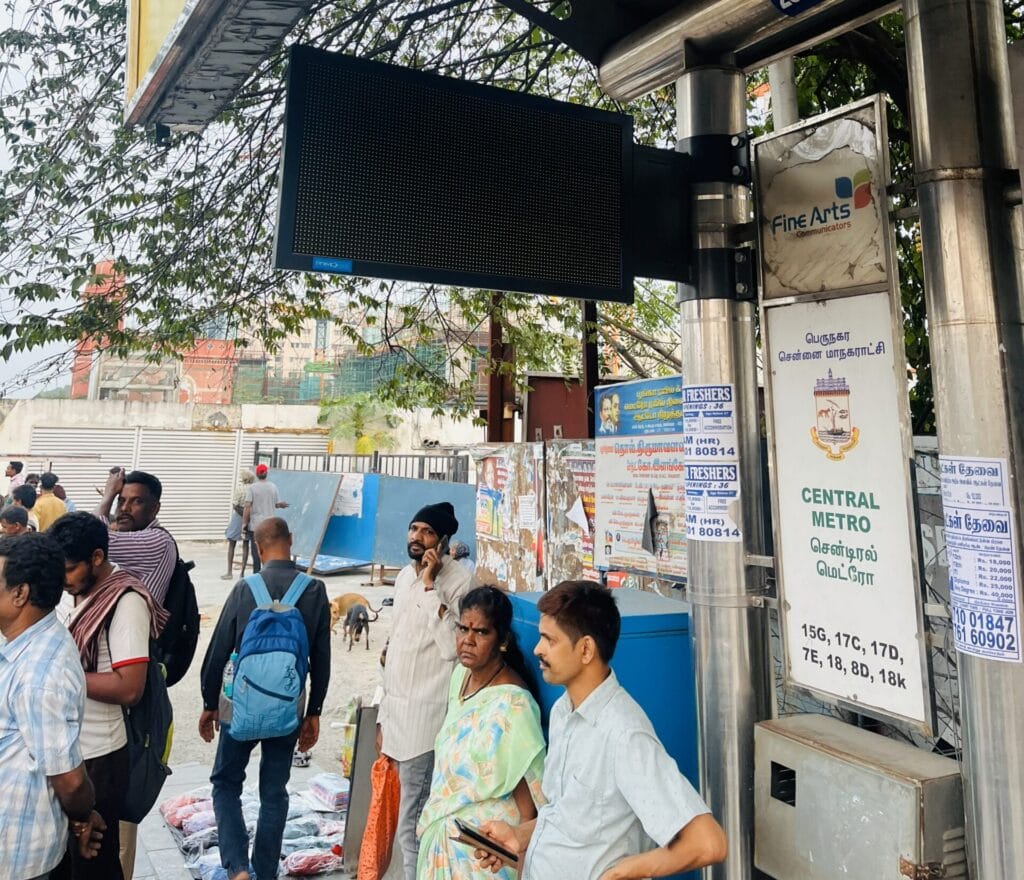
This bus shelter is located at a busy junction that leads to the Chennai Central Railway Station, Chennai Central Metro Station and the iconic Ripon building that houses the Greater Chennai Corporation office, with a view of the newly renovated Victoria Public Hall.
On an average day, thousands of commuters wait at this busy bus stop, yet despite its proximity to the Ripon building, it is not accessible. Located in a bus bay a little away from the traffic, it has no platform, and commuters stand on the road with only a couple of covered seating areas. With no flooring, there are no ramps, tactile paths, or accessible entries. The LED display board is non-functional, and Braille signage is missing.
Does going the legal route help?
In 2023, disability rights activist and member of the Disability Rights Alliance (DRA), Vaishnavi Jayakumar, filed a Public Interest Litigation against Chennai Metropolitan Development Authority (CMDA) after an audit of the ₹394-crore Kalaignar Centenary (Kilambakkam) Bus Terminus flagged 17 deficiencies in accessibility. These include slippery flooring, no ramps, no level flooring at boarding bays, incomplete tactile flooring and no disability friendly toilets, amongst other issues. While dismissing the PIL, the Madras High Court directed CMDA to submit a compliance report on the terminus.
“We went to court for Kilambakkam because it is a bus terminus which is inaccessible despite being recently built, and after spending so much money,” says Vaishnavi. “But after the High Court direction, the concerned authorities are yet to fix all the issues we flagged. We wrote in August 2024 to the CMDA but never received a response,” she adds.
The DRA has noted that the work is being done in “a piecemeal manner” and much is still unfinished. Additionally, work on raised platforms for passengers with disabilities boarding at designated locations has not even started yet.
Citizen Matters has reached out to the CMDA and the GCC for their comments regarding non-compliance with the MoRTH guidelines, but hasn’t received a response. This article will be updated accordingly, based on the response.
This was well written and very useful. Appreciate the effort you put into it.