For those of us who rejoiced for long at the complete absence of large outdoor hoardings (billboards in American parlance) in Chennai, those days of happiness may be very limited. As per a recent news item, the Greater Chennai Corporation (GCC) has invited those interested in putting them up to apply via an online system connected to its website. The civic body has not elaborated on how it has overturned a decision taken by the party in power, both at the Corporation and state levels. And it has also not elaborated on how it proposes to prevent these from becoming the nuisances they were before they were done away with.
A history of violations and weak enforcement
Over the years, the Corporation had been a bystander in allowing rampant violations in the erection of hoardings. More than 90 per cent of the city’s outdoor advertisements were supposedly illegal structures. And even among the few that were permitted by the civic body, rent payment was tardy at best. The Corporation proved ineffective in its collection drives. Litigation was endemic to the industry, and even when the Corporation tried to take recourse to law, it was stymied by delays and stays.
Public safety compromised
The public was the biggest victim of illegal outdoor hoardings. These were erected with no consideration for safety and very often were either distracting or plain obstructions to line of sight at traffic corners and highways. Accidents were caused owing to motorists’ attention being distracted and when there were cyclones there was bound to be a casualty/fatality or two because of improperly secured metal sheets falling on the road. This led to public interest litigations being filed as well. Eventually, the Madras High Court in 1996 decreed that all outdoor hoardings be acquired by the Government.
A short-lived clean-up
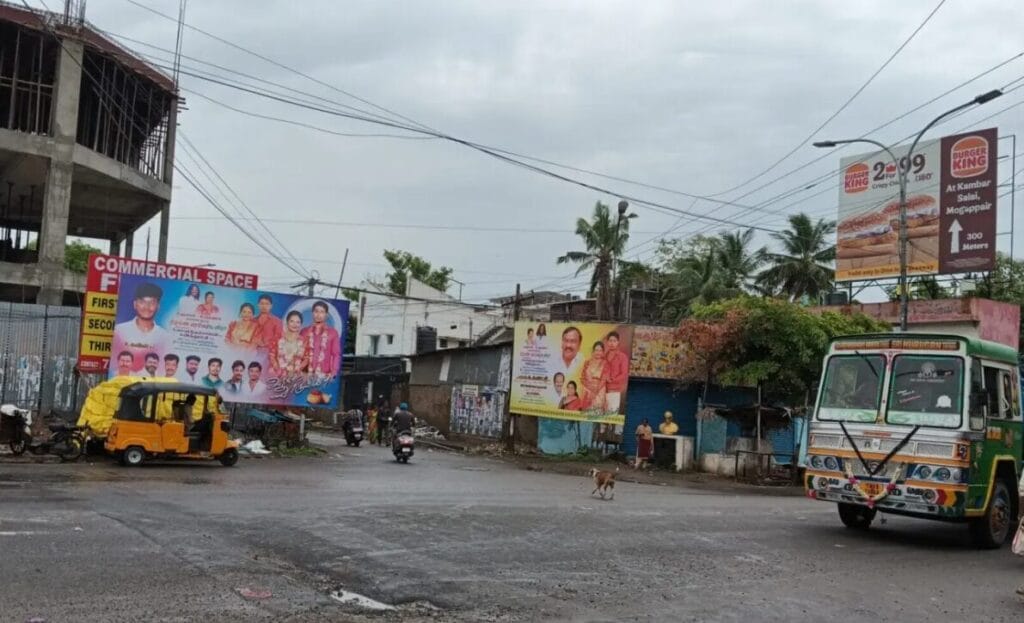
That, however, did not prevent a further batch of illegal hoardings from coming up, with the law enforcement agencies either turning a blind eye or being incapable of taking action. Finally, in 2008, the then DMK government decided to make Chennai city hoarding-free. Even then, tongues wagged about the reasons behind this seemingly altruistic decision; it was rumoured that this was because much of the hoardings, legal and illegal, were owned by worthies in the Opposition.
But what was heartening was that the hoardings were removed. Suddenly, the city could breathe, its iconic buildings and greenery emerged, and the sky was visible once more. Chennai enjoyed this luxury for seventeen years.
Read more: Illegal hoardings in Chennai remain unchecked, raise accident risk
Suburban spillover and political ironies
The problem of illegal hoardings however just refused to go away, at least in the suburbs. The former Mayor and present Health Minister, M. Subramaniam, while in the Opposition even threatened to launch an agitation against these in Saidapet, whereupon action was taken. The present CM, while Mayor was also said to be against hoardings and the way they mar the appearance of Singara Chennai. Which is why it is all the more surprising that the Corporation, which launched Singara Chennai 2.0 with much fanfare should now be going ahead with such a move.
A regressive step in the name of revenue
The problems that plagued the hoarding industry have not gone away. Safety and illegality remain issues. And the Corporation is not going to be a tough bill collector. If it were otherwise, the civic body would not have heavy arrears on property tax. And, if it focused on collecting what is rightfully its due under that head, it would not need to seek funds by erecting hoardings. Overall, this is a regressive step, and the Government will do well to consider a rollback.
[This article first appeared in Madras Musings, Vol. 35 No. 4, June 1–15, 2025 and has been republished with permission. The original article may be read here.]