Every year, an MLA is given Rs 2 crores every year, to spend on developmental works in his constituency. There are around 180 expense items sanctioned under Aravind Limabavali’s MLA Local Area Development Funds, out of 10 crores in five years.
☛ Click here to see what an MLA is allowed to spend Local Area Funds on.
It appears from the data that Limbavali spent more than half of the funds in building bus shelters. 107 bus shelters costing a total of Rs 5.02 crores have been spent.
There are also curious facts in the way the money was spent. For example, when some bus shelters cost Rs 2 lakhs, others cost 32 lakhs. Assuming that the standard size of the bus shelters are the same, the difference in cost is intriguing. Rs 8 Lakhs was spent in 2014-15 for a bus shelter at Bellandur Gate. The picture below shows the first shelter that was finally built in Aug 2017. Another shelter was built right next to it, in a completely different design. 2018 saw another shelter built across the road. It is not clear which was the shelter built with the LAD fund.
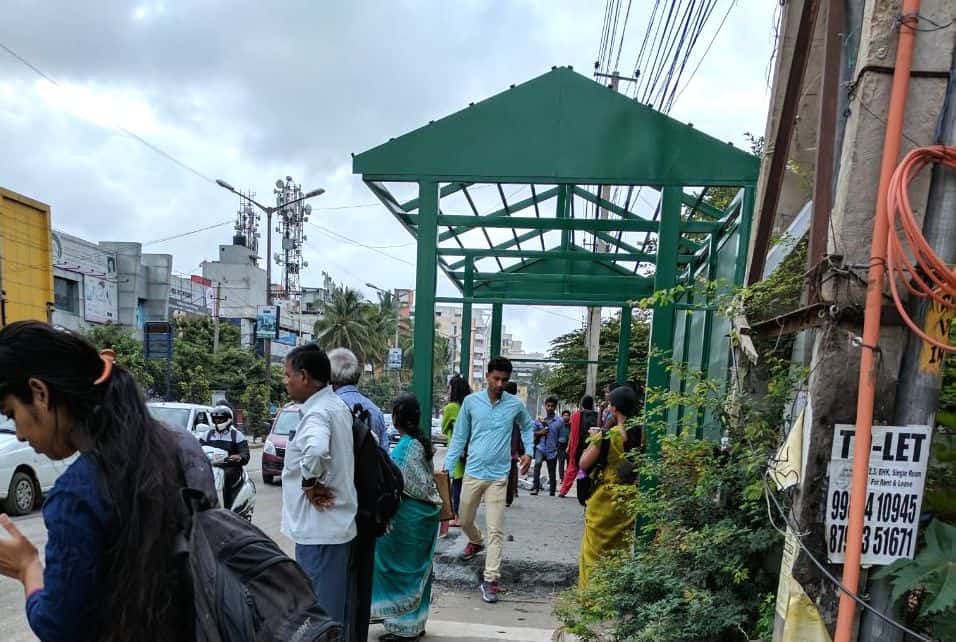
Bellandur gate bus shelter construction, Aug 2017
Rs 90 Lakhs has been spent on 12 projects of constructing school rooms and compound walls. Most amounts are not huge. E.g 10 Lakhs is meant for construction of government high school compound wall in Immadihalli village near Hagdur Ward. Residents say the school is huge, around 9 acres, and the wall is only partially built.
Rs 48 Lakhs has been spent on 12 RO plants, at Mullur village, Setharampalaya, Panathur village, Nellurahalli, Nadagoudagollallahalli, Kannur Gram Panchayat, Bande Hosur village, Bidarahalli Hobli (Adoor Grama), Balagere village, Nagadeenahalli village, Kathakodi Patalamma Layout, Doddanekkundi colony and Immadihalli.
There is one item of 30 Lakhs for a CCTV camera, but it is not clear where the camera was installed.
There are also two 5 lakhs spent on temple (compound wall)
☛ Check for the full data set here.
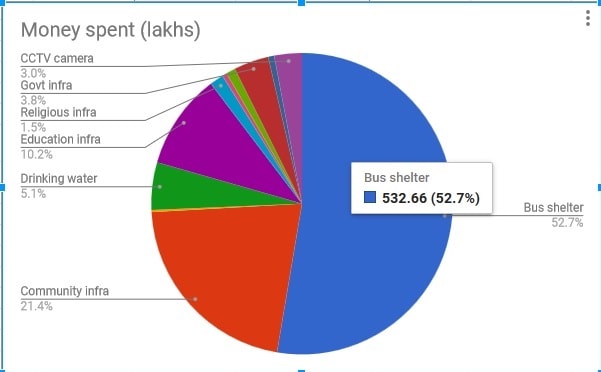
The category break up for all the five years looks like this:
| Category | Money spent (lakhs) | Category | Money spent (lakhs) |
| Bus shelters | 532.66 | Road improvement | 5 |
| Community infra | 216.9 | Toilets | 10 |
| Disability help | 2.31 | Govt infra | 38 |
| Drinking water | 51.5 | Health infra | 6.5 |
| Education infra | 103.55 | CCTV camera | 30 |
| Religious infra | 15 |
Fake and false claims,
Immadahalli shelter is not be seen
Please file a case in police station saying “MLA’s LAD fund Bus Stop is missing”.
It’s shocking to see 52% money spent on Bus Stop, But ONLY 0.005% spent on Road.
Let people decide the fate of this MLA in 2018 election.
Thanks