International World Water Day is held annually on 22 March as a means of focusing attention on the importance of fresh water and advocating for the sustainable management of fresh water resources. An international day to celebrate fresh water was recommended at the 1992 United Nations Conference on Environment and Development (UNCED). The United Nations General Assembly responded by designating 22 March 1993 as the first World Water Day.
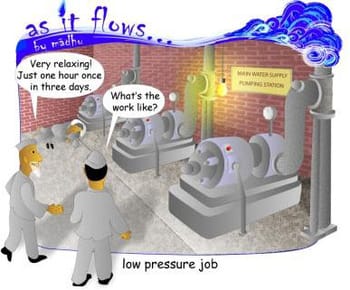
Infrequent BWSSB water supply. (Illustration: Madhu Ramaswamy)
It is an irony that in Bangalore, water gets significantly more expensive the poorer you get. Water is a subsidized commodity for those who get water from the corporation. While, the people in the slums living without a BWSSB connection rely on private tankers. BWSSB water is priced at Rs 6 per kilolitre (lowest slab) while tanker water is Rs. 250-350 per load of 6 kilolitre, i.e., a minimum of Rs 40 per kilolitre. Is this discrepancy something we are comfortable with as citizens?
As citizens of Bangalore, do we know if the water we consume at several instances – home, work, bottled water, hotels is safe enough to be consumed? There are simple tests one can undertake to determine the potability of water (i.e. is the water fit to be consumed without risk of immediate or long term harm).
Most of us presume that the odor / look / source determine if we can drink the water or not, but there are more than twenty standardized tests to check for various harmful parameters. For those interested, the Bureau of Indian Standards (BIS) test for good drinking water quality can be accessed here.
Some of the most important tests are for the presence of harmful fluoride / nitrate / bacteriological contamination in the water. Did you know that multiple studies of groundwater in Bangalore show higher than permissible nitrate content (see example here) The primary reason for this being is because sewage is finding its way into our groundwater.

BWSSB’s water treatment facility at Yelahanka. (Pic: S. Vishwanath)
Most of our sewage runs into our rivers and lakes, polluting them very severely. This does not have to be so, and the BWSSB has some remarkable models in this direction. The Yelahanka water treatment plant of BWSSB treats water to a good enough purity that it is able to sell treated sewage water for industrial use, and is able to cover its cost for treatment of the water. Why can’t this be replicated extensively across India? Why do we continue to allow our waterbodies and groundwater, the sources of our drinking water, to continue getting polluted?

A simple rainwater harvesting system into a rainbarrel. (Pic: S. Vishwanath)
Now consider another matter – rainwater harvesting. One of the sustainable ways to address groundwater depletion as well as improve the quality of groundwater would be through rainwater harvesting. Many people think that it is an impractical investment that serves no utility. We get enough water from BWSSB in the rainy months and there isn’t any rain anyway in the summer season when there is a shortage of BWSSB water. But consider that we are just sucking up groundwater on a daily basis but are not recharging the groundwater and keeping up its quantity for future years.
Rainwater that is harvested and used to recharge the groundwater will ensure a sustainable supply of groundwater for generations. And don’t discount the benefits of storing harvested rainwater in tanks for use. For those who don’t get BWSSB water (and there are a lot of us), harvested rainwater is a free source of good quality water for some months of the year. Even if you get BWSSB water, harvested rainwater is an excellent water security measure and supplementary source. You would be surprised to find out that on average Bangalore gets an appreciable amount of rainfall for 8 months of the year which would contribute to your water security during those 8 months. Rainwater harvesting is no complicated matter – people all over the city are implementing it without fuss and benefiting from it. See some examples here. Rainwater being the purest form of water can undoubtedly be consumed if we take a few precautions around the rainwater harvesting system.
One resource to address all of the water issues mentioned above and more is the India Water Portal, an initiative from Arghyam, a public charitable foundation working on the water sector. There are videos / photographs / case studies / courses that explain rainwater harvesting and other approachable solutions for the water crisis we face on a daily basis. One of the most utilized feature of the site is the Ask a water question, where questions asked by common citizes are addressed by a set of water experts.
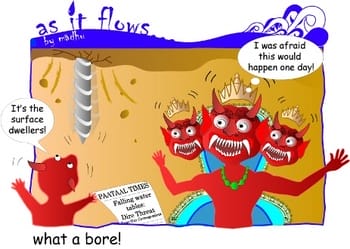
Drilling ever deeper for water. (Illustration: Madhu Ramaswamy)
Indian culture is known to have strong connections to nature as a part of our Panchaa Bhootha religious beliefs as propagated by the Vedas. Just as grandparents and parents would teach one value system of integrity / honesty and a host of other elements of life, we need to revolutionize the value system of our children for environment sensitisation. To inculcate this subject in children as well to enable teachers to teach water related subjects effectively, the Schools Water Portal, is a portal which holds a repository of lively material. This portal has games, quizzes, project material, reading material all related to water. It is aimed at making environment learning meaningful and fun.
A variety of events are being held in Bangalore this World Water Day. The Water Portal will be testing your drinking water for you at Madiwala Lake today, where there is a function to draw attention to the problems of the lake. Alliance Francaise is holding a water photo competition and Suchitra Film Society is screening water films. Even if you don’t get to attend these events, every day is a day to understand more about water and harmonise our lifestyles to wise water management. ⊕