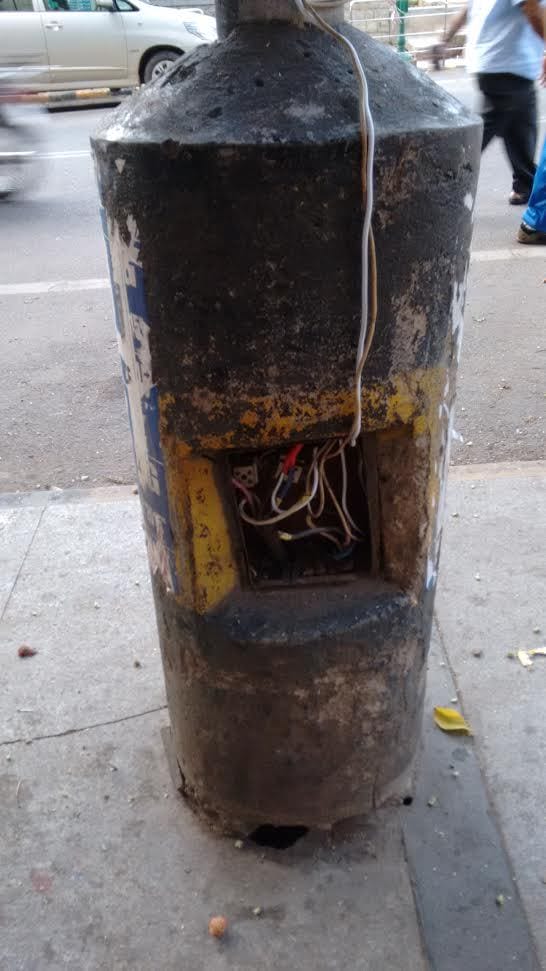
The saga of the Malleshwaram street light continues…

A week has gone by since I last wrote and about six days have gone by since I last heard from BBMP. BBMP called me several times last Friday asking me if the work was done — and in spite of numerous assurances — no work has been done. 

The BBMP Sahaaya complaint number is 10506777 and the last SMS communication I received, informing me that the complaint has been ‘assigned’ was on June 23rd. I also have a Malleshwaram Sahaaya complaint number – 2760084. However, in this case, the SMS only says that the complaint has been created. 

It is impossible, as far as I can tell, to check up on the complaints. I’ve tried to do so, but it only allows you to do a serial search and not a random access search for the complaint. 

Pic: The broken street light in question. Pic: Ramesh Sreekantan

A few days ago, out of frustration, I sent another email to the Commissioner (comm@bbmp.gov.in)

“In spite of receiving over 10 calls from BBMP asking me if the work has been done — and many of them assuring me that they will personally inspect the site and ensure the work is done — ABSOLUTELY NO work has been done. Meanwhile, this is the condition of the street lights. The local kids play a game – they challenge each other to touch the wires…”

Still no reply and no work. The saga continues…

Related Articles

The Malleshwaram streetlight problem that BBMP couldn’t solve

Leave a Reply

Your email address will not be published. Required fields are marked *

Similar Story

Mapping Bengaluru’s stormwater drains: A citizen’s audit guide

Citizen-led audits of Bengaluru’s stormwater drains aim to expose accountability gaps and reclaim these neglected lifelines as public commons.

Stormwater drains are not just “invisible infrastructure.” They are the frontline of Bengaluru’s water security. When they fail, lakes die, groundwater gets poisoned, and neighbourhoods flood. Understanding this system is the first step toward reclaiming it, because without citizen awareness, the crisis remains hidden beneath our feet. In an earlier article, we explored how stormwater drains are the frontline of Bengaluru’s water security. Part 2 of the series shows how citizens can take action themselves by learning the typology of drains and conducting audits using simple tools. Accountability gaps in Bengaluru’s stormwater worksOver the years, Bengaluru’s SWD network has been…

Similar Story

Explained: Bengaluru’s stormwater drain system and the city’s water story

Bengaluru’s stormwater drains, hidden yet vital, channel rain across valleys—when neglected, they fuel floods, sewage leaks, and lake death.

Every summer, Bengaluru’s water crisis makes headlines; tanker prices soar, lakes dry up, and citizens protest encroachments, fish kills, and sewage inflows. While lakes and tanks often dominate the conversation, there’s another hidden system that quietly shapes the city’s water story: stormwater drains (SWDs). These drains are more than just channels; they are the veins of a valley city. Bengaluru sits on a central ridgeline that naturally divides its water flow into two directions: Eastward: draining into the Dakshina Pinakini (Ponnaiyar) River. Westward: draining into the Cauvery Basin via the Vrishabhavathi River. Ironically, what citizens often see as footpaths or…