What a truly delightful evening it was on the 9th, celebrating the magic of monsoon with some 30 children!
The 20 member team from Snehadhara Foundation (SF) led by Geetu had come well in advance to welcome the children. Despite the fact that only 4 or 5 kids had arrived on time, we began the event at the scheduled time of 5 p.m. The late-comers missed the warming up and sing along. Adult and child alike sat on the floor of the Gazebo and introductions began with each participant adding an “O” or “Aa” to their names.
Geetu dramatized the Search for a Rain Woman, her equally talented team members adding sound effects and prompting the shy ones to open up and mimic the falling of the rain drops and gurgling of the water flowing as a stream. More children came running followed by their parents. They joined the “train” that went hopping and skipping to the Viewing Deck for the next part of the event – giving free rein to their imagination through art.
The team members got the children in sit in one of the four designated places along the walking track that curved around the deck. Volunteers handed out sheets of white paper and crayons and the kids were invited to unleash their creativity. The Quick to Begin and Slow to Start were soon deeply involved in their artistic efforts. They didn’t see the birds in the lake behind or hear the call of the Common Coot. (If they, and you, would like to hear please click on https://www.youtube.com/watch?v=6AvfgmUuxT0).
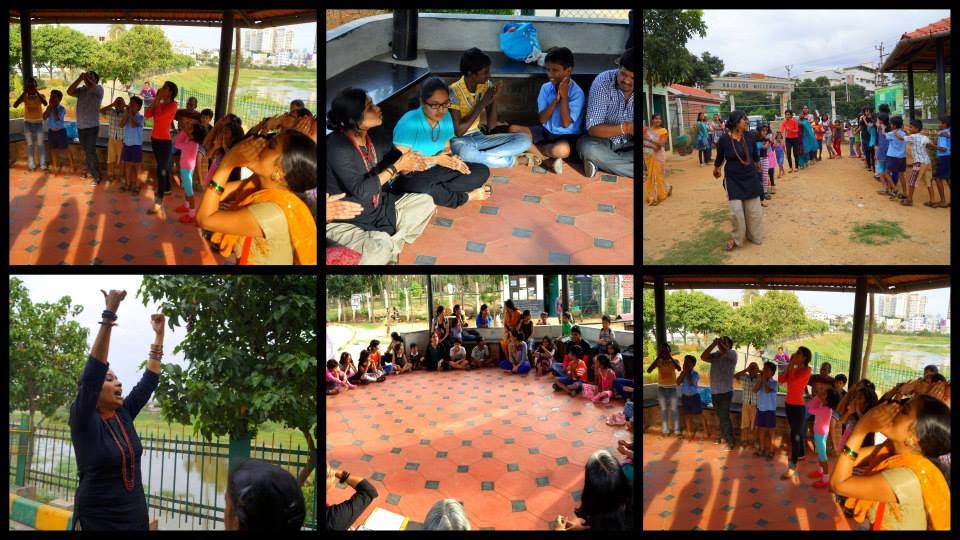
Pic courtesy: Snehadhara Foundation
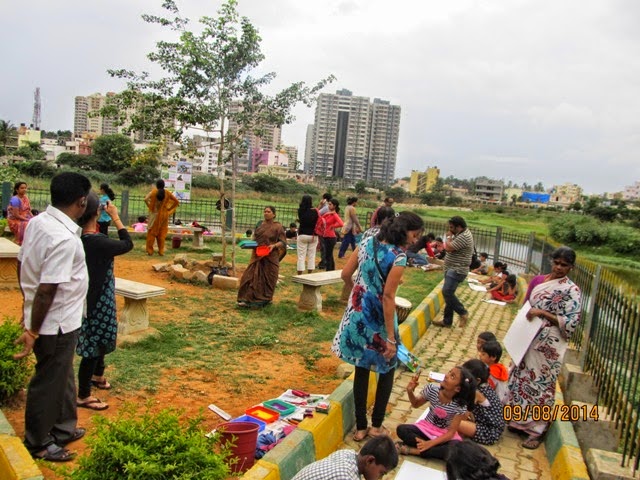
Pic: Usha Rajagopalan
The children and we, trustees, were so caught up with the excitement that we lost track of time but not the SF team! By 6.15 p.m., the “train” was ready to return to the Gazebo, this time waving their sketches triumphantly over their heads. Some children who joined very late were still at work with a few team members keeping an eye on them. Geetu wrapped up the delightful evening and everyone dispersed though clearly loathe to leave! Chin up, folks! The next event is round the corner, on 7th Sept!
On a personal note, I have a request and a regret:
Request – please bring your children on time so that they don’t miss any of the fun. This will also teach them the value of punctuality.
Regret – with so many children living in our residential complexes close to the lake and whose parents have been informed repeatedly through emails, the attendance was still very poor. No entry fee, art material distributed free of cost, talented story tellers, clean environment, loads of teaching through fun and yet the majority of our kids missed it all. Unfortunate indeed!